Two founders told me my launch plan was unusable. I measured it — they were right.
Two founders told me the same week that my launch tool wasn't usable.
One: "it is so long roadmap, so he can't see all."
The other: "$0 budget, so can't follow all steps."
I went and measured it instead of arguing. For a typical AI SaaS,
Zarek was generating 88 tasks spread across 29 calendar days —
and 14 of those days had nothing on them at all.
So the plan was simultaneously too long to read and too sparse to
follow. Four weeks of scrolling to find fifteen days of actual work.
What I changed
Not the research. The tool still reads all 29 directories it tracks,
plus the subreddits, newsletters, podcasts and press for your vertical.
Generating less would have made it a worse product, just a quieter one.
What changed is that it now ranks all of that and puts five per phase
on your calendar. The rest aren't deleted — they're one click away.
Ten steps can never be hidden by the ranking: landing page,
positioning, Product Hunt kit, and so on. A launch without those
isn't a launch, so the ranker doesn't get a vote on them.
88 tasks → 22. 29 days → 15. No empty days.
The half I'd been under-selling
While I was in there I realised the best part of the product was the
part nobody could see.
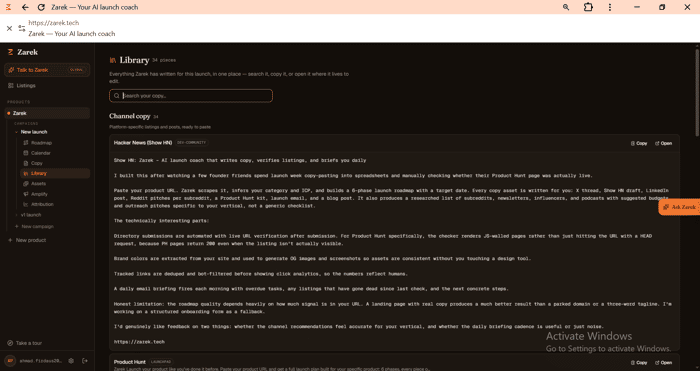
Zarek doesn't just tell you to "post in communities." It researches
the actual subreddits, newsletters, podcasts and press that fit your
product, tells you what each one costs, and drafts the pitch for
each one. That page has existed for months. Nothing on my landing
page pointed at it.
You can read the real one for Zarek's own launch, no signup:
https://zarek.tech/products/00000000-0000-4000-8000-74037a084cd5/campaigns/00000000-0000-4000-8000-4531b7702edb/amplify
That's not a sample. It's the actual list Zarek built for itself,
budgets and drafted pitches included.
What I still haven't fixed
The second founder's problem. "Each with a budget" is a promise to
someone with money and a wall to someone without, and a shorter plan
is cheaper by accident rather than by design. A free-channels-only
mode is the obvious answer and I haven't built it yet.
I also have no outcome data. Two people have told me the output is
good. Nobody has yet told me what happened after they launched, and
until someone does, everything above is a claim about the plan
rather than about the result.
The thing I'd actually pass on
Generating is free now. Choosing still costs something. So every AI
product drifts toward generating more — it looks like value and costs
nothing to produce — right up until the person on the other end
closes the tab.
If you're building anything that hands someone a list: go count how
many items they actually complete. I was four months in before
I looked.
Has anyone else measured completion rather than output? I'd like to
know whether 22 is still too many.

The two pieces of feedback you got feel more important than the exact number of tasks. I'd probably interview the founders who tried the plan and reconstruct what they actually did after receiving it: what they ignored, what they attempted, where they stopped and why. That might tell you whether 22 is still too many, but it could also reveal that task count isn't the real constraint.