Unexpected Challenges of Building a Multi-Service On-Demand Platform
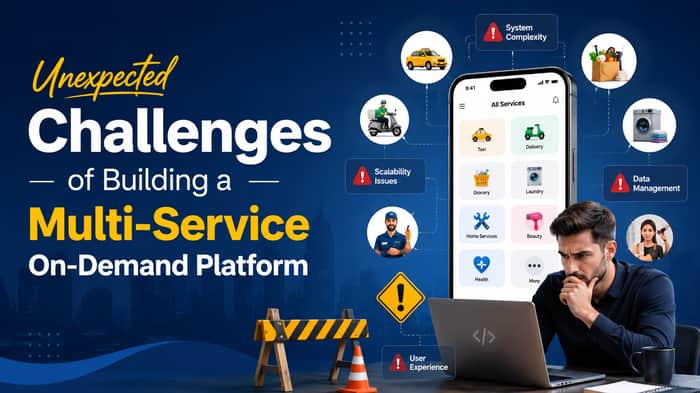
When people talk about on-demand app development, the conversation usually focuses on features: real-time tracking, payments, push notifications, or provider matching. I used to think the same way.
Recently, I spent time analyzing what it would take to support ride-hailing, delivery, and home services on a single platform. The idea sounded efficient: one backend, one user app, one admin panel, and reusable infrastructure across multiple service categories.
What I discovered was that the hardest part wasn’t building the mobile apps. It was designing a platform that could handle completely different business workflows without becoming impossible to maintain.
This post shares the most important technical challenges I encountered while thinking through a scalable multi-service on-demand platform architecture.
Why Build One Platform for Multiple Services?
The business case is obvious. A unified platform can reduce duplicated development effort and create a better customer experience. Instead of downloading separate apps for transportation, food delivery, and home services, users can access everything from a single account.
The potential benefits include:
- Shared authentication and user profiles
- Centralized payments and wallets
- Unified analytics and reporting
- Faster onboarding of new service categories
- Cross-selling opportunities between services
- Lower operational overhead
However, these advantages come with a significant architectural trade-off: shared infrastructure does not mean shared business logic.
The First Problem: Every Service Has a Different Workflow
At first glance, a taxi booking and a home-service booking both look like “a customer requests a provider.” In practice, their lifecycles are very different.
Ride-Hailing Workflow
- User selects pickup and destination
- Nearby driver is matched
- Driver accepts the request
- Trip starts
- Real-time tracking begins
- Fare is calculated after completion
Food Delivery Workflow
- User selects a restaurant
- Items are customized
- Restaurant confirms the order
- Food is prepared
- Delivery partner is assigned
- Order is picked up and delivered
Home Services Workflow
- User chooses a service
- A time slot is selected
- Provider availability is verified
- Appointment is confirmed
- Provider arrives at the scheduled time
- Service completion is verified by the customer
The mistake many teams make is trying to force all of these flows into a single booking status model. That approach quickly becomes difficult to extend and even harder to debug.
The better solution is to maintain service-specific state machines while exposing a common booking interface for analytics and reporting.
Designing a Flexible Database Schema
A common temptation is to create one large bookings table that contains fields for every possible service type. It seems convenient initially, but it usually leads to:
- Many unused or nullable columns
- Complex validation rules
- Difficult schema migrations
- Poor query performance as the platform grows
Ride-hailing needs pickup and drop-off coordinates. Food delivery needs menu items, quantities, and preparation instructions. Home services need appointment details, property information, and estimated duration.
A more scalable approach is to separate the system into:
- Core entities: users, providers, payments, addresses, and bookings
- Service-specific detail tables: ride details, order details, service appointment details, and logistics details
This structure keeps the core platform stable while allowing individual service categories to evolve independently.
Real-Time Tracking Is More Complicated Than It Looks
Real-time updates are one of the defining features of modern on-demand apps, but not all services need the same level of real-time communication.
High-Frequency Tracking
Ride-hailing often requires location updates every few seconds so users can watch the driver move on the map.
Medium-Frequency Tracking
Food delivery usually only needs updates when the order is accepted, being prepared, picked up, or approaching the customer.
Low-Frequency Tracking
Home services may only require appointment reminders, arrival notifications, and completion confirmations.
If every service shares the same real-time infrastructure without proper isolation, high-frequency GPS updates can overwhelm the entire messaging system. The result is increased infrastructure cost, battery drain on mobile devices, and difficult-to-debug performance problems.
One lesson that stood out to me was that real-time architecture should be service-aware, not globally uniform.
Provider Availability Is Not a Simple Boolean
This was probably the most underestimated problem.
A taxi driver can often be represented as online or offline. A home-service professional cannot.
Different providers may have:
- Working hours
- Appointment-based schedules
- Travel-time constraints
- Service-area restrictions
- Vacation or break periods
- Different availability for different services
Once you support scheduled bookings, availability becomes a time-based scheduling problem rather than a simple status flag.
The platform must answer questions such as:
- Is this provider available right now?
- Can they accept a booking tomorrow at 4 PM?
- How much travel time is required between two appointments?
- Do they offer this specific service in this specific area?
As service categories increase, availability management often becomes a dedicated subsystem with its own caching and scheduling logic.
Building a Pricing Engine That Can Handle Multiple Business Models
Pricing rules vary dramatically across on-demand services.
Ride-Hailing Pricing Factors
- Distance traveled
- Trip duration
- Surge multipliers
- Waiting time
- Tolls or additional route charges
Delivery Pricing Factors
- Order subtotal
- Delivery fee
- Packaging charges
- Platform commission
- Taxes and discounts
Home Service Pricing Factors
- Fixed package rates
- Hourly billing
- Emergency surcharges
- Weekend or holiday premiums
- Add-on service charges
Trying to implement all of this inside a single pricing function usually creates a massive collection of conditional statements that becomes difficult to test and risky to modify.
A cleaner architecture is to use pluggable pricing strategies. Each service category calculates its own pricing rules while sharing common utilities such as tax calculation, currency conversion, and promotional discount handling.
Notifications Can Easily Become a Maintenance Nightmare
A multi-service platform generates a surprisingly large number of events:
- Driver assigned
- Driver arrived
- Restaurant accepted order
- Food is being prepared
- Courier picked up order
- Provider is on the way
- Appointment rescheduled
- Payment succeeded
- Refund initiated
Without a centralized approach, notification logic ends up scattered across controllers, services, background jobs, and third-party integrations. That leads to duplicated messages, inconsistent wording, and missing notifications when new features are added.
The pattern I would strongly recommend is event-driven notifications:
- Business services emit domain events.
- A notification service listens for those events.
- Channel-specific handlers send push notifications, email, SMS, or in-app messages.
This keeps communication logic separate from core business workflows and makes future expansion much easier.
Search and Discovery Across Different Service Types
Users expect a single search box to understand requests such as:
- “airport taxi”
- “pizza delivery”
- “electrician near me”
- “grocery delivery tonight”
The challenge is that these queries operate on completely different datasets with different ranking signals.
Restaurants are ranked by cuisine relevance, delivery time, ratings, and popularity. Home-service providers are ranked by expertise, response time, availability, and customer reviews. Ride services are ranked by proximity and estimated arrival time.
This is one area where a simple relational database query often stops being sufficient. A dedicated search indexing layer becomes much more effective for aggregating heterogeneous results and applying service-specific ranking logic.
Scaling the Backend Without Creating Chaos
As the platform grows, the architecture usually reaches a crossroads: monolith or microservices.
Monolith Advantages
- Easier local development
- Simpler deployment process
- Straightforward database transactions
- Lower operational overhead
Monolith Disadvantages
- Tighter coupling between services
- Slower deployments as the codebase grows
- Harder independent scaling of specific workloads
Microservices Advantages
- Independent deployment and scaling
- Better isolation between service domains
- Flexibility to use different technologies where appropriate
Microservices Disadvantages
- Distributed tracing complexity
- Network latency between services
- More complicated debugging
- Higher infrastructure and DevOps overhead
For most early-stage multi-service platforms, I believe a modular monolith is often the most practical starting point. It provides strong separation between domains without introducing the operational complexity of a full microservices ecosystem too early.
The Challenge That Surprised Me Most
The biggest insight from this analysis was simple:
Shared infrastructure is relatively easy. Shared business workflows are extremely hard.
Authentication, payments, analytics, and notifications can usually be reused successfully across multiple services. The real complexity appears in:
- Booking state transitions
- Provider availability rules
- Pricing calculations
- Scheduling logic
- Cancellation and refund policies
- Operational edge cases specific to each service category
If I were designing this system from scratch today, I would separate service workflows much earlier instead of trying to create one universal booking engine for everything.
What I’d Do Differently Today
Based on these lessons, my ideal starting architecture would look like this:
Shared Platform Layer
- Authentication and authorization
- User profiles
- Payments and wallets
- Notification infrastructure
- Analytics and reporting
- Address and geolocation services
Independent Service Modules
- Ride-hailing module
- Food delivery module
- Grocery delivery module
- Home services module
- Courier and logistics module
Shared Infrastructure Services
- Real-time messaging gateway
- Search and discovery service
- Availability and scheduling engine
- Monitoring and observability stack
This structure avoids both extremes: a giant tightly coupled application and an overly fragmented microservice architecture.
Final Thoughts
Building a single platform for multiple on-demand services is far more than combining several apps into one interface. The real challenge is supporting fundamentally different operational models while keeping the system scalable, maintainable, and reliable.
The most important lesson I took away from this exercise is that reusability has limits. Successful platforms do not force every service to behave identically. Instead, they identify which infrastructure components can be shared and which business workflows must remain independent.
A taxi ride, a food delivery order, and a home-cleaning appointment may all begin with a button tap inside the same app, but underneath that button are very different systems solving very different problems. Recognizing that distinction early is what separates a demo that works from a platform that can continue evolving as new service categories, providers, and operational requirements are added over time.
For founders and developers working on marketplace or on-demand products, I’d be interested to hear: what has been the hardest technical problem you’ve encountered when trying to support multiple service types on a single platform?

The distinction between shared infrastructure and shared business logic seems like the key one here.
Once the service workflows diverge enough, how do you decide when a reusable abstraction is actually helping versus just hiding important differences?
Great insights! Building a multi-service on-demand platform is more complex than simply combining multiple services into one app. From managing different service providers and workflows to maintaining scalability, payments, and a seamless user experience, every layer brings unique challenges. The right technology strategy and a scalable architecture can make all the difference. 🚀