Unveiling the Secret Sauce: A Comprehensive Competitor Content Strategy Breakdown Template
In the fast-paced world of digital marketing, understanding the content strategies of your competitors isn't just a luxury—it's a necessity. By dissecting and analyzing their content approach, you gain invaluable insights that can fuel your own content marketing strategy.
This article provides you with a detailed template to break down your competitors' content strategies, offering a step-by-step guide to leveraging tools like SEMRush or Ahrefs.
With this knowledge, you can adapt and optimize your own content game, ensuring your brand stands out in a crowded marketplace.
Competitor Content Strategy Breakdown Template
Once you get to know your winning competitors, it’s time to understand their content game in and out and take action from those breakdowns.
To be honest, this is the most important part of your content marketing strategy. Because this is where you can read through the secret sauces of your competitors, and maybe make it better for your content game.
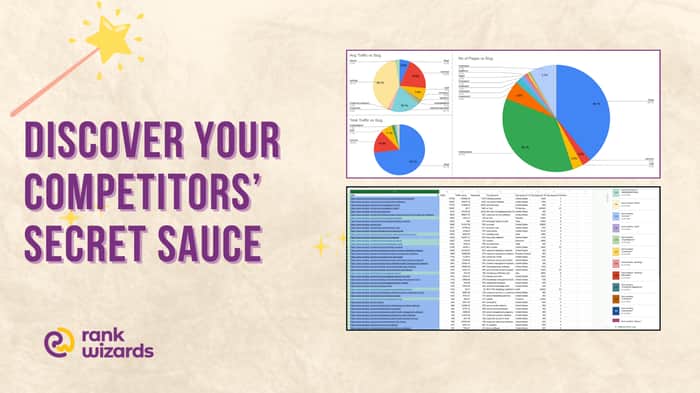
Both in the table and the graphs, we have a few metrics-
-Total traffic vs content groups
-Average traffic vs content groups
-Number of pages created vs content groups.
All this put together, you’ll get to know what types of content a brand is creating, which content are bringing them the most SEO traffic in total, and which is bringing good traffic per content. Plus, how many contents have been created under each type will also show up here.
How to Fill in the Data?
You have to have an SEMRush subscription to go along with the steps. The steps are-
-
Down the top SEO pages and their traffic data from SEMRush/AHrefs
-
Identify the URL patterns and label them against content types. For example, any content with /newsroom/ URL slug goes as company news and any content with /service/ slug goes as service pages. Conditional formatting could be the easiest way to go for this.
-
Add the total and average traffic info from the SEMRush/Ahrefs file into the table. Try to make sure you’ve covered the majority of the contents from the top pages.
-
Sometimes, some content can’t be put under URL slug patterns. In this case, highlight them with different colours and identify the content groups with colours in the table instead of slug patterns.
-
Create pie charts by selecting ‘slug’/‘types of pages’ as one data row and ‘Total Traffic’, ‘Avg Traffic’, and ‘No of Pages’ separately as the second data row. This will end up with three pie charts that go as ‘Avg traffic vs Slug’, ‘No of pages vs Slug’, and ‘Total traffic vs slug’.
Once these pie charts show up, go and study which contents are contributing to the website’s SEO success, and what’s the extent of contribution.
A worked out and blank template have been provided for you in the comments.
Why Use This Template?
-To understand a competitor’s content marketing playbook beyond what you can see on Ahrefs SEMRush or Similarweb.
-Pick up and adapt to the winning content ideas of your industry, and give it a flair of your brand tone.
-Gather seed or root keywords and research to find untapped content ideas that most of your competitors have missed.
-To understand the demand side of your audience, and what’s been driving them towards your competitors’ websites.
-The ToFu, MoFu and BoFu tier contents, their internal linking, CTA placement, conversion technique etc.
Mastering your competitors' content strategies is a game-changer in the realm of digital marketing. By using this template to meticulously break down their approach, you'll uncover the hidden tactics that drive their success.
This isn't just about imitation—it's about innovation. By understanding what works for them, you can refine your strategy, filling in the gaps they've missed and delivering content that resonates even more powerfully with your audience.
In the end, a well-executed content strategy breakdown doesn't just keep you in the game—it puts you ahead of it.
Full Article Link: https://rankwizards.co/content-marketing-strategy-template/

Worked Template: https://docs.google.com/spreadsheets/d/1_fRFbdmy8qFmENhTAcQPLyXCg9cFmnxuACQNCpkhdY0/edit?gid=614031157#gid=614031157
Blank Template: https://docs.google.com/spreadsheets/d/1_tdYiNbSf_WJ0Gzoh6ankaFR5EmeTa0KJk1NL8ph51k/edit?gid=614031157#gid=614031157