Using the Calendar timesheet and template
Originally posted https://nureti.com/blog/calendar-timesheet-monthly-template/
Do you have a really busy schedule, working nine to five ("what a way to make a livin'")?
Do you like to plan ahead to get an overview of you full work week?
Do you need an easy way to see when you can fit in new projects?
Nureti calendar helps you keep your timesheet on track.
No more need for excel spreadsheets! Nureti help you plan and register time all in one place!
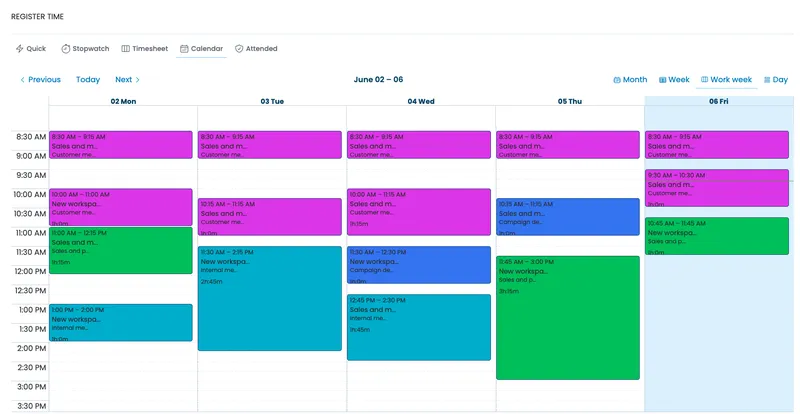
What are the different ways to use Nureti Calendar for time traking?
There are four different ways to view the calendar:
Monthly calendar view
Week calendar view - Monday to sunday (european) or sunday to saturday (American)
Work week calendar view - Monday to friday
Day view - Current day
This gives you the possibility to use the calender for your timesheet tracking just as it fits best with your way of working.
No matter which view you choose, tracking time is done in the exact same way.
You choose your prefered calendar view and get started.
Lets have a look at the monthly calendar
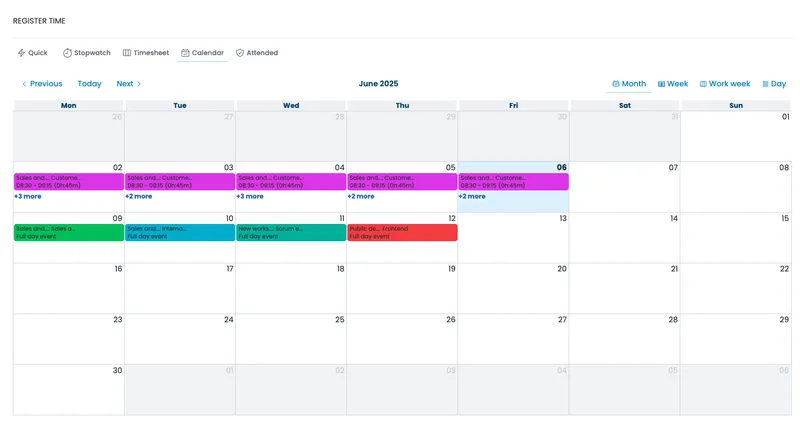
Example:
Choose the calendar for June 2025.
If you want to make a full day event, you click the day of the event, and then register the Project and Task of the event.
That's it.
Time is now registered.
You can also choose several consecutive days.
For example if you were at a seminar, taking place over more days.
You drag your mouse - or finger if you are using your mobile phone - over the number of days you need to track, put in project and task, and now all days are added.
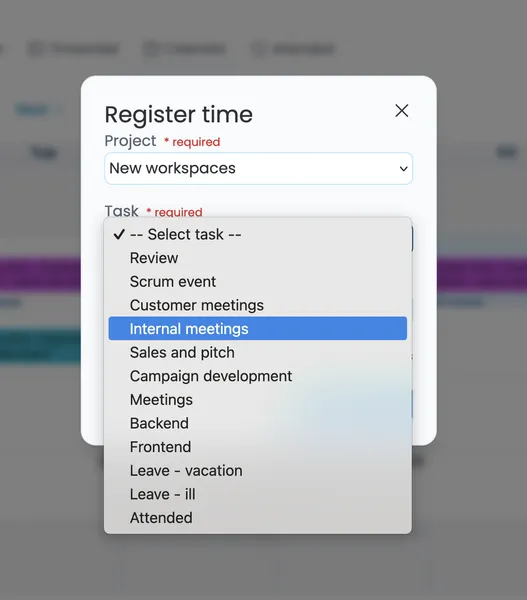
How to track multiple projects in a single day
To track several projects on the same day, use the Week or Work Week view.
Choose day, and select the timeslot by dragging your mouse from start time to end time.
When this is done the Register time box will, appear on screen and you now choose project and task - Done!
Does it get any easier?
No... right?!... I don't think so.
Repeating meetings
Do you have recurring meetings?
You can very easily track these, without having to write the same over and over again
Go to the Week view, and choose the timeslot to put in the task. The Register time screen appears,
before chosing project or task, make sure to check the box
Save project, task and comment as default values, then the same project and task will be pre-selected every time you track time, from now on and until you choose to "uncheck" it.
Plan ahead
What about planning ahead?
This can also be done and can be a big help for getting an overview of all projects planned.
This is one of the strengths of the Nureti calendar feature.
If you want to plan 1, 2 or more weeks ahead, you use the Week or work week template, and you can register all projects, meetings etc. going forward.
This really gives you a great way of being in control of your time, and gives you the best possibilities to plan you time in a very manageable way. An overview of all projects planned.
It can be used to see when you will be able to put in more projects, and give your costumers a forecast on when you will be able to work on their tasks.
Pro tip: Use colours
Make sure that you use different colours on your tasks, this makes it even easier to see what's coming up, and a great way to see which days you have the recurring tasks.
Ready to get started?
Try Nureti Calendar today, and experience smarter time tracking with visual planning, or read more on our features page https://nureti.com/features/.


Really interesting tool - I like how clean and flexible it looks.
Quick thought on the EU Working Time Directive part: I recently came across some country-specific differences. For example, in Spain it’s required to log the exact start and end times of each workday (kind of like a check-in/check-out system), not just total hours.
It can also be necessary to set maximums and even minimums - like always logging exactly 40 hours per week in my case. Just something to keep in mind if you’re planning to support compliance across different EU countries.
Thanks a lot, that means a lot to me. :-)
I agree the rules are different from country to country, and in some countries it is enforced by different laws etc. It is actually hugely complex. In some cases we can directly calculate if you are compliant with European Working Time Directive, and in other instance we make assumptions and provide guidance. For instance the 48 hours max pr. week calculated as average over 4 months differs vastly from country to country.
Thanks again for you input!!