Validate The Writing Workflow Before Scaling The Tool
Founders often test writing AI with a prompt contest: ask several products for the same scene and keep the most impressive output. That can identify a pleasant voice. It does not reveal whether the product will support a repeatable creative business.
A better way to evaluate an AI Script Writer is to run a small workflow experiment. Start with one disposable project, define the operational problem, and measure what happens after the first draft changes. Success means the next collaborator can repeat the process without inheriting hidden reconciliation work.
Write A Workflow Hypothesis The Team Can Falsify
A useful hypothesis links a product behaviour to a business outcome. “AI will make us faster” is too broad. “Keeping script edits, scene structure, and visual references in one project will cut our revision handoff from two hours to forty-five minutes” can be tested.
Choose one constraint that currently hurts: client notes arrive in several places, the team rebuilds storyboards after rewrites, or collaborators keep asking which draft is current. Do not test every feature. A focused experiment produces an answer you can act on.
Use A Project Small Enough To Throw Away
Create a three-to-five-minute film with six scenes, two locations, and one recurring prop. Include a planned reversal so the outline and early scenes must change midway through the trial. Invite only the people needed to expose the handoff.
Laper’s Script project combines screenplay text with outlines, scenes, characters, locations, props, beats, shots, knowledge, assets, and collaboration. The screenplay remains authoritative for scene order and deterministic entities derived from headings and character cues. That makes it possible to test whether a revision propagates through the working context without pretending every creative choice can be automated.
Record A Baseline Before Using AI
Run a comparable revision in the existing workflow. Count the minutes spent locating the right draft, interpreting notes, updating side documents, briefing a visual collaborator, and exporting a review copy. Note each manual copy-and-paste. Memory is not a reliable baseline.
The baseline may reveal that writing speed is not the bottleneck. If approval takes three days, shaving fifteen minutes from scene generation will not change throughput. The experiment should aim at the slowest repeated coordination step.

Set a stopping rule as well. If reviewers cannot identify the current draft after two revision rounds, or if stale references take longer to clean than the baseline handoff, pause the trial. A stopping rule prevents enthusiasm from turning a failed experiment into an indefinite rollout.
Run One Complete Revision Cycle From Brief To Handoff
- Frame the request. Give the assistant a clear objective and the smallest context that can answer it.
- Review the proposal. Accept, revise, or reject each consequential suggestion; do not treat generation as approval.
- Change the source. Put approved story edits into the current screenplay rather than leaving them in chat.
- Trace the consequences. Inspect linked scenes, locations, props, shots, and references affected by the rewrite.
- Ship a milestone. Export the artifact a client or collaborator would actually review.
Test Both Narrow And Broad Context Boundaries
Laper can read the current focus, outline, selected scene, selected range, selected node, or a bounded full draft. Ask the same structural question twice: first with the scene alone, then with the outline and relevant earlier material. Record which scope produced an actionable response and how long verification took.
This is more informative than counting generated words. A narrow answer may be fast but miss setup. A full-draft answer may surface useful dependencies but cost more attention to review. The product needs a predictable way to match context size to decision size.
When testing an AI Script Writer Generator, count rejections. Label each one: stale premise, character mismatch, unsupported invention, redundant prose, or simply weaker than the existing line. A rejection is not wasted data. It tells the team where AI assistance needs tighter framing or should not be used.
Force A Breaking Change Through The Entire Project
Halfway through the experiment, change a core constraint. Remove a location, combine two roles, or move the reveal earlier. This is the moment when a workflow proves its value. Inspect whether the current screenplay remains obvious and whether dependent references still advertise old assumptions.
Laper keeps visual results as durable tasks and project assets associated with characters, locations, props, scenes, or storyboard shots. That relationship can make outdated work easier to locate, but it does not decide whether an asset remains valid. The experiment should include a human review of every affected dependency.
Record the person who found each dependency and the time required. If only the original writer can reconstruct the chain, the workspace has not yet created a team process. Repeatability means another authorized collaborator can reach the same current state without private context.
Measure The Whole Loop Instead Of Generation Speed
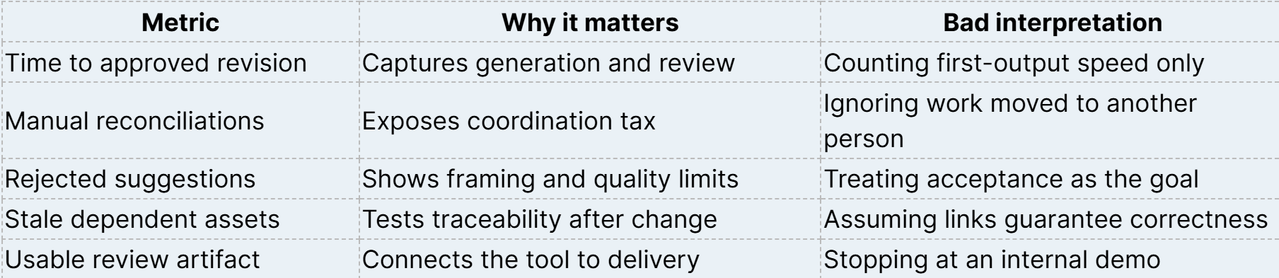
Compare the trial with the baseline. If total cycle time falls but review defects rise, the workflow has not improved. If writing time stays similar while handoff and reconciliation shrink, the product may still be valuable. The metric should follow the business constraint, not the feature headline.
Calculate A Conservative Payback From Real Project Volume
Translate saved time into the team’s real cost, then subtract subscription, setup, review, and migration effort. Use conservative assumptions for monthly project volume. A founder does not need a perfect financial model; a simple range is enough to avoid buying capacity that an unvalidated process cannot use.
Also identify the failure threshold. If the tool saves an hour but causes one avoidable client correction every third project, that correction may erase the gain. Quality risk belongs in the calculation.
Include adoption time in the first month. Templates, permissions, naming conventions, and review habits do not appear automatically. If the trial succeeds only because one founder remembers every exception, the process is not ready to hand to a contractor or employee.

Scale Only The Step The Experiment Actually Proved
If the experiment succeeds, document the exact request pattern, review owner, source-of-truth rule, and milestone export. Add another collaborator or a larger project only after the small loop remains stable. Scaling an undefined workflow multiplies confusion.
Laper is most compelling when structured writing, targeted AI operations, collaboration, and early production references genuinely belong in one process. It is unnecessary overhead if a founder only needs occasional ideation and already has a reliable handoff.
The founder’s advantage is not access to infinite generated pages. It is the ability to learn cheaply. Run one complete loop, keep the measurements, and let evidence—not novelty—decide whether the tool earns a permanent place in the stack.
