VC-backed startups are being sold for scraps on Acquire (startup marketplace)
VC-backed startups are being sold for scraps on acquire.com
Well well well
How the turn tables
After being started as a marketplace for profitable bootstrapped SaaS exits
acquire.com has become a place where failing VC-backed startups go to die and get sold for scraps.
Global VC funding in Q1 2023 dropped to $76 billion — a 53% decline YoY from $162 billion in Q1 2022
An example of VC backed company trying to sell
Today we're gonna talk about:
How new factors (marketplaces like acquire) will force the current venture model to evolve
Here are 7 insights on why the VC and startup industry will never be the same (this generally happens every couple of years anyway)
this is from a kid who spends his whole day on acquire and is in sf rn learning new things about VCs and the startup ecosystem every day
I think I’ve seen a majority of the listings on acquire (I wish I was kidding. tbh 95% of the older listings don’t have much to them)
I was working a full-time internship at a VC last semester
I like to think these factors give me a unique perspective on this
So what’d I learn?
- The venture model as we know it doesn’t quite make sense anymore
It will be hard to deploy $500+ million funds as founders requirements for funds have drastically changed in just the last 2-3 years. Most startups are no longer anywhere near as capital-intensive as they were 5-10 years ago.
Software like MVP creation and marketing via organic socials have become much more cost-effective.
Funding will be used very differently as VC money is no longer the best and only way to grow nor do you need large engineering teams to build most products (technical barriers to entry are reducing every quarter)
VCs aren’t going anywhere, but the types of business models and founders they invest in will be very different. The funding stage at which VCs come in will change as more founders bootstrap and get traction on their ideas before raising funding
- Exits and liquidity as a VC: This almost seems like the hardest part
The end goal/ exit/ liquidation landscape has changed drastically
Besides the holy grail of exits with an IPO, funds are usually locked for a period of long time and it’s difficult to get an exit for most companies.
Marketplaces like @acquiredotcom have become a place where failed VC backed startups come to be sold for scraps. But this is only the start and just a product of the current environment. Soon profitable VC backed startups could look to exit via @acquiredotcom as well.
I’ve seen startups that have raised $500,000+ giving up and now try to sell their pre-revenue business for $25,000. There are those who have raised millions to reach $1 million ARR and now are giving up and selling the business.
(Links to these listings^ will be in the comments)
Definitely better than going to 0 and not a realistic plan B for most failed startups even just 2 years ago.
It’s honestly sad to see sometimes.
Prediction: These changing market dynamics and especially the change in the narrative around startups will lead to founders building very different kinds of companies with new end goals in mind.
most importantly what the end goal looks like and how they define success will change
Marketplaces like Acquire provide many startups with more options and flexibility that just wasn't possible before.
- How VCs think: 1/100 investments need to 100x for the fund to be successful
That’s just how the economics of a fund are set up to work- only 1% of the bets are ‘supposed’ to hit and have such massive returns that they cover the remaining 99% of failures
Depending on the fund size and stage a 10x return sometimes isn’t even considered successful
To achieve this, the growth at all costs mindset has taken over startups for the last 10 years. The startups with exponential growth are the only ones that get media recognition, even if the growth is obviously not sustainable or healthy growth.
For VCs, they are making 20-30+ bets/ year. This leads to the risk-reward dynamic being imbalanced and misaligned incentives between VCs and their founders in a typical fundraising situation.
Founders really need to focus on how incentives are aligned
I think one of the ways for founders to solve for this is to wait and raise when
they have traction
Or go for more personally invested individual investors or company VC funds that don't work with the same fund economics that most VC funds work with.
this is most of the VCs out there but not most of the money in circulation
a lot of the top funds are much cleaner from this since they do not have to worry as much about fund dynamics either and have a much larger time horizon.
- Raising VC funding will no longer be the default for most entrepreneurs
When I tell people I’m working on a startup they usually ask me if I’m trying to raise funding
VC-funded startups are the only startups that have gotten any kind of attention: media recognition, recognition at colleges, from peers
There's just something about raising hundreds of thousands of dollars for an idea that seems to impress people 🤷
This has been the case for a while and I really think this will change going forward
As more founders realize the trap that comes with most VC money
There is growing awareness amongst entrepreneurs of the different kinds of successes that are possible, especially as bootstrapped exits and vehicles like search funds become more popular in the media
Entrepreneurs are often driven by much more than just money and success so once they see alternatives there will be no going back
I think this switch will happen slowly, but once it kicks in it will be quick and more drastic than most realize
There will still be many moonshot startups that need VC funding
But that being the default for ALL startups is just stupid
This perception of raising funding as a default for entrepreneurship will hopefully change
Maybe this is just wishful thinking tho
- Trends that make it hard to see what will happen:
- Two kinds of AI-VC hype:
In June of 2023, AngelList reported that AI deal share had increased more than 200% in the past 12 months, even while the venture market was down 80%.
AI tools are going to change how VCs are run and how they invest.
Running a fund will require less manpower and enable you to deploy capital much more efficiently.
AI agents are coming to the VC workflows.
Prediction: we’ll see massive funds being raised without anywhere near as many analysts and employees as previously thought possible.
- The collapse of SVB has changed how many founders look at deals
Money doesn’t quite flow through the system like it used to
who provides capital in between rounds via the venture debt that SVB was providing?
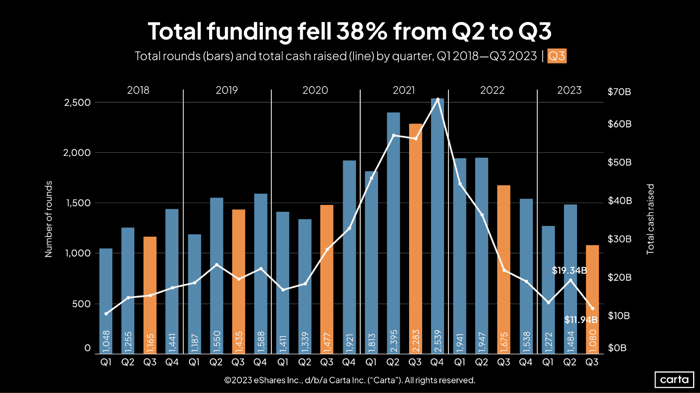
- Total funding fell 38% Q2 to Q3 and is down in 6 of last 7 Quarters
The downturn for venture capital continued for most of 2023, with total VC funding dropping for six of the past seven quarters through Q3 2023
Recent high-profile IPOs have not performed well and late-stage valuations have dropped significantly (average down ~50% in majority of portfolios):
The VC game is changing as multiple go down drastically and new investment into startups is low
There is still plenty of remaining dry capital and I’m curious where this money will go instead
Pricing has come down significantly and VCs with active capital will take advantage of these terms.
The last month of last year was looking extremely busy as quiet funds/ managers began to deploy capital to demonstrate deal activity for 2023.
Couple of things I learned about VCs and how they work:
- It’s all about relationships:
Investor relations are the most important
VCs depend heavily on other VCs they know in order to fund companies they’ve backed in future fundraising rounds
They need each other for deal flow, to share valuable information, resources, founder networks, etc.
- This leads me to the next point
Herd mindset amongst VCs is real
even for those who are following it with awareness 🤷
It is almost inevitable with how the game is played
Riding trends is a vital part of being a VC.
It greatly reduces your risk of failure, how good the founder needs to be, and leaves more leeway for mistakes or imperfect execution.
If the market is growing rapidly it gives massive headwinds for startups to ride on.
- Investor-fund fit is real
VCs look to align their funds investment principles to those of high-value investors.
Many smaller funds have just one main source of capital (anchor LP)
Advice for founders: thinking about how it will look for VCs to be involved in your deal and what they can tell their investors
Try and match your startup's goals with not just the fund, but also their major investors' goals
Bonus: Presentation AI tools get a special shout out fr
Beautiful (dot) ai is so damn good
Saved me hours of work at my internship
Thanks for reading! I’m just making guesses at the end of the day.
Failed VC-backed startups being sold:
https://app.acquire.com/startup/wl1HanJBG4RqCUHGIbpmcYeB0so2/o06S28xGg4CN6g6fMYRR?source=marketplace
https://app.acquire.com/startup/ciGGlDQfdwUZ1f8buMtE7FP8Bfj1/rKt4cVrl3sEORlqRboHX?source=marketplace
https://app.acquire.com/startup/YSG5VwaIsKVBelfgmu1cbs6alkI3/Sbd3c6dOJpkYSqlxPnYl?source=marketplace
https://app.acquire.com/startup/Nc5fhnJdIqWEP0EluTuiWF24ncS2/J80kn87KgmZD0otyKrwq?source=marketplace

This feels less like a failure of startups and more like a reset in pricing expectations.
When capital is abundant, valuations expand beyond fundamentals. When conditions tighten, outcomes start reflecting actual revenue, efficiency, and product-market fit.