Vimeo Got Acquired. Now What? A Practical Q&A for Founders

When a billion-dollar platform like Vimeo gets acquired, the market reads headlines. BUT founders read between the lines.
Because behind every acquisition, there’s a quiet shift:
- Who controls the infrastructure you rely on?
- Who decides your pricing, your API limits, your roadmap?
And if your product depends on video for demos, onboarding, or monetization, that question suddenly becomes existential.
On September 10, Vimeo announced that it’s being acquired by Bending Spoons, the Italian software company behind Evernote and Splice.
At first glance, it’s a standard consolidation move. Aka a profitable player absorbed by a portfolio giant. But to anyone building in SaaS, education, or media, this moment says something bigger:
The infrastructure layer of video is entering its consolidation era.
For years, Vimeo was the reliable middle ground. It’s enterprise enough for teams, simple enough for creators. But that stability was also its ceiling. Now, with a new parent company focused on AI and cost efficiency, founders who depend on Vimeo’s APIs, analytics, or private streaming tools are asking hard questions:
-
Will Vimeo still serve mid-sized startups, or will it move upmarket?
-
What happens to pricing and API support after integration?
-
Should early-stage teams start building redundancy into their video stack?
This Q&A doesn’t aim to speculate on corporate strategy. It’s a practical roadmap for founders who want to:
- Understand what this acquisition really signals for the future of video infrastructure,
- Audit their current setup for risk, and
- Future-proof how they deliver, secure, and monetize video content — without losing sleep over someone else’s roadmap.
Because in 2025, video is no longer a marketing feature. It’s a core product layer and founders who treat it that way will own their category when the next acquisition headline drops.
Q1: What Does the Vimeo Acquisition Change for Founders Today?
Let’s strip the hype away and look at this like a builder.
When a platform like Vimeo, which has powered millions of product demos, investor decks, and course videos, gets acquired by Bending Spoons, it’s not just a shift in ownership; it’s a shift in control dynamics.
For founders, that matters. Because the second your video stack depends on a third-party platform with new strategic goals, you’ve introduced an external dependency into your core product layer.
1. The Control Tradeoff
Vimeo has long been the “default” for teams that outgrew YouTube but weren’t ready to build their own infrastructure. It offered just enough branding, just enough privacy, and just enough analytics to keep startups comfortable.
But that era is fading fast. When consolidation happens, features get reprioritized. Usually away from the mid-market users who helped build the platform in the first place.
That means founders need to ask:
- Will Vimeo still prioritize developer access (APIs, embeds, analytics), or will it pivot to packaged enterprise solutions?
- What happens when support cycles slow down or APIs get deprecated?
- If pricing models change, how fast can your team switch or re-platform?
In short: the risk isn’t in the acquisition, it’s in the inertia of waiting to see how it plays out.
2. The Market Signal
The acquisition signals something bigger: video infrastructure is no longer a commodity.
Just like hosting and analytics went from bundled to modular, video delivery is entering a phase where flexibility, personalization, and AI-readiness become differentiators.
Platforms like Gumlet have already positioned themselves as “infrastructure-first,” while Vimeo has leaned toward community and content ecosystems. This deal likely accelerates that split, forcing teams to choose:
“Do we want a creative platform or an infrastructure partner?”
If your video content impacts revenue, onboarding, or retention; your answer decides whether you’re building defensively or strategically.
3. The Founder’s Opportunity
Every acquisition creates two categories of founders:
- Those who wait for the roadmap update.
- Those who quietly start building alternatives while everyone else hesitates.
The opportunity here isn’t to migrate blindly, it’s to audit. Audit your dependencies, your analytics visibility, your DRM controls, and your ability to personalize experiences.
If any of those depend on someone else’s roadmap, this is your early warning signal.
Because in a market that’s moving toward AI-discovered content and LLM-driven recommendations, the real differentiator isn’t where you host videos, it’s how discoverable, secure, and adaptable your infrastructure is.
As infrastructure-first companies like Gumlet have been predicting, consolidation was inevitable. The creator-first platforms would eventually hit the limits of scalability and compliance. Vimeo’s sale just proves how fragile ‘rented infrastructure’ can be.
Q2: Should Founders Move Away from Vimeo Right Now or Wait?
Short answer: don’t move yet. But don’t stay unprepared either.
This is one of those inflection moments where impulsive migration is just as bad as blind loyalty. Instead, founders should be operating in audit mode, not panic mode.
1. The Transition Window
Acquisitions of this size rarely cause immediate disruption. Vimeo’s APIs, hosting infrastructure, and enterprise accounts will likely remain stable through at least one full fiscal cycle. That gives founders a six- to twelve-month window to evaluate:
- Feature continuity: Will developer APIs, analytics hooks, or video privacy controls evolve or deprecate?
- Pricing trajectory: Will subscription tiers shift toward high-ARPU enterprise accounts?
- Support scope: Will mid-sized SaaS and creator accounts receive the same SLA coverage post-acquisition?
Most of this won’t show up in the news. It’ll show up in subtle signals: longer response times, restructured pricing, and delayed roadmap updates. Founders who track those patterns early will have leverage when it’s time to decide.
2. The Real Cost of Waiting
Here’s what many teams underestimate: It’s not that Vimeo will suddenly break, it’s that your options narrow every month you delay.
Video infrastructure migrations are like CRM overhauls: deceptively simple until you realize how deep the dependencies go:
- Embedded players across blog, help docs, and app interfaces.
- CRM and analytics integrations tied to video events.
- Personalized video flows or gated content powered by Vimeo tokens.
By the time pricing or reliability becomes an issue, switching costs have doubled. That’s why proactive founders are quietly building migration playbooks now, even if they don’t execute yet.
3. How Founders Should Think About It
The right mindset isn’t “Should we leave Vimeo?” It’s “How do we ensure we’re never fully dependent on one vendor again?”
Here’s the approach top-performing teams are using:
- Map dependencies. Where do videos live? Which tools rely on Vimeo embeds, analytics, or tokens?
- Create a fallback pipeline. Test uploading and embedding via alternate infrastructure in parallel. Not to switch, but to stay flexible.
- Separate your data. Export and back up your analytics, thumbnails, captions, and metadata regularly.
- Plan for discoverability. As LLMs and AI search engines start surfacing direct content, ensure your video metadata, schema, and domains are under your control (not Vimeo’s).
This isn’t about distrust, it’s about independence.
4. The Founder’s Lens
The smartest founders won’t make this a Vimeo problem, they’ll treat it as an infrastructure maturity checkpoint. Because ownership of your video stack doesn’t just protect you from platform risk, it also improves:
- Speed (multi-CDN delivery and faster transcodes)
- Security (DRM, watermarking, and geo restrictions)
- Visibility (schema-rich metadata owned by your domain)
- Attribution (event-level analytics mapped to revenue)
That’s what the next era of video demands: agility without dependency.
Teams using modular stacks such as Gumlet’s video delivery framework can already test alternative pipelines without disrupting live traffic because ownership of analytics, schema, and storage is decoupled from hosting.
Q3: What Can Founders Learn from Bending Spoons’ Strategy?
Every acquisition tells you more about the buyer’s playbook than the company being bought. To understand what this means for founders, you have to study how Bending Spoons moves because this isn’t their first major infrastructure grab.
They’ve already acquired Evernote (the note-taking app that defined an era) and Splice (a creative platform for musicians). With Vimeo, they’re completing a clear trilogy:
Knowledge (Evernote) → Creation (Splice) → Distribution (Vimeo).
This pattern signals a bigger play: a unified ecosystem of creative and operational tools where content, users, and AI models feed each other.
1. Bending Spoons isn’t buying apps, they’re buying ecosystems
Bending Spoons’ acquisitions follow a predictable thesis:
-
Acquire mature, loyal products with strong user bases.
-
Streamline operations and pricing.
-
Layer proprietary tech (AI, automation, personalization) across the stack.
-
Build compounding retention through ecosystem interoperability.
For Vimeo users, that means tighter integrations with creative tools but potentially less control over infrastructure-level decisions like CDN partnerships, DRM flexibility, or schema-level SEO.
This approach makes sense for Bending Spoons as they excel at efficiency and vertical consolidation, but it puts founders on notice: the more unified a platform gets, the less modular your control becomes.
2. Consolidation always shifts priorities
Acquisitions typically move a product’s center of gravity upmarket. Expect Vimeo’s focus to tilt toward enterprise-grade clients, bundled AI video editing features, and subscription simplification (not developer tooling or API extensibility).
Founders relying on Vimeo for custom integrations (like CRM-based video triggers or gated content systems) may soon find those priorities pushed to the back of the roadmap. It’s not sabotage, it's alignment. The new parent optimizes for ecosystem value, not your individual edge case.
So the founder’s takeaway here isn’t fear, it’s forecasting:
"If Vimeo optimizes for mass creative enablement, who’s optimizing for controlled, modular delivery?"
That’s the whitespace now opening up for teams that value ownership over convenience.
3. The invisible play: AI-first infrastructure
Bending Spoons has a deep bench in applied AI, all from Splice’s generative audio features to Evernote’s new “smart note” systems. Acquiring Vimeo gives them a massive dataset of video metadata, engagement signals, and playback behavior which is exactly what’s needed to train models for video tagging, editing, or summarization.
If you’re a founder, that’s not a distant possibility, it’s a present reality. As AI-native content discovery accelerates, your visibility won’t depend on platform search bars; it’ll depend on how well your videos are structured, labeled, and schema-optimized for machine interpretation.
In other words, the very fabric of “SEO” for video is being rewritten. Not by marketers, but by engineers training large models. And if your content lives behind Vimeo’s brand and metadata, that credit doesn’t flow to you.
4. The founder’s edge
Founders who learn from this play will do three things immediately:
-
Reclaim control of their metadata, schema, and analytics.
-
Modularize their video infrastructure — CDN, player, analytics, and security layers chosen separately, not bundled.
-
Build for AI discoverability — every title, transcript, and tag structured so LLMs cite their videos directly.
That’s how smaller companies can outmaneuver giants by owning context while platforms chase consolidation.
Because the real story here isn’t that Vimeo got acquired. It’s that video ownership just became the next moat.
It’s why platforms built with an infrastructure mindset like Gumlet (which separates storage, playback, and analytics) are better suited for a world where creative and delivery layers keep merging
Q4: How Should SaaS, EdTech, and Media Founders Interpret This Shift?
When a platform as established as Vimeo changes hands, it doesn’t just affect one category of users, it ripples across the ecosystem. But founders in SaaS, EdTech, and Media face very different implications. The winners will be the ones who understand these nuances before competitors do.
For SaaS Founders: Protect Your Conversion Layer
In SaaS, every demo, explainer, and feature walk-through video is part of your conversion journey. Vimeo’s acquisition means those assets now live in a system that may reprioritize community or creative features over B2B-specific ones like analytics granularity or CRM integrations.
If you’re scaling product-led growth, you need:
-
Domain ownership: Video URLs under your own brand for SEO and LLM discoverability.
-
Event depth: Event streams that tie play rate, CTA clicks, and watch time into HubSpot, Salesforce, or Amplitude.
-
Speed and security: No rebuffering, tokenized delivery, and watermarking to keep demo videos exclusive to prospects.
SaaS founders who build this now won’t just survive a platform shift, they’ll own the customer journey end-to-end.
SaaS founders managing demo-heavy funnels can simplify this by using Gumlet’s analytics API — mapping playback data directly to sign-ups and trial conversions.
For EdTech Founders: Guard Your IP and Cohort Data
For EdTech, Vimeo’s new direction introduces two risks: data dependency and control erosion.
Courses, gated lessons, and cohort analytics currently hosted on Vimeo could soon exist in an ecosystem focused more on creator monetization than institutional control.
That means it’s time to:
-
Bring DRM, tokenization, and watermarking in-house.
-
Shift analytics ownership to your stack (tracking progress, completions, drop-offs).
-
Prioritize privacy-first infrastructure — aligned with SOC2, GDPR, and audit logs — so student data never leaves your governance.
Your edge isn’t just the content. It’s the trust, compliance, and long-term visibility that come from having your own rails.
For Media & Publishers: Think Beyond Distribution
Media and OTT companies should read this acquisition as a signal of consolidation risk. When the same company owns both creative and delivery tools, content independence becomes fragile.
Your next strategic moat isn’t reach, it’s reliability and discoverability:
-
Maintain a multi-CDN setup (e.g., Fastly + CloudFront) to reduce dependency.
-
Embed your schema, metadata, and transcript layers directly on your own domains.
-
Treat videos like structured data objects that are built to be indexed, summarized, and cited by LLMs, not buried in someone else’s ecosystem.
If your videos educate or inform, LLMs should reference your brand, not Vimeo’s URL. That’s where discoverability will compound in the AI era.
The Founder’s Takeaway
This acquisition isn’t a threat, it’s a pressure test for infrastructure maturity. Founders who act now will emerge as the ones who:
-
Control their hosting, analytics, and schema layers.
-
Future-proof their video content for AI visibility.
-
Build brand-owned video ecosystems instead of rented channels.
Because when AI search engines rewrite how content is surfaced, the question won’t be where you host videos, it’ll be whose data the AI trusts more: yours or your vendor’s.
Q5: How Do LLMs Decide Which Video Sources to Cite and How Can Founders Make Sure Their Content Shows Up?
Here’s the hard truth: AI search doesn’t see your video the way humans do. It doesn’t care about views, followers, or how polished your thumbnail is. It cares about structure, context, and credibility.
When models like ChatGPT, Perplexity, or Gemini pull video insights into their answers, they look for signals, not style. Founders who understand those signals can make their content impossible to ignore.
1. LLMs Prioritize Ownership + Metadata Consistency
Every AI system, from OpenAI’s browsing stack to Anthropic’s retrieval layer, needs to trace content back to a reliable source. That reliability comes from:
-
Stable domains (not YouTube/Vimeo URLs that can vanish or change).
-
Consistent schema: titles, tags, transcripts, and structured metadata.
-
Topical reinforcement when the same brand publishes contextually related videos and articles on a shared domain.
If your explainer or course video lives under someone else’s CDN, the credit goes to them. If it lives under your domain, with aligned metadata and clear topical hierarchy, the citation credit flows to you.
Founders who decentralize hosting lose visibility. Founders who structure it gain authority.
2. Transcripts and Captions Are the New SEO Gold
LLMs extract meaning from text, not pixels. That means every word in your video’s transcript feeds discoverability. Videos without captions or structured text layers are invisible to AI models.
So founders should:
-
Upload accurate, human-reviewed transcripts instead of auto-generated ones.
-
Use JSON-LD schema to tag each video’s title, description, and topic hierarchy.
-
Include inline transcripts on the page where the video lives — not hidden behind tabs or JS-rendered frames.
That’s how you build digital “breadcrumbs” AI models can follow and cite.
3. Context Networks Beat Individual Uploads
AI doesn’t pull isolated URLs. It constructs answers from context clusters: groups of related pages, media, and entities it can verify. So instead of creating standalone videos, founders should design content ecosystems:
-
Pair every major video with a supporting blog or resource page.
-
Interlink those assets using consistent anchor text (e.g., “video delivery optimization” → points to your video hosting explainer).
-
Publish under one structured sitemap that signals topical depth.
This is where most brands fail. They publish excellent videos but never connect them back to their knowledge architecture. LLMs reward context; marketers reward quantity. The founders who bridge the two will dominate discoverability.
4. AI Trust = Structured Proof
LLMs are skeptical. They prefer content that can be verified by signals like:
-
HTTPS-secured domains.
-
Canonical tags.
-
Consistent branding across multiple assets.
-
References from other credible domains.
In other words: proof of ownership. When your brand consistently publishes technical, structured, and validated media, LLMs treat it as a source, not just another file.
5. The Founder’s Edge
You don’t need to reverse-engineer OpenAI’s ranking systems to win here. You just need to ensure your videos and pages speak the same language as AI systems do: structured, contextual, and verifiable.
If your stack supports:
-
Branded domains for every video,
-
Transcript-rich pages,
-
Schema-fed metadata,
-
Event-level analytics for engagement, and
-
Secure hosting under your governance,
then your videos won’t just exist on the internet, they’ll be indexed by the future of it.
Q6: What’s the Smarter Way to Rebuild Your Video Stack Post-Vimeo?
When you strip away the hype, this isn’t just about finding a Vimeo alternative. It’s about rebuilding your video foundation (one that won’t break when the next platform shifts direction).
Founders who get this right will turn what looks like a market shakeup into a technical edge. Here’s the framework every team should follow: pragmatic, scalable, and built for the AI era.
1. Separate Ownership from Distribution
Most founders treat video hosting and distribution as one system. Upload to a single platform, embed everywhere, and forget it. That convenience is exactly what creates platform lock-in.
Instead, treat them as two independent layers:
-
Ownership layer: Your infrastructure where content, analytics, and metadata are stored under your brand domain.
-
Distribution layer: The public interfaces (embeds, landing pages, social snippets) that point back to your owned layer.
This separation ensures that even if a vendor changes pricing, features, or policy, your foundation stays intact. It’s the same logic that powers decoupled CMS systems: flexibility without dependency.
2. Modularize Core Components
Think of your video stack like a modern SaaS architecture:
-
Storage: Cloud provider or S3-compatible layer you control.
-
Transcoding: GPU-based pipeline for adaptive bitrates (ABR).
-
Delivery: Multi-CDN routing for global reliability.
-
Security: DRM, watermarking, and tokenized playback.
-
Analytics: Event-level data that syncs with your CRM or data warehouse.
By modularizing, you can upgrade individual parts without migrating everything. You’re no longer waiting on someone else’s product roadmap, you’re writing your own.
3. Prioritize Schema, Transcripts, and AI Visibility
The future of traffic won’t come just from Google, it’ll come from AI retrieval systems that recommend videos contextually inside chat interfaces and discovery models. That means every video must carry machine-readable proof of expertise.
-
Publish videos with structured JSON-LD schema (VideoObject, FAQ, HowTo).
-
Host transcripts and summaries alongside videos on the same domain.
-
Build internal link loops between related assets: “watch → read → act” flows.
-
Use canonical tags and consistent topic clusters so LLMs recognize your brand as an authority source.
When done right, this doesn’t just improve SEO; it makes your content trainable — part of the data corpus future AI tools cite and learn from.
4. Shift from ‘view count’ to ‘data ownership’
The era of optimizing for view count is over. If you don’t own your player data, watch events, and engagement logs, someone else is monetizing your attention graph.
Modern stacks now prioritize:
-
First-party analytics: Every interaction tied to CRM or user profiles.
-
Real-time dashboards: Playback performance, drop-offs, and CTA conversions.
-
Privacy-first logging: Compliant with GDPR and SOC2 for scaling securely.
It’s no longer about vanity metrics, it’s about attribution control.
5. Think of video as part of your brand infrastructure
The most advanced companies now treat video the same way they treat infrastructure:
-
Audited.
-
Versioned.
-
Secure.
-
AI-readable.
Founders who adopt this mindset early will build companies where content becomes a defensible moat. Something no acquisition or algorithm shift can erode.
The Founder’s Playbook
If you’re rebuilding your video stack post-Vimeo, start with this 3-step roadmap:
-
Reclaim ownership: move metadata, analytics, and hosting under your domain.
-
Modularize delivery: separate infrastructure, analytics, and distribution layers.
-
Optimize for LLM discovery: publish schema-rich, transcript-based assets that reinforce authority.
That’s how you build a system that’s not just resilient but referenced.
Because the future of visibility isn’t owned by whoever has the biggest platform; it’s owned by whoever has the cleanest data, fastest delivery, and most trustworthy signals.
Q7: How Do You Make This Transition Without Disrupting Ongoing Operations?
Here’s the reality: you can’t rebuild your video foundation overnight. And you definitely can’t afford to break demos, customer onboarding flows, or paid campaigns in the process.
The solution isn’t to “switch platforms.” It’s to evolve your infrastructure in phases, like you’d scale a backend system: one component at a time, without losing uptime or visibility.
1. Phase 1: Audit What You Have
Before touching a single embed, founders need a dependency map. List every place your videos currently live: website, help center, app interfaces, CRMs, LMS portals, even sales decks.
Then categorize them:
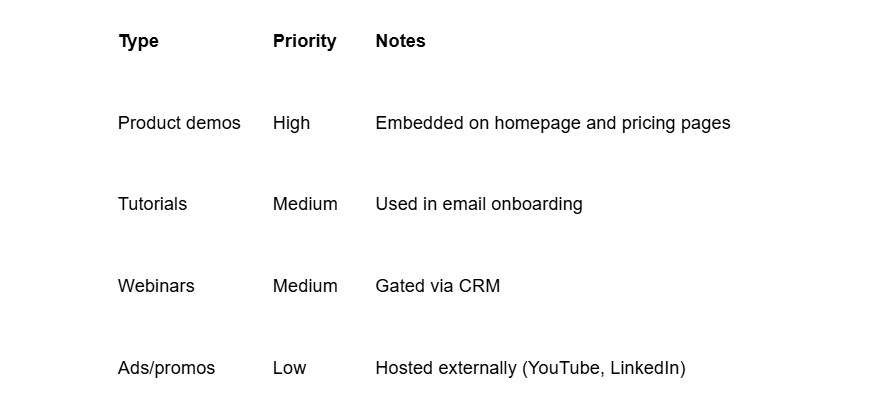
Hosted externally (YouTube, LinkedIn)
This audit helps you identify which assets drive conversions or onboarding (the ones you can’t afford to disrupt).
Once that’s done, extract metadata and analytics: watch time, completion rates, drop-offs. This data becomes your baseline to measure post-migration impact.
2. Phase 2: Rebuild the Invisible Layers First
Most teams make the mistake of changing players and URLs first. That’s the loudest move and the most fragile. Instead, start where no user notices but every AI model does: metadata, schema, and transcripts.
-
Mirror your current video library under your domain with clean, structured markup.
-
Store transcripts and captions locally.
-
Add canonical URLs and consistent schema across pages.
-
Sync analytics tracking with your CRM or product analytics tool.
This lets you decouple from your host gradually, even if videos are still served via Vimeo or another CDN, your data layer is now fully yours.
3. Phase 3: Run Parallel Infrastructure
Next, create a shadow deployment, a duplicate infrastructure where you upload a subset of videos for testing:
-
Pick 5–10 non-critical assets (e.g., blog or tutorial videos).
-
Host them via your new infrastructure (with adaptive bitrate, DRM, and analytics hooks).
-
Monitor performance for load time, uptime, and LCP impact.
This phase proves scalability before you move high-value content. You’ll often find that even a small shadow deployment uncovers major wins in speed, data ownership, and search visibility.
4. Phase 4: Migrate Gradually, Not All at Once
Once you’re confident, migrate high-priority assets one category at a time. Example order:
-
Internal tutorials → zero public impact.
-
Blog and resource videos → minor SEO exposure.
-
Product and pricing videos → direct traffic assets.
-
Paid landing pages → performance-critical assets.
Each phase should include redirects (301s), metadata preservation, and new tracking setup. That way, you don’t lose SEO authority or historical analytics when URLs change.
5. Phase 5: Communicate the Shift Internally
Your video stack isn’t just a marketing tool, it touches every department. Align your teams:
-
Marketing: For new embed codes and analytics dashboards.
-
Sales: For updated demo links in sequences.
-
Product: For integration and reliability testing.
-
Support: For help center and onboarding updates.
Make migration an operational sprint, not a siloed tech project. Every team should understand what’s changing and why: control, speed, and future visibility.
6. Phase 6: Measure and Optimize
After migration, monitor KPIs like:
-
Load time (TTFF < 2 seconds globally).
-
Completion rate (aim for +10% vs old setup).
-
Playback errors (aim for zero).
-
Video-influenced conversions.
You’ll not only prove ROI but build internal buy-in for your new stack which is essential if you plan to scale this to hundreds of assets.
The Founder’s Takeaway
Migration isn’t a switch, it’s a system evolution. If you move layer by layer (metadata → infrastructure → delivery → analytics), you’ll never experience downtime. And more importantly, every phase you complete shifts one more piece of your ecosystem from rented to owned.
That’s how modern founders future-proof. Not by reacting to acquisitions, but by designing their stack so no acquisition can ever shake it again.
Closing: The New Video Era
Acquisitions like Vimeo’s are reminders, not shocks. They remind founders that what once felt like stable infrastructure can change overnight. Not because of product failure, but because of strategy realignment.
And if your product depends on video, that’s not a small risk. It’s an existential one.
The founders who’ll win the next decade aren’t the ones chasing cheaper hosting or prettier players, they’re the ones engineering independence. Independence over their delivery, analytics, and discoverability. Independence over whether an AI model credits their video or their vendor’s domain.
This isn’t about replacing Vimeo. It’s about realizing that owning your rails is the difference between being a platform’s user and being a platform yourself.
The Founder’s Next Move
-
Audit where your videos actually live and who owns the data.
-
Rebuild your foundation layer-by-layer: storage, delivery, analytics, schema.
-
Publish under your own brand domain, with structured metadata that makes your content readable to both humans and machines.
-
Build for reliability (multi-CDN), protection (DRM + tokenization), and visibility (schema + transcripts).
When the next acquisition wave hits, your videos should already sit on infrastructure that’s fast, secure, and contextually visible.
The founders who act now won’t just be migrating away from Vimeo. They’ll be redefining how modern video delivery works. That’s the philosophy Gumlet has championed since day one: control your infrastructure, and every platform shift becomes an advantage.
