We Added AI Picture Books to Inkfluence AI -Here's What We Learned About Keeping Characters Consistent
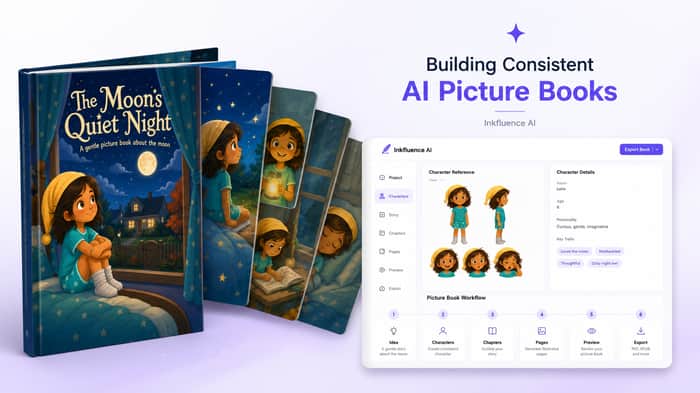
We recently added AI picture-book creation to Inkfluence AI, and one problem turned out to be much harder than simply generating attractive illustrations: keeping the same character recognizable from page to page.
Generating one good children's-book illustration with AI is relatively easy. Generating 15–30 illustrations where the protagonist still looks like the same person is a very different problem.
For a picture book, small inconsistencies become surprisingly obvious. Hair changes. Clothes change. Facial features drift. Age changes between illustrations. After several pages, it can feel like you're looking at different characters entirely.
What we changed
Instead of treating every illustration as an independent image-generation request, Inkfluence AI now creates a character reference first.
That reference establishes things like:
- appearance
- clothing
- proportions
- hairstyle
- visual style
- distinguishing features
The book's illustrations can then use that character identity as context rather than trying to reconstruct the character from a text description every time.
It sounds like a small architectural change, but the difference across an entire children's book is huge.
We also stopped thinking of it as an “image generator”
This was probably the bigger product lesson.
Someone making a children's picture book doesn't really want 20 AI images.
They want a finished book.
So the workflow we've been building in Inkfluence AI is:
idea → story → characters → illustrations → page layout → cover → PDF/EPUB → finished book
Keeping all of those stages inside one project means information established early in the process can carry through the rest of the book.
The interesting product lesson
AI products are increasingly easy to build at the individual-feature level.
Image generation is available everywhere. Text generation is available everywhere.
I think the harder—and more defensible—problem is turning those capabilities into a workflow where the user doesn't have to understand all the machinery underneath.
A parent, author or creator shouldn't need to become good at prompt engineering just to make a children's book.
They should be able to describe the book they want and have the software handle the repetitive parts.
That's the direction we're taking Inkfluence AI, an AI book creation platform for creating, editing, illustrating, formatting and exporting books.
What we built
As a test, we created a children's book called The Moon's Quiet Night.
The same main character appears throughout the story in different scenes and poses, and the finished book can be previewed as an actual paginated picture book rather than a collection of generated images.
I recorded the complete workflow here:
https://www.inkfluenceai.com/learn/how-to-make-a-picture-book-with-ai
I'm particularly interested in how other founders working with generative images are handling identity consistency across multiple generations. Reference images have helped us enormously, but there's still plenty of room for improvement.

The workflow shift is more interesting than the image generation.
Do users come back for the full book workflow, or mainly for the illustration generation?