We built a tool that tells you who your competitors are and where they're weak. No signup. Just describe your product
every founder i know has done competitive research wrong at least once.
not because they were lazy. because the process itself is broken.
you open a competitor's site. read the homepage. check their pricing. maybe scan a few G2 reviews. close 5 tabs. feel vaguely informed.
then you write positioning copy that sounds almost exactly like everyone else in your space - because you only happen to look at the surface.
the real problem isn't that founders skip competitive research. it's that the research they do tells them what competitors say, not what they leave open.
the gap between what a competitor claims and what they're quietly ignoring is where every good positioning decision lives. that's the angle nobody else is owning. that's where you win the customer who's slightly wrong for the category leader.
i spent a long time doing this manually - reading between the lines of competitor homepages, mining G2 reviews for what wasn't there, watching messaging change over time. it worked. but it took hours i didn't have.
so we built something to speed it up.
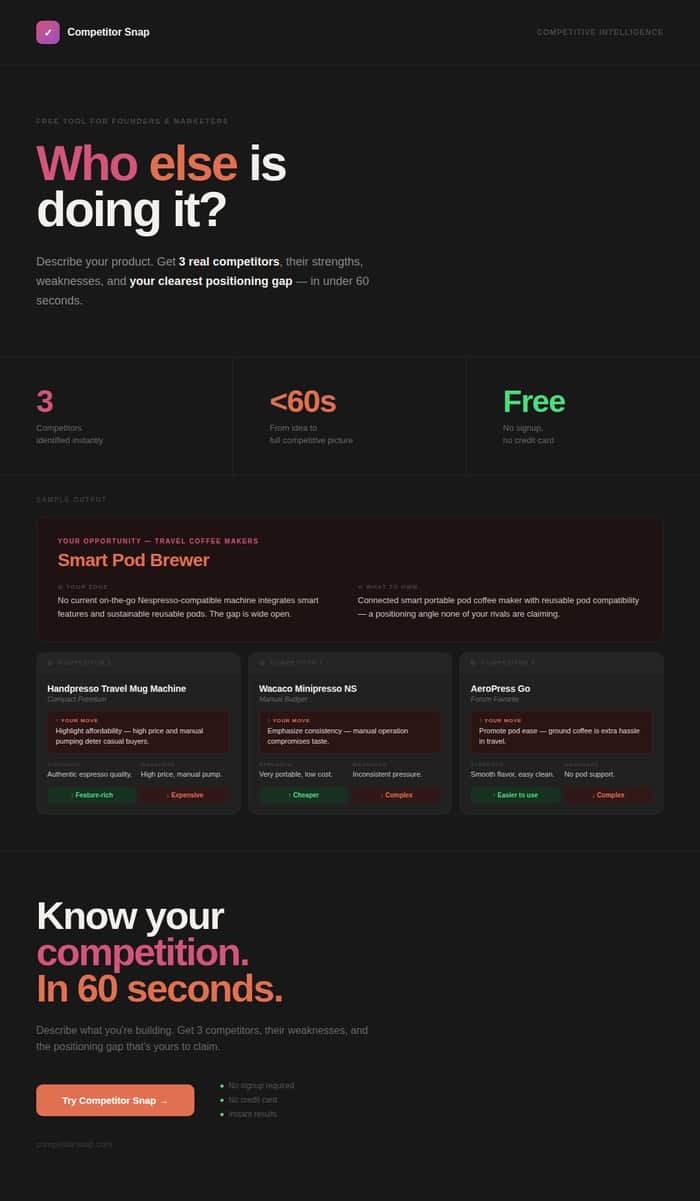
you describe your product. CompetitorSnap gives you >3 real competitors, what each one does well, where each one is weak, and - most importantly - your clearest opportunity given what they're all missing.
no login. no setup. you type, it thinks, you get a competitive picture in under a minute.
it's not a replacement for the deep research. job listings, customer interviews, win/loss conversations - those still matter and nothing automates them. but the first layer? the "who are we actually up against and what are they leaving on the table" question that should take 30 seconds and currently takes 3 hours? that part is solved.
try it at competitorsnap.com (https://www.competitorsnap.com/) - describe what you're building and see what comes back.
curious what people find. especially interested in: does the opportunity framing surprise you, or does it match what you already suspected?

Interesting and very useful tool for first time founders.
Can I share this on GrowthStash.io ? I run this directory of growth strategies shared by indie founders.
All the best with this project!
please do - that would be great. first-time founders are exactly who this was built for. the experienced ones have usually built an intuition for reading between competitor lines, but that doesn't mean they can't use it :). earlier stage, you don't even know which competitors are worth watching yet. that first orientation layer is where a lot of time gets wasted.
thanks for building GrowthStash, by the way - that kind of curated resource is underrated for founders who don't know what they don't know yet. would also love for you to check out competitorsnap.com and let us know what you'd add or remove - we're early and very open to all opinions.
The competitor angle is especially useful when users describe the same product with different jobs-to-be-done. With Kinetic Override, one person calls it an Android auto clicker, another calls it a macro recorder, another just wants to record taps/swipes. Mapping those phrase clusters is almost more valuable than a normal feature comparison.
this is a sharp observation and it points to something the tool actually has to handle - because when you describe Kinetic Override as "Android auto clicker" vs. "macro recorder," you'll likely get different competitors surfaced. which is partly the point. the real competition for each framing is different, even if the product is the same.
what i find interesting in your example: did you end up finding a single frame that unified all three buyer intents, or did you effectively build different messaging tracks? because that choice: one positioning vs. multiple - is one of the harder calls for a product like yours. curious how you landed.
Interesting angle.
The thing I'd be careful with is that finding an opportunity and deciding which opportunity is worth owning are not the same problem.
A lot of founders get stuck not because they can't see the gaps, but because multiple gaps look plausible at the same time.
That sounds like a small distinction, but it tends to affect much bigger decisions than people expect.
I wouldn't make that call casually in a thread.
that distinction is underrated. most founders i've seen get stuck at exactly that point - not because they missed the gaps, but because two or three looked equally real at the same time, and the cost of picking wrong only becomes clear six months later.
the research layer can help narrow the field but you're right that it doesn't resolve the judgment call. what have you found actually moves the needle when you're stuck between two plausible bets?
Possibly.
The reason I keep stopping short is that the useful part isn't the observation.
It's making the actual call when multiple paths all look reasonable.
I wouldn't unpack that casually in a thread.
If you'd like the tighter version, drop your email and I'll put it together properly.
The "what competitors leave open" framing is sharp. Most tools (Crayon, Klue, Kompyte) surface what competitors do, not what they're ignoring. Gaps are more useful for positioning.
Honest pressure-tests:
AI surfacing weaknesses from landing page copy alone misses what actually matters — feature gaps, pricing strategy holes, support response times, integration coverage. Landing pages are marketing artifacts, not product reality. Worth being explicit about what the tool sees vs doesn't.
"No signup" is great for trial but probably bad for retention. No memory, no comparison over time, no alerts when competitors update. The signed-up version needs to do deeper work to justify paid.
Real positioning angle: you're not competing with Crayon ($50K+/year enterprise). You're competing with "founder typing competitor names into ChatGPT for an hour." Different positioning than existing competitive intelligence category.
What's the model doing — pulling live competitor sites or matching against pre-built database? That affects how to position the depth question.
thank you for the precise feedback and questions, Hire_Hivemind! "what's the model doing - pulling live competitor sites or matching against pre-built database?"
it draws on multiple sources and methods to lift up the most relevant results. these include llm web search, a given LLM model's knowledge base, and a proprietary database we maintain for use by this and our other growth tools (mainly Crowdfunding AI). that database is focused on data quality and representation across e-commerce product categories, not just quantity. within these we also split the calls between multiple models/methods and measure the results. that lets us see which models or tools are doing the best work for a given step in the workflow.
the more you interact with your competitor snap results, the better they will be. that is, answer a couple questions and press "+3." it's learning as it goes.
we may incorporate live competitor site data in the future. it's more likely we will first focus on getting third party review data from sources like Google Shopping and Amazon, per the point you made re: "landing pages are marketing artifacts, not product reality." (it's unlikely to give enough ROI to build out today, but i'm also curious about grabbing comments on a brand's ads. you can learn a lot from a post that's been ratio'd.) if you have requests, drop them in the feedback box below the competitor results!
questions for you:
and an easter egg. wait for the first results to load, then scroll all the way down and hover over the copyright info. you will see the name of the model that kicked off your results.
The e-commerce database focus is the most useful thing in your reply — it changes my read. CompetitorSnap for e-commerce sellers is a sharper category than generic SaaS competitive intel, and the review-data direction (Google Shopping, Amazon) fits that wedge way better than live site scraping would. For physical products, reviews ARE the product reality. Lean into that.
The ratio'd-ads insight is genuinely sharp. Comments on a brand's underperforming ads surface the objections the brand won't admit on their own site. That's competitor weakness data nobody's systematically mining.
On your questions:
Point #3 — what helps discern next steps: the gap between "here's a competitor weakness" and "here's what you do about it." Most tools stop at the weakness. The next-step value is connecting the weakness to a specific move — "Competitor X has no sizing guide and reviews complain about fit → lead your PDP with fit confidence." Weakness + the positioning move it unlocks. That's the layer that turns research into action.
Deeper live site data in paid version: for e-commerce specifically, less valuable than review/ad data. Sellers don't need competitor homepage analysis — they need "what are buyers complaining about across the category that I can solve." Live site data is a SaaS-competitive-intel need. Review aggregation is the e-commerce need. Pick based on which ICP you're actually serving.
Which is the real focus — e-commerce sellers (your database suggests this) or general founders (your post framing suggests this)? Those are different products. The e-commerce angle looks more defensible given what you've already built.