We built Avenir because founders are optimizing for upvotes instead of inevitability
Over the past few years, something strange has happened in the startup world.
Building became easy.
Shipping became fast.
Launching became performative.
Validation slowly turned into a game of:
- upvotes
- launch-day noise
- short-lived attention
Product Hunt is the clearest example of this shift.
It’s not broken — it just validates a very specific thing: can your product create immediate reaction?
But reaction ≠ inevitability.
A lot of strong ideas fail quietly because they don’t fit a 30-second launch narrative.
And a lot of weak ideas look successful because they do.
That gap is what led us to build Avenir.
What Avenir actually is
Avenir is not a launch platform.
It’s not a feedback tool.
And it’s not another “validate your idea” checklist.
It’s an observation layer for early-stage ideas.
Instead of asking:
“Will people upvote this?”
Avenir asks:
“Does this idea generate signal when exposed to reality?”
Why the design looks the way it does
Everything about Avenir’s design is intentional.
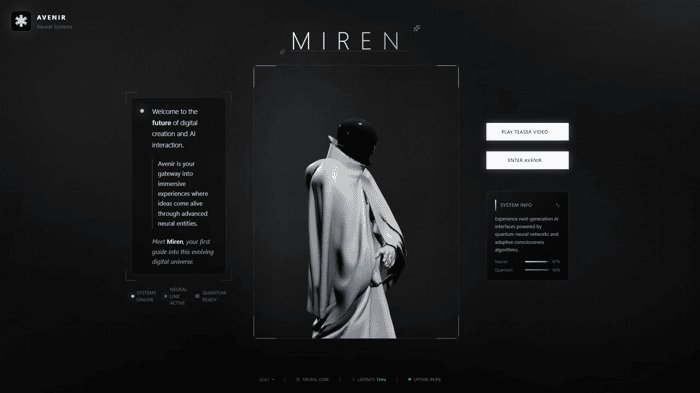
Terminal-style navigation
We chose a terminal interface because builders don’t think in marketing flows — they think in intent.
Commands, clarity, directness. No unnecessary UI noise.
3D pre-home environment
The pre-home experience isn’t decoration. It’s a psychological filter.
If someone is curious enough to enter, they’re already engaging with the idea of futurism and systems — not just tools.
Futuristic palette & minimalism
Most startup tools try to feel friendly.
Avenir tries to feel inevitable.
This isn’t nostalgia or aesthetics-first design.
It’s about setting the mental frame before interaction.
The core systems inside Avenir
1. Billboard (public exposure layer)
Ideas go live publicly with minimal context.
No decks. No long explanations.
Just the idea, exposed.
We observe:
- attention
- interaction
- patterns over time
Not opinions.
2. Avenir Picks
As patterns emerge, some ideas clearly pull more signal than others.
Avenir Picks is a curated layer that highlights ideas that demonstrate long-term potential — not short-term hype.
3. The Pulse
The Pulse tracks emerging themes, recurring problems, and shifts in what founders are trying to build.
It’s less about trends and more about inevitable directions.
4. Marketspace
Marketspace maps ideas against real-world demand, category saturation, and long-term relevance.
It’s designed to help founders understand where they’re building — not just what.
Why this was necessary
Founders are not failing because they lack motivation or tools.
They’re failing because they’re optimizing for the wrong signals too early.
Upvotes feel like validation.
Encouragement feels like progress.
Neither predicts outcomes.
Avenir exists to shift the focus from:
- storytelling → signal
- hype → clarity
- reaction → inevitability
Who Avenir is for
Avenir isn’t for everyone.
It’s for founders who:
- want to understand why ideas work, not just if
- are willing to expose ideas early
- care more about long-term relevance than launch-day metrics
If that sounds like you, you’ll probably feel at home here.
This is not a launch in the traditional sense.
It’s the beginning of a different way to think about ideas.

The difference between novelty and usefulness is huge. Avenir sounds interesting if it helps surface what people are actually ready to adopt, not just what sounds good on paper.
The distinction between reaction and adoption is huge. So many platforms reward things that are easy to react to but hard to actually use consistently. If Avenir can surface ideas that generate pull without heavy explanation, that alone would be valuable.
The idea of an “observation layer” really stood out to me. Most tools either hype you up or tear you down with feedback, but neither actually helps you see how ideas behave in the wild. Watching patterns emerge over time feels way more aligned with how real markets work.
What stands out to me is the idea of reducing cognitive load. The less someone has to understand before they act, the more likely adoption actually happens. Pull beats persuasion almost every time.
The design choices actually make more sense after reading this. At first glance the terminal navigation and futuristic feel might seem intimidating, but framing it as intentional — almost a filter — clicks. It’s refreshing to see a product that isn’t trying to be universally friendly.
I appreciate that this doesn’t position Avenir as anti–Product Hunt, just honest about what PH optimizes for. Reaction and inevitability are very different things. I’ve seen boring ideas quietly win because they solved something obvious, and flashy ideas die after launch week. This seems designed to surface that difference earlier.
The philosophy is compelling, but there’s a risk that intentional friction becomes exclusion instead of focus. A terminal-style interface and heavy abstraction might filter for curiosity, but it can also filter out good thinkers who don’t want to fight the product to understand it. Clarity shouldn’t require decoding. If Avenir leans too hard into “not for everyone,” it may confuse selectiveness with usability and limit the very signal it’s trying to surface.
I completely agree. There’s a line between creating focus and creating unnecessary barriers. I like the idea of intentional friction, but if it starts feeling like a puzzle just to use the product, it risks losing the very people whose insights matter most. Clarity and accessibility don’t have to compromise depth, and striking that balance seems key for Avenir to actually surface any meaningful leads or long term usability.
What’s interesting here is the shift from explaining value to revealing it. When people instantly see where something fits, adoption feels less like a decision and more like a reflex.
The Pulse and Marketspace concepts are interesting because they move the focus away from individual ideas and toward patterns. Most founders obsess over their own product, but the real leverage often comes from understanding where the broader momentum is forming.
What resonates most is the idea that encouragement is a weak signal. Startup communities tend to overcorrect toward positivity, which feels nice but often delays hard decisions. A system that prioritizes clarity over comfort feels uncomfortable — and probably necessary.
This hits close to home. I’ve launched on Product Hunt before and walked away more confused than informed. The upvotes felt good for a day, but they didn’t really tell me whether the problem was urgent or if people would come back a week later. Framing validation as observation instead of reaction feels like a healthier mental model.
Avenir has an interesting approach, but right now it feels like philosophy could be outweighing practicality. The terminal interface and abstraction might filter users, but that doesn’t automatically help them make better decisions. Founders don’t just want to explore patterns they want tools that actually change what they do next. Observation is nice, but without actionable guidance, it risks becoming something people look at and then forget. If Avenir wants to be truly useful, it needs to turn those patterns into concrete next steps. Otherwise, it might end up being fascinating to talk about, but hard for teams to rely on day to day.
What stands out is how Avenir treats uncertainty as a feature, not a bug. Most tools try to erase ambiguity for founders, but real progress usually starts with sitting in it a bit longer. That restraint feels rare.
A lot of founders try to manufacture demand. It’s usually stronger to notice where demand is already forming and then remove friction from it.
Adoption happens when a product becomes invisible in the workflow. If users have to think about using it, you’ve already lost some momentum.
There’s something powerful about not optimizing for dopamine. A lot of platforms confuse engagement with usefulness. If Avenir resists that and focuses on long-term signal instead of short-term reaction, it could change how founders actually think.
I appreciate that it doesn’t frame every idea as a future unicorn. Most products push optimism, but realism builds better founders. Knowing why something won’t work is often more valuable than hearing that it might.
Pulse and Marketspace shift the focus from ego to environment. Instead of asking “Is my idea good?” you start asking “Is the world ready for this?” That’s a much harder and more useful
Most feedback loops are built around reactions, not outcomes. The platforms that win long-term are the ones that optimize for what users actually keep coming back to.
Most platforms optimize for clicks, not commitment. It’s easy to get reactions, much harder to earn habits. Anything that bridges that gap is already playing a different game.
This comment was deleted 8 months ago