We just shipped our 300th product — here's what fixed-price AI engineering actually looks like at scale
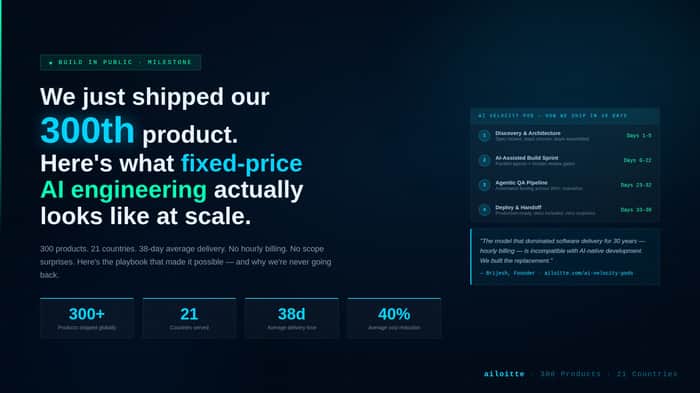
Three hundred products. Twenty-one countries. Thirty-eight days median delivery.
I want to write the honest version of this post, not the press release version — because most milestone posts skip the parts that actually took years to figure out.
What the Number Means
300 products is a lot of scoping calls, a lot of post-mortems, and a lot of moments where we had to decide whether to absorb cost overruns or go back to a client. The number isn't impressive on its own. What it represents is a repeatable system — and that took longer to build than any individual product.
What Actually Works
- Governed agentic workflows, not just AI tooling: The difference matters. Dropping an LLM coding assistant into a standard delivery process makes developers faster. Building a workflow where AI agents operate inside defined checkpoints, with human review at critical junctures, makes the output predictable. That's what clients are actually paying for — not speed in isolation, but speed they can trust.
- Outcome-based pricing as a governance mechanism: Fixed-price contracts forced us to build this. When you absorb delivery risk instead of billing for it, every inefficiency in your process costs you directly.
What Failed
1. Scoping (Repeatedly)
Early engagements where the scope was loosely defined cost us margin and, more expensively, trust. We now spend more time on pre-engagement definition than most vendors spend on the first delivery sprint. That investment pays back on every project that doesn't drift.
2. Underestimating Compliance Overhead
We underestimated compliance overhead in regulated industries. ISO 27001 and HIPAA/GDPR built into delivery architecture sounds like a differentiator on a sales call — and it is — but operationalizing it across every engagement took significant investment to get right.
What We'd Do Differently
Build the governance layer first, not after the first client escalation. We learned our milestone accountability framework from pain. We could have learned it from first principles.
What We're Still Figuring Out
How outcome-based pricing should evolve as AI reduces effort further. When a product that took 400 dev-hours in 2023 takes 180 in 2026, how should fixed prices adjust? We don't have a clean answer yet.
If you're thinking through fixed-price AI delivery or outcome-based contract structures, the case data is at ailoitte.com/roi-case-studies. Happy to dig into specifics here.
What's the hardest governance problem you've hit at scale?
Tags: #buildinpublic, #milestone, #AIengineering, #startups, #productdevelopment

The pricing question is especially interesting. If AI cuts delivery effort but the vendor still owns the scope, quality, compliance, and failure risk, pricing purely around hours no longer makes sense. Perhaps fixed pricing should gradually reflect the value and risk of the outcome rather than how quickly the team can produce it.