We launched Zo Computer. My thoughts on how to launch a product.
We launched Zo Computer 2 weeks ago, and it was a great success.
Zo is an intelligent cloud computer that helps you turn ideas into reality fast. You can store your files, connect your tools – and then research or build practically anything with AI. Because Zo is a server, you can host anything – your projects, a Plex media server, self-hosted n8n, you name it. You can even text your Zo – turning your cloud computer into a personal assistant.
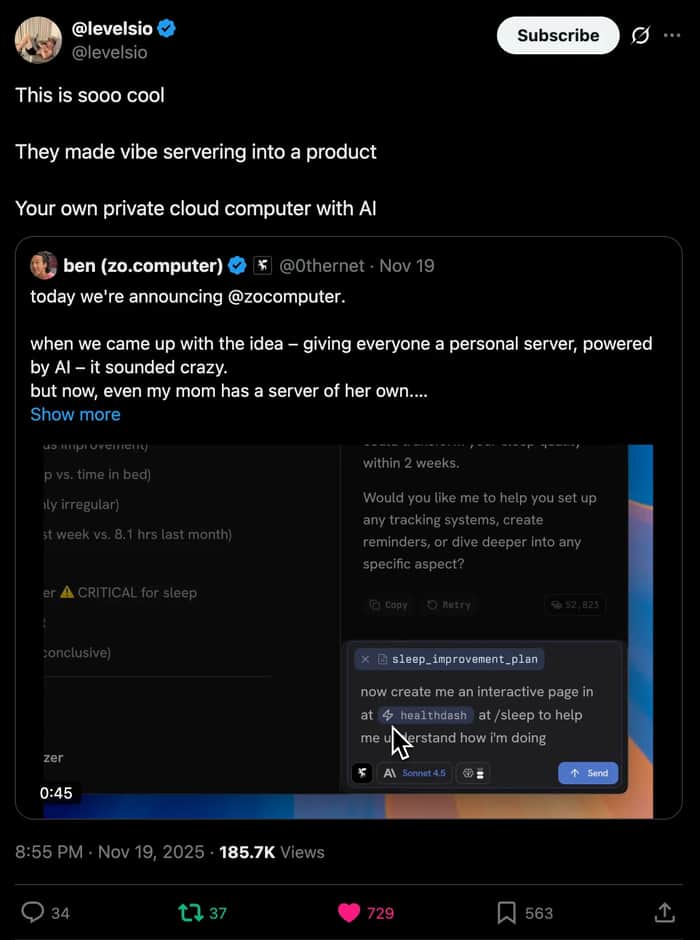
On launch day, we were trending on X, with over half a million views on my post alone, and got a huge spike in signups. Even 2 weeks later, hundreds of people are signing up every day (and we haven’t even turned on ads yet – it’s all from the launch).
My favorite moment was a quote tweet from Pieter Levels, someone I’ve long admired: https://x.com/levelsio/status/1991324565495247295
Our launch video wasn’t fancy. In fact, we started working on the video 3 days before. The timeline:
- On Sunday, my cofounder Rob and I walked around lower Manhattan with a DJI Osmo Pocket, reciting lines.
- On Tuesday, Rob was busy editing footage and recording a product demo.
- At 3am on Wednesday, I recorded some simple background music in Ableton.
- At 7am, I woke up after a long nap and rewrote my personal launch post, turning it into a story about my mom.
- At 9am, the team got together for a final editing pass across all the posts.
Storytelling is arguably the most important ingredient in a successful launch – but we kept putting it off. We had a lot of ideas brewing in the background, but it wasn’t until 2 weeks before launch that we really started dialing in our video script, positioning, website copy, and launch posts.
We’d workshop copy until late in the evening, agree that we “finally had it” – and then wake up the next morning to scrap it all. I was beginning to feel like I was losing my mind, stuck in a never-ending cycle of rearranging the same words and ideas. But the process of exploring all the possible branches was crucial to eventually landing in the right place.
We considered so many possibilities for the video. Hiring a professional filmmaker. Contracting with a motion designer. Playing off the original Steve Jobs iPhone announcement. A sizzle reel about the history of computing, and the vibrant early internet. But in the end, we decided to keep it simple: a brief introduction, some interesting scenery, and then a product demo.
Reflecting on the journey, here’s the advice I would’ve told myself a month ago:
-
Draft your positioning right now. 1 sentence, 3 sentences, 5 sentences.
-
Draft the launch post right now. You’ll have a lot of things to say. It will take many iterations to realize you don’t need to say most of them.
-
Ignore the siren song of cinematic performative startup launch videos. Zig when they zag.
-
Keep it personal. “AWS for my mom” was a great hook.

Ben, this is an insanely inspiring breakdown.
The simplicity of the launch + personal storytelling is exactly why Zo resonated ,it felt real, not over-produced.
What’s even more interesting is how much organic momentum you’re still getting 2 weeks later.
If you ever explore Reddit as an acquisition channel, Zo could explode there. Communities like r/selfhosted, r/SideProject, r/automation, and r/AItools would love this angle , especially the “host anything + personal AI assistant” part.
Happy to share a quick sentiment check and community mapping if you’re curious. No strings attached , just love seeing products like Zo win. 🚀
As someone who helps founders launch on Reddit, this breakdown really resonates. A lot of people overcomplicate launches, but what you showed here is exactly what tends to perform best on community-driven platforms: clarity, a personal angle, and a product people can immediately understand.
The simplicity of your video and the focus on storytelling were smart moves. On Reddit especially, polished “startup-cinematic” launches often get ignored, while authentic, founder-led stories spark conversation and organic traction. “AWS for my mom” is the kind of hook that would land well in multiple tech subreddits because it instantly communicates both purpose and humanity.
And your point about iterating on positioning is spot on. From what I’ve seen, the founders who rewrite their core message 20+ times usually end up with the clearest narrative and the clearest narrative wins attention.
Huge congrats on the momentum so far. Zo Computer has the kind of utility and personality that communities genuinely respond to. Looking forward to seeing how it grows next.
thank you!