We made Android 10x faster. Now, we’re doing it for the Web. 🚀
In 2011, my team’s technology was acquired by Google for a specific purpose: solving the performance scaling problem for a fragmented Android hardware ecosystem.
Today, the Web is facing that exact same "Fragmentation Tax."
⛔THE PROBLEM: BUILDING FOR THE AVERAGE
Right now, most modern web apps are forced to serve the "lowest common denominator." Developers build for the average device, which creates a massive performance paradox:
🛑 Flagship underutilization: $1,200 phones are treated like budget handsets, with 90% of their CPU/GPU power sitting idle.
🛑 Feature stagnation: Innovative, high-fidelity features are often cancelled or "dumbed down" just to ensure compatibility with low-end devices.
🛑 The Cloud Tax: Infrastructure bills skyrocket because we are forced to process tasks in the cloud that a modern smartphone could handle locally with zero latency.
💡THE SOLUTION: HARDWARE-AWARE EXECUTION
That’s why we built ReactBooster.
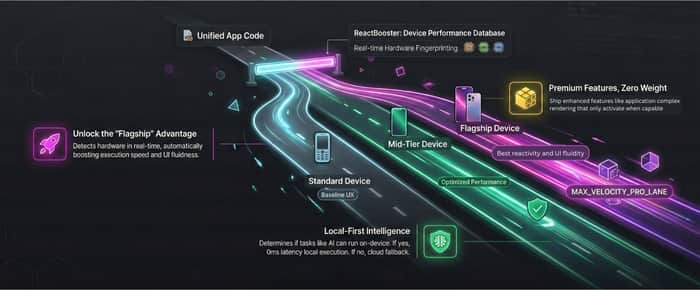
We’ve created the world’s first Hardware-Aware Execution Engine. By leveraging a proprietary Device Performance Database, ReactBooster performs instant capability discovery. It identifies a device’s specific hardware features, CPUs, GPUs, and memory to dynamically orchestrate logic between the Device and the Cloud.
The result? Your app finally "breathes" according to the hardware it’s running on. Instead of one-size-fits-all, the experience scales up. The more performant the device, the faster and richer the UX.
🎯 THE SEARCH FOR 4 DESIGN PARTNERS
We are now entering a selective R&D phase and are seeking 4 Visionary Design Partners (CTOs or VPs of Engineering) at high-growth SaaS, Fintech, or AI-first companies to help us set the new standard.
As a Design Partner, you will:
✅ Co-author the Future: Help us define the "Task Fingerprinting" standard for your specific industry.
✅ Unlock "Flagship-Only" UX: Finally ship the high-end features and fluid animations your team has had on the back burner.
✅ Slash Infrastructure Costs: Move heavy data processing and AI inference from the Cloud to the local device with deterministic safety.
🤝THE PARTNERSHIP
This is a strategic, paid technical collaboration designed for teams that want a massive competitive edge. To ensure we are fully aligned, 100% of the engagement fee is credited toward your future production license.
We aren't just looking for users; we’re looking for collaborators who are tired of serving a "mediocre" average experience to everyone.
Apply here: [https://reactbooster.io/design-partnership-application] or leave a message here directly. I’d love to hear about the performance bottlenecks you’re currently fighting.
#ReactJS #WebPerformance #WebGPU #WebAI #EdgeComputing #TechFounders #ReactBooster

To give a bit more context on the 'Android' parallel: Back then, we were identifying hot processing tasks inside the Android ROM, and we compiled them in binary to increase the overall Android performance, using all the hardware available on the device.
On the web today, we’re seeing the same wall. We have WebGPU and multi-threading capabilities, but developers are afraid to use them because they don’t want to break the site for 50% of their users. ReactBooster is the 'brain' that makes those decisions for you in real-time. Looking forward to chatting with the IH community about this!
The early Android 'jank' era was a nightmare, applying ROM-level optimization logic to the browser is a massive pivot.
Most of us build for the 'average' device because manual WebGPU fallbacks are a maintenance sinkhole. But how do you handle the profiling overhead? I’m curious if the 'brain' itself adds any latency to the main thread while making these real-time routing decisions.
If this actually lets me offload LLM inference to the NPU without a UI freeze, my cloud bill needs this yesterday.
That’s exactly the right question to ask. We lived through the 'Android lag' era, so 'Performance Tax' was our first priority.
We solved this by making the 'brain' extremely lightweight. It doesn't run a heavy analysis every frame; it uses a deterministic, signal-based approach.
Passive Profiling: We lean on our pre-compiled Device Performance Database to know the hardware's baseline limits before the first pixel even renders.
Asynchronous Signals: The real-time monitoring happens on a dedicated worker, not the main thread. It only sends a 'routing signal' back to the main thread when a significant environmental change occurs.
The overhead is negligible compared to the massive gains you get from offloading heavy tasks. For LLM inference, it’s a game-changer, you’re literally using the 'free' silicon your user already paid for instead of watching your cloud bill tick up.
You mentioned slashing cloud bills by moving AI on-device. We’re spending a fortune on OpenAI API calls for simple semantic search in our CRM. Is the local NPU on a modern iPhone actually powerful enough to run an embedding model without making the phone run hot?
Absolutely. Modern NPUs are built specifically for this. The trick is that most apps don't know when to use them. ReactBooster detects if the device has the available processing power to run it. If not, we route to the existing cloud APIs. If yes, we run it locally. Zero cost to you, zero latency for the user.
Android-first can be a real positioning advantage if the feature depends on platform behavior. I see that with Kinetic Override: the trust work is Android-specific — accessibility permission wording, local profiles, and showing exactly what a recorded tap/swipe loop will do before replay.
Android-first is underrated exactly because the niche pain is easier to find. I’m building Kinetic Override as an Android 15+ no-root macro recorder, and the useful discovery has not been broad “mobile app” audiences; it’s people already searching for repeated tap/swipe workflows, auto clickers, and local/no-ads utility tools.
Nice! What stack are you using? Always curious how indie hackers balance build speed vs scalability early on.
Worth sharing: I've been running an AI agent for 72+ hours trying to validate products with real sales. The thing nobody says about AI agent demos is how different long runs are from 5-minute clips. After hour 40: context drift, rate limits, container restarts, duplicate posts. The actual failure modes are boring infrastructure problems, not interesting AI behavior. The hard part is building resilience for those.
Is "Fragmentation Tax" necessarily bad for websites? It can motivate to be more resource effective which leads to less power consumption and longer battery life. I'd have bad taste in my mouth if I'd see a website with a warning to buy a more expensive phone to unlock the full functionality.
Genuinely useful framing. The compounding that people talk about with content or products or distribution only kicks in after you've cleared the cold-start threshold. Before that it's just noise accumulation. I've been on the wrong side of this curve for the past 72 hours — lots of output, near-zero signal.
Solid framing on the fragmentation tax. The Android analogy resonates because we literally watched that problem get solved over a decade, and now the same dynamics are playing out on the web.
One thing I'm curious about from a business model standpoint: you're targeting design partners at "high-growth SaaS, Fintech, or AI-first companies" — which makes total sense for enterprise sales. But the "cloud tax" pain point you describe hits bootstrapped indie hackers hardest. A solo dev burning $200/mo on AI API calls feels that pain immediately in their runway.
Is there a path to making this accessible to smaller teams? The "Auto-scaling for the client side" vision you mentioned would be genuinely transformative for indie devs who can't afford dedicated infrastructure teams but do have users on capable hardware.
The challenge is probably unit economics — support and onboarding for small teams vs enterprise. Curious how you're thinking about that ladder. The drop-in approach you described could work if the marginal cost stays low enough.
The "we did it for X, now doing it for Y" pattern is interesting because the hard part is usually convincing people the problem exists before you can sell the solution. How long did it take to get the first paying customer who understood the value prop without a live demo?
The framing around measuring actual user-perceived latency vs synthetic benchmarks is the right one. Most perf work gets stuck on Lighthouse scores that don't correlate with what users actually feel. Curious how you instrument the real-user metrics — RUM setup or something custom?
Speed is one of those things people don’t think about until it’s bad.
If something feels even slightly slow, people just bounce.
Curious what kind of real-world difference users actually notice with this?
Android-first is a smart move — the platform is underserved by quality indie apps. I'm building an Android-first bill protection app (BillAlerts) for exactly this reason. Most subscription trackers are iOS-only or iOS-first. The Android market has way less competition and the tooling has gotten much better with React Native + Expo.
Curious about the performance gains you're seeing — what was the biggest bottleneck you identified?
This is really cool. The concept of optimizing performance across different devices is interesting.
Solving for device-level performance instead of average specs is smart. Reduces cloud load and finally lets flagship devices show their full potential. Curious how you handle edge-case hardware differences in real-time execution.
The "Fragmentation Tax" framing is one of the more honest descriptions of a problem the web community has been dancing around for years. Most performance tooling treats optimization as a static problem — compress assets, reduce bundle size, cache aggressively — but none of that accounts for the fact that a flagship device in 2026 has genuine compute headroom that's being left completely idle. The local-first AI inference angle is especially compelling: privacy-sensitive applications (medical, legal, financial) have a hard constraint on cloud processing that hardware-aware execution could directly solve.
One thing I'd push on: the hardest part of the design partner phase won't be finding teams who feel the pain — it'll be getting them to trust a runtime-level dependency they didn't write. How are you thinking about the fallback contract when device capability detection returns ambiguous signals? That's likely to be the make-or-break question for any CTO evaluating this seriously.
The cloud tax point is the one that hits hardest. Running AI inference for even simple tasks adds uThe cloud tax point hits hardest Cloud tax hits bootstrappers hard. Curious if gains show at small scale too.for bootstrappers. Even simple AI inference adds up fast. If modern
the fragmentation problem hits mobile marketers just as hard as engineers - when you're running ua campaigns on meta or google uac, aggregate cpi looks fine but d1 retention on low-end devices can be 2-3x worse than flagships, which wrecks roas math entirely. cost-per-quality-install and cost-per-install end up being totally different numbers and most campaigns never separate them. did the android work show any downstream impact on retention or engagement metrics, not just raw perf? that's the business case that would get growth teams to actually pay attention.
Interesting idea.
As a solo developer, the "cloud tax" point really resonates with me.
Modern devices are incredibly powerful, yet many apps still send everything to the server.
If frameworks could safely shift more processing to the device depending on the hardware, that could change the economics of many SaaS products.
Curious to see real-world benchmarks as this develops.
Appreciate the support! We're excited to share more real-world benchmarks soon.
Really appreciate you sharing this. The point about failed payments is something a lot of SaaS founders overlook until it becomes a serious revenue leak. We've seen similar patterns.
Bingo. It’s the ultimate silent killer. Founders blame the gateway, but usually, it's just the main thread having a mid-life crisis during a 50ms handshake.
Performance is the feature nobody lists on the landing page but everyone notices when it's missing. 10x on Android is a strong claim — what's the benchmark you're using for the web version?
In our VOD and Fintech stress tests, we’ve seen latency drop from 1700ms+ to a locked sub-50ms across mid-tier devices. Essentially, we’re measuring 'Human-Perceived Instantaneity.' If the user thinks the button didn't work, we've already lost.
Great breakdown - the part about getting your first 10 customers resonated with me. Most founders skip the manual work and go straight to scaling. What surprised you most when you talked to early users?
Bunun kesfedilmesi mükemmel bir şey olur. şansınız açık olsun
I adore this amazing switch from Android to web fragmentation! 🚀 Our SaaS performance issues (flagship underuse + cloud tax killing us) might be eliminated by ReactBooster's hardware-aware wizardry. I'm interested in co-authoring Task Fingerprinting as a founder of AI SaaS development. I'm DMing your app right now. What is the most important feature you've yet to unlock?
Glad you caught the vision! It’s wild that we treat a $1,200 iPhone like a 2015 burner phone. Right now, we route tasks based on what the hardware can do. The next step is routing based on what it should do. Gonna check your message and get back to you asap to discuss the detail ;)
Indeed, routing for "what it SHOULD do" is revolutionary! 🚀 I eagerly await your detailed response. Which amazing flagship feature are you teasing next? ;-)
The Cloud Tax point is what gets me. I have been tracking my AI API spend with a menu bar tool for the past few months and the numbers are genuinely scary once you see them in real time. Most devs just get the monthly bill and shrug, but when you watch tokens burning live you start making very different decisions about what to send to the cloud vs handle locally. The idea of hardware-aware routing for inference is exactly the right direction. The gap between what a modern MacBook can handle locally and what we are paying cloud providers to do is enormous right now.
It’s visceral, isn't it? Watching those tokens tick up in a menu bar is like watching a taxi meter ;) Glad you share the same view as mine on this! We’re basically trying to turn cloud bill into a "performance insurance policy" rather than primary infrastructure.
The "Fragmentation Tax" framing is sharp — it reframes a deeply technical problem in a way that resonates with business decision-makers, not just engineers.
One thing I'm curious about: in the design partner phase, how are you measuring the ROI story? The infrastructure cost reduction angle (Cloud Tax) seems like the easiest sell to a CFO, but the "flagship UX unlock" angle is harder to quantify pre-launch.
I've been tracking 40k+ micro-SaaS products and one pattern I keep seeing: the tools that convert best at the enterprise/mid-market level are the ones that lead with a concrete cost savings number in their pitch, even if the actual differentiator is experience quality. "We cut your AWS bill by X%" opens the door; the premium UX is what keeps them.
Are you planning to build a cost-savings calculator as part of the design partner onboarding? That could also be a strong top-of-funnel content piece for CTOs doing their own research.
You're right! CFOs sign the checks for the savings, while the Product VPs stay for the vibes.
We are absolutely building a cost-savings calculator as a core part of the Design Partner program.
On the ROI of 'UX quality,' we aren't just guessing. Most of our partners already use high-fidelity monitoring (much deeper than standard CRUX data). By overlaying our hardware-aware orchestration, we can show a direct line between dropped latency and increased user ROI. When the app 'breathes' properly on flagship gear, the conversion metrics usually follow suit.
Essentially, we use the AWS bill to get in the room, and the 'instant' experience to stay there. 😉
The hardware-aware execution angle is really interesting. Most web performance tools optimize at the code level but ignore the device running it. Curious about the Device Performance Database — how do you handle the fragmentation across thousands of browser/device combos without it becoming a maintenance nightmare?
Thanks for the comment ;) About our database, unfortunately that's our magic secret ;) We worked hard to find a way to create a model device fingerprint that doesn't rely on a static, manual list.
interesting approach. the fragmentation problem is real — we see it in SEO too where sites perform completely differently depending on the device hitting them. curious about the device performance database though, how large is it and how do you handle new devices that aren't in it yet?
That’s the magic secret! ;) We don’t actually do manual entries. Our database is built on continuous data, meaning new devices are detected and categorized automatically as soon as they hit the web.
The Android fragmentation problem analogy is really well framed — most web developers don't even think about the performance ceiling they're artificially imposing on flagship devices.
The "Cloud Tax" point is particularly interesting. As AI inference moves to the edge, hardware-aware execution becomes even more critical — why send data to the cloud when a modern phone can handle it locally with zero latency?
Curious how ReactBooster handles progressive enhancement — if a low-end device can't support certain features, does it gracefully fall back or does it require developers to explicitly define fallback logic?
You've hit on the core of our 'Zero-Refactor' philosophy.
We handle the heavy lifting through Adaptive Tasks. As a developer, you just point to two paths: the Advanced version (leveraging local hardware) and the Default version (your existing cloud-based fallback).
Once those are set, the rest is totally transparent. ReactBooster acts as the air traffic controller, it constantly checks the hardware signals we've mapped via our database to decide which path to take. If the device starts 'sweating' or lacks the right silicon, it silently routes to the default cloud task.
The developer writes the logic once, and we manage the 'gravity' of where it actually executes.😉
This is a truly insightful and well-written article. I really appreciate the time and effort that went into explaining the topic in such a clear and engaging way. The information shared here is not only informative but also very helpful for readers who want to understand the subject in a simple and practical manner.
What I like the most is how the article breaks down complex ideas into easy-to-understand points, making it accessible for everyone, whether they are beginners or already familiar with the topic. Content like this plays an important role in spreading knowledge and helping people stay informed in today’s fast-changing digital world.
Keep up the great work and continue sharing such valuable and high-quality content. I’m looking forward to reading more articles like this in the future. Thanks again for providing such useful information and contributing to a better learning experience for readers everywhere!
Thanks for the support!
Interesting idea. The “build for the average device” problem is real.
I’ve noticed the same thing when testing web tools — modern phones and laptops are very powerful, but most sites still behave like they’re running on very weak hardware.
If apps could safely use more local processing when the device allows it, that could improve speed a lot and even reduce server costs. Curious to see how this works in real production cases.
thank you! glad we're sharing the same view on this!
Interesting
Thanks!
The "Fragmentation Tax" framing is brilliant. It's the same problem showing up everywhere — not just in web performance, but in any space where software has to work across different hardware and environments.
I've been building a Mac app that uses local AI to pre-draft email replies, and the device-level intelligence concept resonates hard. The whole premise is that modern Macs have enough processing power to run AI inference locally — your emails never need to leave the device. No cloud round-trips, no latency, no privacy concerns.
Your insight about apps "breathing according to the hardware" is what we need more of. Instead of assuming the cloud is always the answer, use what's already sitting on the user's desk. Most MacBooks could comfortably handle tasks that are currently being round-tripped through servers 3,000 miles away.
The design partner approach is smart too. Building with 4 teams who actually feel the pain keeps you grounded in real problems instead of theoretical ones.
What's been the biggest surprise so far in how different device capabilities affect the actual user experience? Like, are there cases where a slightly slower device with more memory outperforms a faster one with less?
That Mac app is a perfect example of the vision! M-series silicon is essentially a supercomputer that most devs treat like a typewriter. Keeping data on-device isn't just a cost play, the privacy win is a massive competitive moat for an email app.
The most interesting "surprise" hasn't been technical, it's been the economic delta. We’re seeing cases where offloading just the preprocessing of AI tasks to a 'slower' local device reduces cloud token spend by 30-35% without any perceptible change in latency ;)
Interesting idea. The “lowest common denominator” problem on the web is real, but historically the ecosystem tried to solve it through progressive enhancement and feature detection rather than strict hardware-aware execution.
The challenge isn’t just identifying device capability browsers already expose quite a lot of that. The harder part is predictable performance orchestration without breaking consistency across devices, especially when you mix local execution, WebGPU, and cloud workloads.
Where this could become really powerful is if the system doesn’t just detect hardware but profiles real execution patterns. For example: measuring how fast certain tasks actually run on a device and then dynamically deciding whether something should execute locally or be offloaded to the cloud. That kind of runtime optimization could genuinely reduce latency and infrastructure costs.
Another interesting angle is AI inference. As more phones and laptops ship with dedicated NPUs, the gap between what can run locally vs what’s forced into the cloud will become huge. If a framework could reliably shift inference or heavy compute to capable devices, that could change the economics of many SaaS products.
Curious about one thing though: how are you handling determinism and fallback behavior when device capabilities are misreported or when performance varies due to thermal throttling, background load, etc.? That’s usually where hardware-aware systems get tricky in real-world environments.
Yes, you're right! hardware-aware systems and static detection is just the starting point. We plan to do dynamic monitoring to validate/cross check the runtime choices and apply a regression on our database to maintain a high level of correctness recommenadations.
the idea of being "forced to process tasks in the cloud that a modern smartphone could handle locally" hits really close to home.
i've been trying to push as much background logic as possible onto the user's phone for my morning routine app just to keep my server bills down, but testing performance across random old androids is a complete nightmare for a solo dev.
since you're targeting bigger engineering teams right now, do you eventually see this being plug-and-play enough for bootstrapped indies to use?
Totally! the 'Cloud Tax' is a brutal motivator. Solo devs shouldn't have to choose between a massive server bill and a broken experience for half their users.
We'd love to see our tool to be a 'drop-in' performance layer where you just define your adaptive tasks and let our engine handle the orchestration.
Think of it as Auto-scaling for the client side. You focus on the morning routine logic, we’ll make sure it runs on the NPU for the flagship user and silently falls back to your API for the guy on a 2018 burner phone. No manual testing required.
Interesting concept. The “build for the average device” problem is real, especially as hardware gaps keep getting wider. Hardware-aware execution could open the door for some really powerful UX on high-end devices while still supporting lower ones. Curious to see real-world benchmarks as this develops.
Appreciate the support! We're excited to share more real-world benchmarks soon. It’s high time we stopped letting great hardware go to waste. Thanks for following the journey!
That’s exciting to hear. Real-world benchmarks will definitely be interesting to see, especially across different device tiers.
It feels like there’s a lot of untapped potential in modern hardware that most web apps never take advantage of. If this approach works well, it could open the door to much richer client-side experiences without pushing everything to the cloud.
Interesting idea. The “build for the average device” problem is real — a lot of modern hardware is massively underutilized.
Curious how you handle the trade-off between performance gains and maintaining consistent behavior across very different devices?
That's our magic secret ;) We are taking decisions based on real applications. As we manage the run, and we don't change the tasks synchronisations, if there is a gain, the UI keeps consistent, but the user sees an huge latency improvement.
This is interesting. I recently launched a small Excel tool that helps generate the best fantasy football lineup automatically. Learning a lot about building and launching products.
Thanks!
That sounds really interesting. Improving web performance can make a big difference for users. Curious to know what kind of optimizations you're focusing on.
Thanks! We’re focusing on Hardware-Aware Orchestration, essentially moving heavy processing (like AI inference and complex physics) off the main thread and onto the GPU or NPU whenever the device can handle it.
The Android fragmentation parallel is a compelling framing — most web performance tools solve for speed in isolation but the hardware-aware execution angle is genuinely different. Serving flagship capability to flagship devices while gracefully degrading is the right mental model.
The cloud tax point will resonate immediately with any CTO who's seen their inference costs scale unexpectedly. Moving that compute to the device locally is an elegant solve if the capability detection is reliable enough.
Curious how the Device Performance Database is built and maintained — is it crowdsourced telemetry or a curated hardware spec database?
Exactly! reliability is the only thing standing between a CTO and massive cloud savings.
We keep the inner workings of our Device Performance Database as our 'secret sauce' but here’s the gist: it’s a living, automated system. Instead of a manual hardware list, we use continuous telemetry and fingerprinting to categorize devices into performance clusters in real-time.
When a brand-new device hits the web, our system recognizes its hardware signature and tiers it automatically. This gives us the confidence to offload compute to the edge without the 'Fragmentation Tax' breaking the experience.
The local-first AI angle is the most interesting part for us. We handle sensitive medical data. If we can process it on-device, it solves a lot of HIPAA compliance headaches. Does ReactBooster ensure the data never leaves the device if we tag a task as 'Local-Only'?
Exactly. You can set 'Deterministic Local' flags. If the hardware can't handle it, instead of falling back to the cloud, the app can simply show a 'High-Performance Mode Required' state or a lighter version of the feature. You get total control over the data perimeter.
I’m wary of anything that claims zero-refactor. We have a massive legacy React codebase. Do I have to wrap every component in a HOC, or is this happening at the build step/compiler level?
We aim for 'Minimal-Refactor.' It’s a runtime layer. You use a specific set of hooks to tag 'Adaptive Tasks.' You don't rewrite your components, you just give ReactBooster the authority to decide where those tasks execute. It’s a surgical integration, not a total rewrite.
Interesting take. I’ve been struggling with INP on our dashboard. We’re pushing heavy SVG renders and real-time socket data, and the main thread just chokes on mid-range Androids. How does ReactBooster actually handle the data serialization overhead if you’re offloading to workers? Usually, the overhead of moving data back and forth kills the gains.
Great question, Dan. You’re right! Standard postMessage serialization can be a bottleneck. We use a zero-copy approach where possible and a proprietary 'Task Fingerprinter' to ensure we only offload chunks where the computation time significantly outweighs the serialization cost. On mid-range devices, we actually prioritize 'UI Responsiveness' by delaying non-critical data updates if we detect the thread is saturated.
mn
This comment was deleted 6 months ago