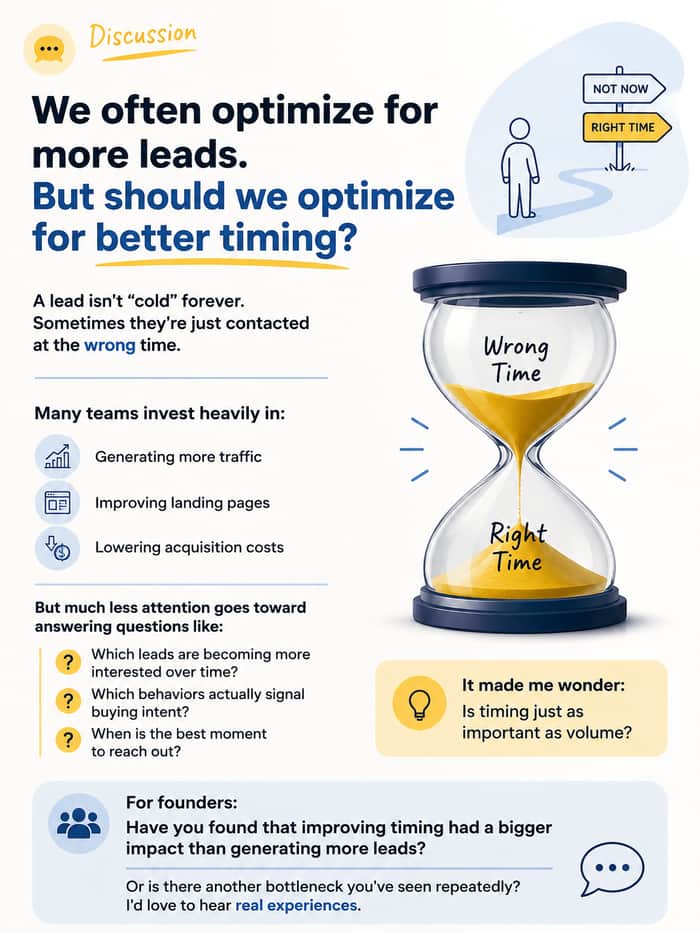
We often optimize for more leads. But should we optimize for better timing?
Over the last few days, I've been reading discussions from founders across SaaS and EdTech.
One pattern keeps coming up:
A lead isn't cold forever.
Sometimes they're just contacted at the wrong time.
Many teams invest heavily in:
Generating more traffic
Improving landing pages
Lowering acquisition costs
But much less attention goes toward answering questions like:
Which leads are becoming more interested over time?
Which behaviors actually signal buying intent?
When is the best moment to reach out?
It made me wonder whether timing is just as important as volume.
For founders:
Have you found that improving timing had a bigger impact than generating more leads?
Or is there another bottleneck you've seen repeatedly?
I'd love to hear real experiences.

One thing I've noticed is that "better timing" can end up explaining a lot of things after the fact.
A lead who buys after a follow-up often looks like a timing success.
A lead who doesn't buy often looks like a timing miss.
The difficult part is figuring out when timing is actually the bottleneck versus when it's standing in for something else.
Those can lead to very different conclusions.
That's a great point. It's easy to label outcomes as a timing issue in hindsight when timing may just be the visible symptom.
I've found it useful to ask whether the lead actually had enough context, urgency, and trust to make a decision. If those aren't in place, changing the follow-up timing alone rarely changes the outcome.
The challenge is separating readiness from timing they often look similar in the data but call for very different actions.
Possibly.
What makes it tricky is that context, urgency, trust, and timing can all improve together.
When that happens, the eventual conversion tends to get credited to whichever factor was easiest to observe.
That's usually where I'd become cautious about the conclusions being drawn.
Those situations can look much clearer in hindsight than they actually were.