We picked the one game engine nobody was building AI tools for. Here's what happened.
The gap we saw
In early 2025, every AI coding tool was fighting over the same market: VS Code extensions for web developers. Cursor, GitHub Copilot, Codeium, Tabnine, dozens of others. The web dev AI market was already saturated.
Meanwhile, Godot Engine had crossed 90,000 GitHub stars and was growing faster than any game engine in history. After Unity's runtime fee disaster in 2023, thousands of developers migrated to Godot. The GDC 2026 survey found that 11% of developers now use Godot, up from single digits two years ago.
But zero AI tools were built specifically for the Godot editor. Game developers who wanted AI assistance had two options: copy-paste code into ChatGPT (losing all project context) or use a general VS Code extension that didn't understand GDScript, scene trees, or Godot's node-based architecture.
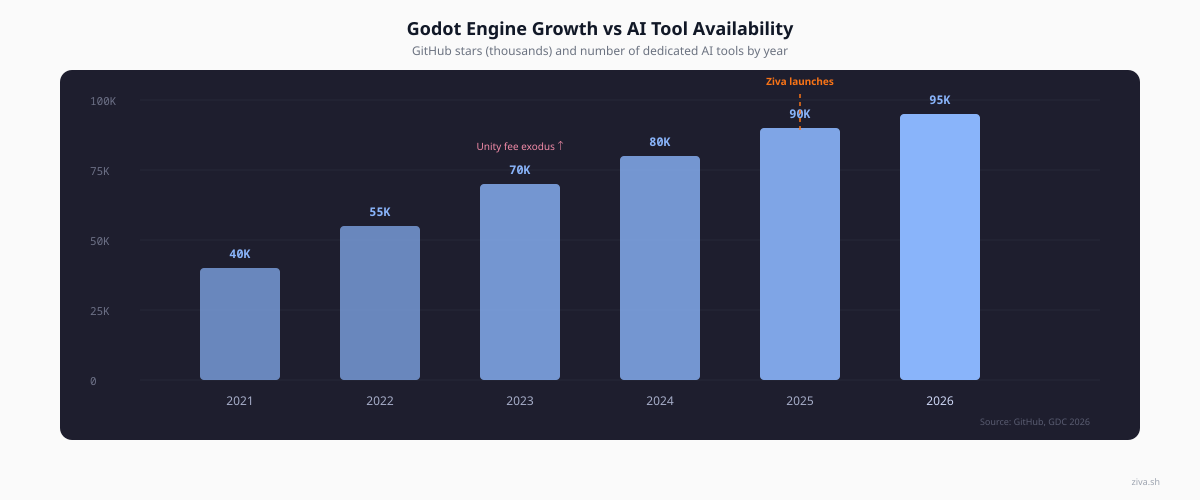
That was the gap. We built Ziva to fill it.
What we actually built
Ziva is an AI assistant that runs inside the Godot editor as a plugin. It reads your project files, scene tree, and scripts, so when you ask it to generate code, it generates code that fits your actual project.
The three features that turned out to matter most:
-
Error diagnosis from real stack traces. You paste a Godot error, Ziva reads your code and tells you what's wrong. An independent review found this cut debugging time from 10-20 minutes to 5-8 minutes per issue.
-
TileMap editing through natural language. Describe a layout, get a TileMap. This is tedious manual work that developers hate doing by hand.
-
Scene scaffolding. Describe a game mechanic, get a node tree with scripts attached. Saves the boilerplate setup phase.
We launched with a free tier and paid plans. The free tier is deliberately generous because game developers (especially indie ones) are price-sensitive and skeptical of AI tools.
Why Godot specifically
Godot has a technical property that makes it uniquely suited for AI tooling: everything is a text file. Scenes are .tscn, resources are .tres, project settings are project.godot. An AI model can read and modify the entire project structure without any binary format parsing.
GDScript itself is a small, consistent language with ~850 built-in classes and Python-like syntax. Compare that to Unity's C# ecosystem (massive, fragmented, version-dependent) or Unreal's C++ macro system. AI models produce significantly better GDScript than they do equivalent Unity or Unreal code because the language surface area is smaller.
This isn't just our observation. The GDC 2026 survey found that among game developers who use AI, 47% use it for code assistance and 81% for research. Code generation is where AI delivers real value in game dev. Art and player-facing features are still almost entirely human (only 5% of studios use AI for player-facing features).
What we learned
The market is real but opinionated. Game developers are more skeptical of AI than web developers. The GDC survey found 52% of game professionals view AI negatively, with artists at 64% negative sentiment. You cannot market to this audience with hype. You have to show real utility and be honest about what doesn't work.
Context beats model quality. We initially thought the model powering Ziva mattered most. Turns out, project context matters more. A smaller model with full access to your scene tree and scripts produces better GDScript than GPT-4 with a code snippet pasted in. This is our core competitive advantage against "just use ChatGPT."
Free tiers drive word of mouth. Indie game dev is a community where people share tools in Discord servers and Reddit threads. A generous free tier means every user is a potential referral source. Gating basic features would have killed adoption in this market.
Niche is an advantage. Being "the AI tool for Godot" means we're the default recommendation when anyone asks "what AI tools work with Godot?" in any forum, Discord, or Reddit thread. We trade total addressable market for category ownership.
Where we are now
Godot just crossed 95,000 GitHub stars. The Godot Discord has 80,000+ active members. Slay the Spire 2's developer Mega Crit just funded the Godot Foundation directly. The engine is gaining momentum.
We're building for a market that's growing. That's the bet.
If you're looking for a niche AI product opportunity, the pattern we followed is simple: find an open-source ecosystem that's growing fast, where no specialized AI tooling exists yet, and where the technology is structurally suited to AI (text-based formats, consistent API, small language surface area). Godot happened to check all three boxes.

Great read on finding a niche. "Context beats model quality" is a great insight. Curious how you're managing API costs, especially with a generous free tier. Are you using a specific model through an API, or is this something you're actively optimizing?