We scanned Nike’s store — and found where revenue is leaking
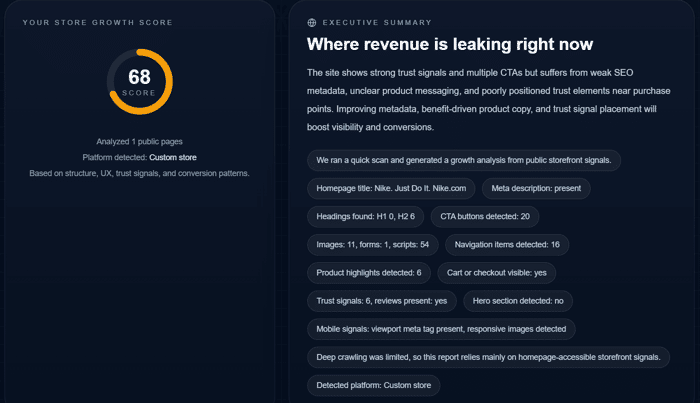
I’ve been working on a tool that analyzes ecommerce stores and surfaces conversion issues.
Decided to test it on a well-known brand — Nike.
Here’s what came up 👇
Store growth score: 68
At first glance, everything looks solid:
– strong branding
– multiple CTAs
– trust signals present
But digging deeper, a few issues stood out:
• Weak SEO metadata → limits visibility
• Unclear product messaging → reduces clarity
• Trust elements not positioned near key purchase points
None of these are obvious.
But together, they quietly hurt conversions.
What’s interesting is that even large brands with massive resources still have these gaps.
It’s not about traffic — it’s about how well the store converts.
Curious — when you look at your own store, do you actually know where users drop off?

Hey, I just read your Nike audit. Interesting approach — you're scanning live e-commerce stores and finding revenue leaks in real time.
The technical angle is smart: slow page loads, broken checkout flows, missing upsells, bad mobile UX. Those are the exact issues that cost stores 20-40% of potential revenue.
But here's the hard truth: Nike doesn't care. They're a $50B company with an internal team handling this. However, 4.4M Shopify store owners would pay between $9/month - $49/month for this exact tool.
Your real market isn't enterprise — it's small/medium e-commerce. They have the same leaks but no team to fix them. And they'll actually respond to outreach.
Have you thought about pivoting your target? Happy to help you figure out the GTM strategy.
Appreciate the insight — and I agree, Nike has the resources and internal teams to handle this.
The point of the analysis wasn’t to “fix Nike,” but to highlight that even large brands have conversion gaps.
For smaller Shopify store owners, this is exactly where it becomes valuable — it shows what to look for and what to improve before these issues start impacting their business.
The goal is to make these insights accessible, so store owners can avoid common mistakes, improve their performance, and build more sustainable stores without needing an enterprise-level team.