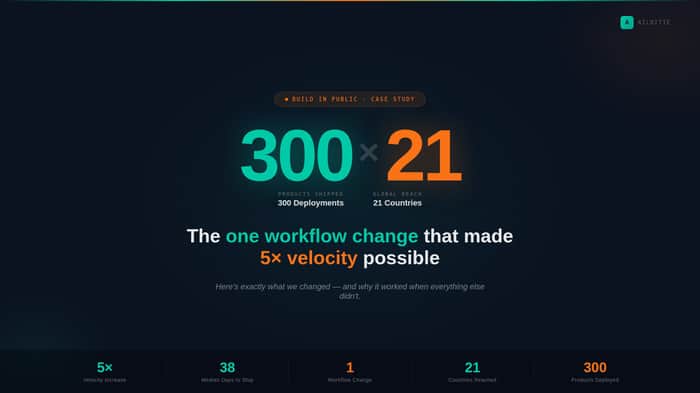
We Shipped 300 Products in 21 Countries. Here’s the One Workflow Change That Made 5x Velocity Possible
A milestone post from the Ailoitte team.
I want to share something we learned the hard way, because I think it's going to save a lot of builders from the trap we fell into.
We're an AI-native product engineering firm. Over the last few years, we've shipped more than 300 products across 21 countries — everything from B2B SaaS MVPs to enterprise-grade agentic systems. Our current median delivery time sits at 38 days per product.
That number — 38 days — didn't come from hiring better developers or grinding harder. It came from one specific structural change to how we work. And before that change, we were making the exact mistakes that most teams make when they try to "use AI" in development.
What we tried first (and why it didn't work)
When AI coding tools started maturing, the instinct was to hand them to individual developers and say: go faster.
And for a while, it looked like it was working. Code was being generated quickly. PRs were getting bigger. Features were shipping faster — at least on paper.
But something was off.
The velocity gains were real in isolation and chaotic in aggregate. Developers were using different models, different prompting strategies, and different levels of review rigor:
- One person would ship a module that worked perfectly in isolation and broke three integrations.
- Another would generate a full auth flow that passed review but quietly introduced a security edge case nobody caught until QA.
The deeper problem: AI amplifies ambiguity.
When requirements are fuzzy, a human developer gets stuck and asks a clarifying question. An AI agent fills in the gap with a confident assumption — and builds the wrong thing at 10x speed.
We had ungoverned agent loops running across complex systems. We had a requirement ambiguity that previously would have surfaced early, now surfacing late — because the code was written before anyone asked the hard questions. We were fast at building the wrong thing.
Velocity without governance isn't velocity. It's technical debt at scale.
The change that actually worked: AI Velocity Pods
We stopped thinking about AI as a tool and started thinking about it as a workflow design problem.
The structure we landed on: small, elite teams — typically 3 to 5 engineers — operating inside what we now call AI Velocity Pods. Each pod owns a full product delivery end-to-end.
- No handoffs across functional silos.
- No "backend team" and "frontend team" talking through tickets.
- One pod, full ownership, shared accountability for the outcome.
Inside each pod, AI usage is strictly governed, not free-form. That means:
- Defined model choices for defined task types (generation vs. review vs. architecture reasoning).
- Mandatory human review gates at every integration point.
- Shared prompting standards so outputs are consistent across team members.
- Requirement validation before agent loops are allowed to run — not after.
That last point is the most important one. We run a structured Requirement Definition Workshop at the start of every engagement. User stories, acceptance criteria, edge cases, integration dependencies — all documented and signed off before a single line of AI-generated code is written. This is where we catch ambiguity, not in sprint 5.
The result: AI isn't amplifying our mistakes anymore. It's amplifying our precision.
What the numbers actually look like
- Before this structure: Our average delivery time was in the 90–120 day range — comparable to most traditional agencies.
- After restructuring around AI Velocity Pods: That dropped to a 38 days median.
That's not a cherry-picked number from our fastest project. It's the median across our delivery history.
The compounding effect is real, too. Each pod develops shared muscle memory around the governed workflow. They get faster with each engagement — not because they're cutting corners, but because the process gets more efficient as the team internalizes it. Our fastest pods are now delivering complex MVPs in under 30 days.
On the business side, we moved to fixed-price contracts to align our incentives with this model. Under hourly billing, faster delivery would have been a revenue loss. Fixed price means our margin improves when we're faster — so we have every reason to push the model as hard as it can go.
What I'd tell a team trying to do this
If you're trying to build AI-assisted velocity into your development process, the honest advice is: Don't start with the AI. Start with the structure.
The tooling is commoditized. Claude, Cursor, Copilot — there are a dozen solid options, and the gap between them is smaller than the gap between governed and ungoverned usage. What actually matters is:
- Requirement clarity before generation: If you can't describe exactly what you're building and what "done" looks like, don't let the AI start. Clarify first.
- Review gates at integration points: AI-generated code at the module level is usually fine. AI-generated integrations between modules need human eyes before they merge.
- Team-level prompting standards: Inconsistent prompting produces inconsistent output. If five developers are prompting five different ways, you have five workflows, not one.
- Full-stack pod ownership: Handoffs are where context dies. The team that understands the requirement should be the team that ships the feature — start to finish.
None of this is glamorous. It's operational discipline. But it's what turned AI from a productivity gimmick into a genuine delivery multiplier for us.
Where we are now
300+ products. 21 countries. 38-day median.
We're still learning. The models are getting better. The governance frameworks are evolving. We've had projects where the pods ran perfectly and projects where we caught our own process failures mid-engagement and had to adapt.
But the structural insight — that AI velocity requires workflow design, not just tool adoption — has held up consistently across every context we've put it in.
If you're building something and trying to figure out how to work AI into your development process in a way that actually scales, I'm happy to talk through what we've built. And if you want to see the AI Velocity Pods model in action, you can read more about how we structure engagements here.
Let's discuss:
- What questions do you have about this setup?
- What's the biggest blocker you've hit trying to govern AI usage inside a dev team?
Tags: #dev #productivity #ai #saas #growth #operations
