We shipped 6 products in 90 days using AI Velocity Pods — here's what we learned about scope control
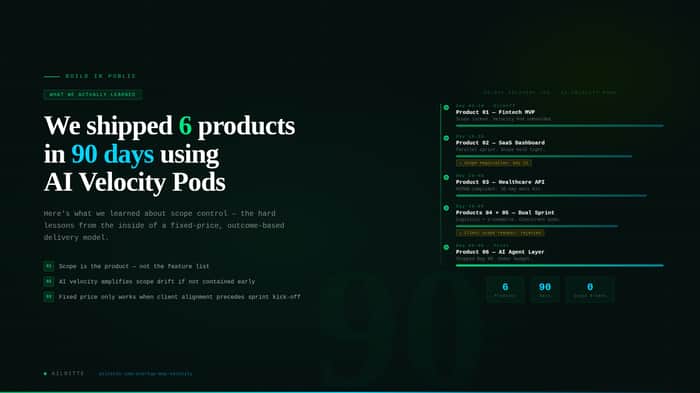
Ninety days. Six products shipped. All fixed-price. Here's the honest breakdown of what actually made that possible — and where things almost went sideways.
We run engineering through AI Velocity Pods — small teams of 3–5 engineers with agentic AI baked into the full delivery stack. Median time-to-MVP is 38 days. We've shipped 300+ products across 21 countries. The model works. But it only works because of something most founders underestimate going in: scope control is the entire game.
Here's what we actually learned:
Fast delivery costs more upfront thinking, not less. The clients who get their product in 38 days are the ones who showed up to kickoff with defined acceptance criteria, a prioritized feature list, and a clear "what does done look like" answer. The ones who treated scoping as a formality paid for it in revision cycles. AI can compress execution time. It can't compress unclear requirements.
The Three Places Projects Still Slip — Even with AI
1. Scope creep disguised as "small additions"
A feature that "should only take a day" introduced mid-sprint costs more than a day when it affects downstream dependencies. Our fixed-price model requires a formal change order for anything outside the original scope document. Clients who resist this process end up with a project that slips.
2. Stakeholder alignment lag
The engineering velocity is real — but if the client's internal decision-makers take 5 business days to review and approve a milestone, the 38-day clock pauses. Fast delivery requires fast decisions on both sides.
3. Definition-of-done ambiguity
"It should feel intuitive" is not an acceptance criterion. "Users can complete the onboarding flow in under 3 minutes without external help" is. The more concrete the success criteria defined before the build starts, the cleaner the handoff.
If you're evaluating whether an AI-native fixed-price model would work for your next build, the ROI case studies are the honest place to start: real delivery timelines, real scope documents, real client outcomes.
What's the scope control failure you've seen kill a fast-moving project? Curious what this community has run into.
Tags: #building-in-public, #ai, #product-development, #lessons-learned

"Fast delivery costs more upfront thinking, not less" is the most important line in this whole post and the one most teams resist because it feels counterintuitive. If the AI is fast, shouldn't we just iterate quickly? The answer is no, because at AI execution speed, the cost of fixing bad requirements multiplies. You're not waiting days for a feature to come back wrong, you're waiting hours. And every hour of rework compounds against the timeline you sold on. The three failure modes you listed are all the same root problem: requirements that describe what to build but not what done looks like, what the stakeholder means, or what constraints apply. The AI executes against the spec it's given. If the spec is vague, the output is vague in ways that look correct until someone tests it against reality. Definition-of-done ambiguity is especially expensive because it doesn't surface until the client sees the feature and realises they wanted something different. Structured requirements that define observable outcomes before the build starts are what separate teams that ship clean from teams that spend sprints in rework. What's your process for scoping when the client is unclear about their own acceptance criteria at kickoff?