We shipped our 300th product in 38 days (fixed-price, AI-native model) — here's what we've learned
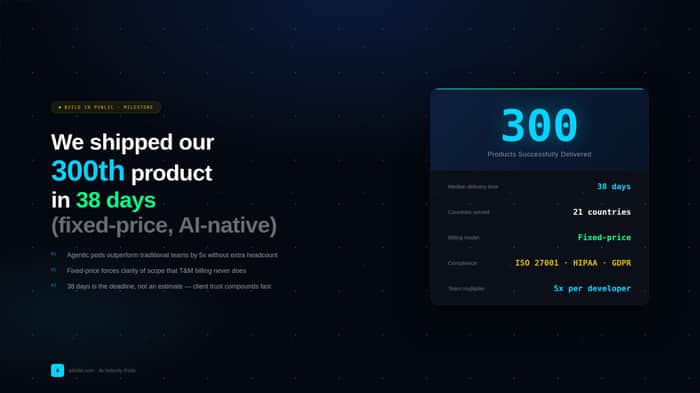
We crossed 300 products shipped this month. Fixed-price, AI-native, across 21 countries. I wanted to write an honest retrospective — not a pitch, but the real lessons from building this delivery model over the past few years.
What failed early
Our first version of the "AI Velocity Pod" model had a simple problem: we were using AI for generation but still relying on human review as the primary quality gate. Developers were reviewing agent output line by line. The speed gains from agentic generation were almost entirely eaten by the review overhead.
Worse, the code quality was inconsistent. Agents without architectural constraints would implement the same pattern three different ways across the same codebase. Technical debt was accumulating faster than we could see it.
We were shipping faster than a traditional agency. We weren't shipping well.
What actually fixed it
The breakthrough was building an agentic QA layer — not just adding more automated tests, but building a second agent layer whose only job is validating the output of the first. Agent writes feature. QA agent checks for duplication, coverage gaps, and pattern drift. Human approves the net result.
Test coverage went from 40–60% at launch to consistently above 85%. Post-launch bug rate dropped significantly. And paradoxically, the review process got faster — because humans were approving validated output rather than hunting through raw agent code.
The second fix was structural: full-domain ownership per engineer, not file-level. Each person on a pod owns a feature domain end-to-end and is responsible for the agent threads within it. This eliminated the coordination overhead that killed early pod experiments.
Why fixed-price works (when incentives are aligned)
The honest version: fixed-price only works when the delivery team is genuinely faster than the hours they've priced in. If AI makes your team 3x faster, the efficiency gain goes to margin — which creates a real incentive to actually use agents well, not just claim you do.
The broken version of AI-accelerated development is hourly billing with AI tooling. The client absorbs all the downside risk of scope creep and quality issues, and the agency has no structural incentive to go faster. We've seen this model fail repeatedly for founders.
Our ROI case studies show what the numbers actually look like in practice — not projections, but delivery data from real client builds.
The question I'd ask anyone building a similar model:
What does your QA pipeline look like when agents are doing 80% of the implementation? If the answer is still "senior dev review," you haven't solved the problem — you've just moved the bottleneck.
Curious how other IH founders are handling quality at high agentic output volume. What's working for your team?
Tags: #productivity #ai #engineering #startups #buildinpublic
