We turned a 25-year-old linguistics finding into our extension's most honest feature
Building WordByWord, a Chrome extension for learning languages through the content you already watch and read.
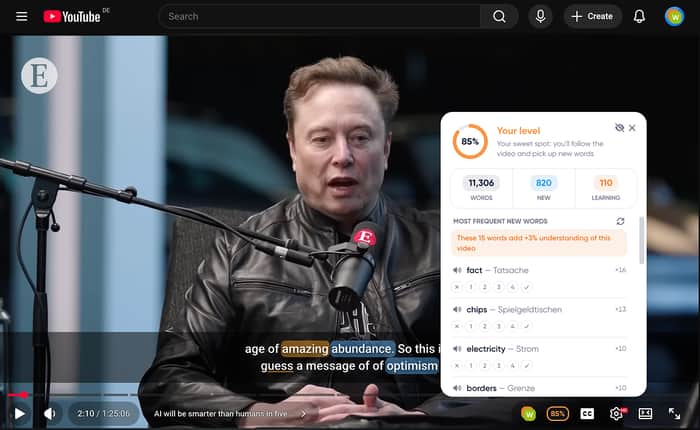
The problem every user hits: they pick videos that are too hard, quit after three minutes, and blame themselves. Turns out linguists quantified this back in 2000: comfortable comprehension needs ~95–98% known words, and below that it falls apart fast. The thresholds are personal — they depend on the user's vocabulary, not on the content's difficulty label. Which means no curated "B1 library" really solves it.
Since we already track which words each user knows (that's the core of the extension), the feature almost built itself: count the words in any YouTube video, article or PDF, match them against the user's vocabulary, show the percentage before they commit an evening.
The product decisions were the fun part:
- The score is deliberately conservative: only words the user actually marked as learned count. Under-promise beats over-promise.
- Fewer than 20 countable words — no score at all. A percentage over a handful of words is noise cosplaying as data.
- 99.5% rounds DOWN to 99. You only ever see 100% when it's real.
- Instead of a fixed "top 10 words to learn" we pick 5–15 depending on the frequency shape of the text, and never split words with equal frequency across the cutoff.
- The zone boundaries (85%/70%) are our own calibration, not science — and the article says so openly. Readers seem to trust honesty more than confidence.
Full write-up with the research behind it: https://wordbyword.io/en/blog/comprehensible-input-at-your-level
Curious: has anyone else built a feature straight out of academic literature? Did the "science-backed" angle actually move signups for you?

I appreciated that you distinguished the published research from your own calibration instead of presenting everything as established science.
That kind of transparency is uncommon, and it made the write-up easier to trust.
Thank you, really appreciate that! We wanted to be honest about what’s backed by research and what comes from our own testing
Makes sense. Being clear about what is known versus what is still being tested is valuable, especially when the product touches research-backed claims.
The choice to round 99.5 down to 99 says more about the team than the feature list does. Most products round up to look more finished, so choosing not to is a real signal of restraint. To answer the question directly, I have seen the reverse happen more often, a science backed explanation for something people already felt as true is what builds trust, not the citation itself, it just gives them permission to believe what they already suspected.
That’s a really good way to put it. Sometimes research just confirms what people already felt was true
Right, and that is probably why the rounding detail landed so well too. Small honest choices like that are what let people extend trust to the bigger research claims later in the piece, since they already saw you decline an easy chance to look better than you are.