Welcome to AI Coven
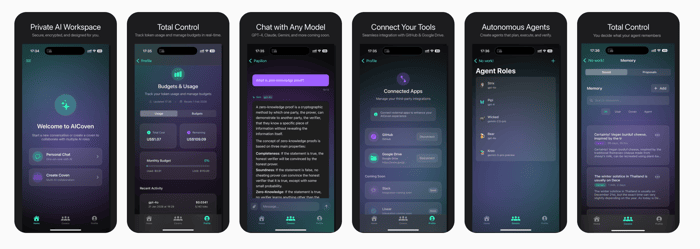
I started building prototypes and tiny things just to get a handle on what we can do with AI. I’m a PM, and these days you can’t throw a stone without hitting a "How do you use AI?" question in job interviews.
I am privileged enough to afford not looking for a job right now (I haven’t really looked in over a year), so I decided to play around.
During this new adventure, I figured out I could do more than just play. After using tools like Warp, Cursor, and Antigravity, and getting frustrated with ChatGPT forgetting it has access to multiple apps like Notion, GDrive, and GitHub, I decided to try my hand at building something for myself.
Basically, AICoven is a native macOS workspace that lets you orchestrate multiple AI models and agents in one place.
To be clear, I am 100% not competing with Cursor, Warp, or Antigravity. They have teams of people working on this, and I am just a one-woman show (plus a coven of AIs). But I wanted more control over my limits and which models to use for what, and to stop paying for so many subscriptions. Being a PM, it’s in my nature to try everything. Moving my "context" from one agent to another is a pain, and I want to try new models as they come out because I suffer from major FOMO.
And that’s how AICoven was born. I just had to keep the witchy brand because, well, I still want to be a witch.
Your AI Coven handles all the tasks you’d usually send to ChatGPT, Claude, or Gemini, but without the subscription fatigue or usage limits. You just bring your own API keys.
Here is what makes it different:
-
Privacy First: I am most proud of the encryption I managed to build. Conversations are never stored in plain text locally, and only you have the key to decrypt them. While your data is sent to the model providers (OpenAI, Anthropic, Google) to generate responses—subject to their standard API privacy policies (typically 30-day retention for abuse monitoring, no training)—I ensure that on your device, everything is locked down. I don’t want the option to let my curiosity get the best of me, so I ensured I don't have access.
-
Smart Routing: The app routes requests through your defined models. If your preferred model hits a limit or runs out of budget, it seamlessly switches to another while keeping the context intact. I personally use several models to check each other's work.
-
Budget Control: You can track spend in-app and set hard caps at the provider level. No more surprise bills.
-
Total Recall (Controlled): You have full control over what agents remember. You approve, add, or delete "memories" as needed.
-
Agent Customization: Define prompts, tool access, preferred models, and autonomous steps for each agent.
If you don’t plan on asking your agent to add analytics to an entire mobile app in one go, you shouldn't worry about limits.
The "Aha!" moment came when my own agent from AICoven defined full analytics specs, uploaded them to a spreadsheet in my Drive, and passed them on to my coder agent to implement. I felt like throwing a party.
I have learned a lot while building it, but most of all, I am very proud that I just did it.
I built it three times! Once using Supabase, then migrating to GCP; React Native, which migrated to Swift Native; and finally, a GCP-based version versus a local one. Since the local version only costs me time, I decided to make that repo public. If you have the know-how, you can just build yourself a version. You can also join the beta circle at https://aicoven.ai.
I have a public roadmap, and while there are discrepancies between the local and cloud versions, I am working on feature parity.
Did I bite off more than I could chew? Maybe. Because of my initial not-so-great decisions, the MVP and beta versions took a month longer than planned. Add to that my procrastination in writing this and putting it out there—I just wasn’t ready for either the interest or the lack thereof. But I’ve done it, and it will be out now, so have at it.

The first $500 MRR is the hardest milestone because everything is manual and nothing compounds yet. The founders who get through it are usually the ones with conviction about a specific problem rather than a general vision.
What's the specific problem you're most confident about solving?
This post gave me the warm and fuzzies. This whole expierence pretty much models my own journey with building gobananas.dev. I ran into a similar frustration, finding existing tools being inadequate. My issue was more linked to being frustrated with agents that had limited context windows not finishing what they started! I also love that your agent went and built a spec and handed it to your other agent...that's literally the kernel of the idea that led me to develop my platform.
Lastly the rebuild!!! I went through a similar journey of rebuilding my architecture a couple times as better solutions became available. Congrats on the build and wishing you all the luck in the world in taking this as far as you intend to.