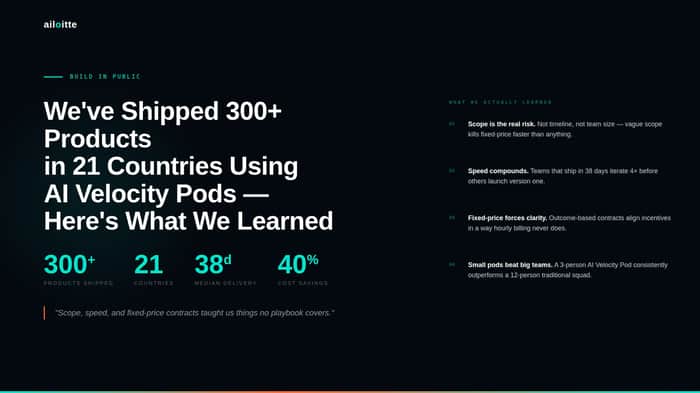
We've now shipped 300+ products in 21 countries using AI Velocity Pods — here's what we learned about scope, speed, and fixed-price contract
This is the post I wish had existed when we started this.
Three years ago, Ailoitte ran like most product studios: scoped projects, time-and-materials billing, senior engineers reviewing junior output, QA at the end of the sprint. We were good at it. We delivered.
But we kept running into the same ceiling: the model itself was the constraint. Hourly billing means the vendor is financially neutral about how long a project takes. Clients absorb scope creep. Engineers absorb burnout. The incentive structure is misaligned from the first conversation.
We blew up the model. Here's what happened.
The transition from hourly to outcome-based billing
The first thing that breaks when you move to fixed-price delivery is your estimation process. Hourly billing is forgiving of uncertainty — you guess wrong, the clock keeps running. Fixed-price contracts are not forgiving. If your spec is ambiguous and your estimate is wrong, you eat the delta.
This forced us to get dramatically better at two things: spec clarity before contracts are signed, and scope enforcement after they are.
Spec clarity sounds obvious. It's not. Most clients come to us with a product vision, not a product spec.
- The vision: "A platform where freelancers can find clients and get paid."
- The spec: "A search interface with five filters, a messaging thread, a Stripe-connected payment flow, and a dashboard showing lifetime earnings."
The gap between those two things is where most fixed-price contracts die.
We now spend the first part of every engagement on a structured scoping session before any commercial terms are agreed. We use AI tooling to stress-test the spec — flagging ambiguities, generating edge-case scenarios, and surfacing integration dependencies the client hadn't considered. This isn't billable time. It's how we protect the contract we're about to sign.
Scope enforcement post-contract is the other half. We define a change control process that is explicit, not implicit. New features go into a second phase. Not because we're being rigid — because the alternative is a fixed-price contract that silently becomes a time-and-materials one.
What this did to client relationships: It made them dramatically better. Clients who previously felt like they were managing a cost centre started treating us as a delivery partner. Because we'd aligned incentives — our success was their success shipping, not their success extending the engagement.
What breaks when you move fast with AI
Speed exposes every weakness in your process. Slowly is a kindness. Fast is brutal.
Here's what we broke, in order of how painful it was:
- Context management: Agentic coding agents are powerful and amnesiac. If you're running parallel agents on a large codebase without a shared context management layer, you get integration conflicts at a rate that scales with the number of agents. We learned this the hard way on our fourth AI-native delivery. The fix was an orchestration layer — a meta-agent that manages context distribution, flags conflicts, and routes edge cases to human review. Adding this cut integration rework by roughly 60%.
- Test coverage as an afterthought: In the first six months of AI-native delivery, we were generating code fast and writing tests afterward. This produced a subtle but expensive problem: the tests we wrote afterward were shaped by the implementation we'd already built, not by the acceptance criteria the implementation was supposed to meet. We flipped it. Test assertions are now written from acceptance criteria before a single implementation agent runs. This changed our QA failure detection from "end of sprint" to "within the agent loop." Defects that used to surface in production surfaced in CI instead.
- Client-side scope drift: Moving fast creates an illusion: because output appears quickly, it feels easy to add things. "Can we just add a search bar?" feels different when it appears three weeks into a project than when it appears three months in. The psychological anchor changes. We added explicit scope tracking to every client-facing update — not to be defensive, but to make the cumulative picture visible before it became a problem.
Governance patterns that prevent agentic debt
"Agentic debt" is our term for the category of technical debt that's specific to AI-generated code at speed. It's different from traditional tech debt in one important way: it's less visible. AI-generated code is syntactically clean, passes linters, and looks like deliberate engineering. The debt is in the architectural decisions the agent made silently, without the context a senior engineer would have applied.
Three governance patterns that have worked for us:
- Mandatory human review at integration boundaries: We don't review every line of agent-generated code. We do review every integration point — every place where one component hands off to another. This is where agentic drift compounds. Catching it at the boundary costs 20 minutes. Catching it in production costs weeks.
- Immutable acceptance criteria: Once a sprint's acceptance criteria are locked, they cannot be changed by anyone except the product lead — and every change triggers a re-scope review. This sounds bureaucratic. In practice, it takes two minutes and has saved us from scope drift more times than I can count.
- Weekly architecture review with a human senior engineer: Agentic output is reviewed weekly against the intended architecture by a senior engineer who hasn't been running the agents. Fresh eyes catch things that the delivery team, deep in execution, will miss. We call this the "outside-in review," and it's now non-negotiable on every engagement.
Real ship-time data
We track this obsessively because it's the core claim of the model.
- Median time from spec sign-off to production deployment: 38 days
- Industry average (Gartner, 2025): 120+ days
- Cost delta vs. traditional model: approximately 40–60% lower total cost for equivalent scope
- Geographies served: 21 countries
- Products shipped: 300+
The 38-day number isn't the best case. It's the median across a dataset of 300+ engagements, including projects in regulated verticals (HIPAA, GDPR), enterprise integrations, and products that went on to scale to millions of users.
The model works. It works repeatedly. And the repeatability comes entirely from the governance layer, not the speed layer. Fast without governance is just expensive chaos with a faster feedback loop.
What we'd do differently
One honest thing: we underinvested in documentation tooling for the first year. AI agents produce code faster than humans produce documentation. The gap accumulates.
We now run a documentation agent in parallel with every delivery sprint — auto-generating technical docs from code context and flagging wherever human annotation is needed. We should have built this on day one.
If you're building an AI-native product studio, running a startup scoping an MVP, or thinking through outcome-based delivery models — happy to compare notes in the comments.
Specifically curious: How are others handling scope enforcement on fixed-price contracts? It's the piece of this model that I've seen the most variance in, and I don't think anyone's solved it perfectly yet.
Tags: #AI #SoftwareEngineering #Agile #ProductManagement #Startups

The part that stood out to me is that most fixed-price disasters start before the contract is signed, not after. A lot of freelancers think scope creep is a delivery problem, but the earlier failure is vague acceptance criteria, vague revision limits, and no explicit change-order trigger. Once those are fuzzy, the contract is already leaking before work starts.