What 2025 taught me about growing a bootstrapped SaaS to $110K/MRR (WP Umbrella)
I run a bootstrapped SaaS in the WordPress space that allow agencies to manage all their WordPress sites from one place.
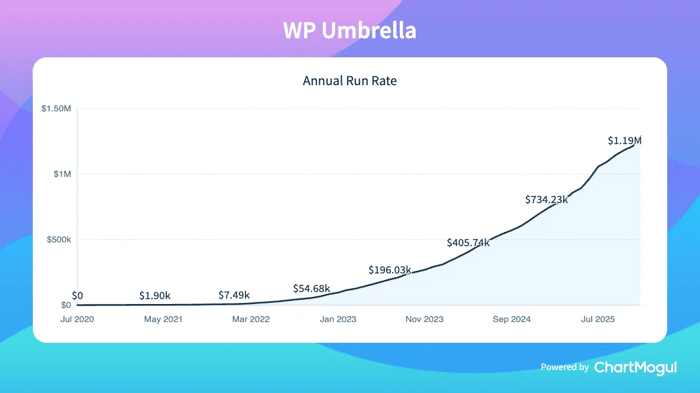
In 2025, we crossed $110k MRR, grew 67% year over year, stayed fully bootstrapped, and ended the year with a small team of 7 people.
This isn’t a “how to grow fast” post. It’s more a list of things that became obvious to me this year, sometimes later than they should have.
1. Growth doesn’t change your business, it changes how careful you need to be
At a certain point, instinct isn’t enough anymore.
When more people rely on what you build every day, you stop optimizing for speed and start optimizing for things holding up over time. Not in theory but in boring, operational ways.
For us, that meant spending less time thinking about what to add next and more time making sure the core of WP Umbrella actually works as expected.
2. Numbers get messy once you scale
On paper, $110k MRR looks clean.
In practice, it’s multiple currencies, payment fees, refunds, and things you don’t think about when you’re smaller. This year alone, currency variation cost us around €7k per month, and we paid roughly €40k in Stripe fees.
Nothing dramatic, just part of operating at scale. But it changes how you look at growth, and the sooner you anticipate this, the better, especially on currencies.
3. Expectations rise faster than usage
One thing that surprised me: expectations grow faster than adoption.
As usage increased, tolerance for edge cases dropped to zero especially on critical parts of the product. Some things simply can’t “mostly work”.
For us, backups fell into that category. If you’re not ready to treat certain features as obligations rather than features, scale will force the issue for you.
So we ended up spending a lot of time building a backup system far beyond the usual standards of our market, and it’s so good that it's now becoming our main differentiator. Go big on hard things.
4. Consolidation often looks like slowing down
From the outside, it probably looked like we slowed down in the second half of the year.
Internally, we were consolidating a lot, systems, infrastructure, processes, so customers managing hundreds or thousands of sites could rely on the platform day to day.
This kind of work rarely shows up in changelogs, but it compounds more than visible features.
5. Shipping doesn’t stop but it becomes more intentional
Even while focusing heavily on foundations, we still shipped a lot.
But the bar changed. Fewer “nice to have” things. More work aimed at clarity, traceability, and predictability.
Looking back at the year, the product improved less through big launches and more through many small, unglamorous changes.
6. Team fit matters more than role fit
This year, we added three people to the team.
What mattered most wasn’t their titles, but their attitude: nice people, a lot of energy, and the ability to genuinely care about what they’re doing and what the company is building.
The biggest signal for me was seeing people keep talking about work during our company retreat, not because they had to, but because they were invested. With the rise of AI, ownership is everything.
7. Ownership is what unlocks resultq
Speaking of ownership, as soon as people truly owned parts of the company, execution sped up.
Not because we rushed more, but because decisions stopped bouncing around. Fewer discussions. Clearer responsibility. Less second-guessing.
This also meant the company became less dependent on any single person, including me.
8. Community still matters more than most channels
We don’t grow through ads.
Most of our growth still comes from word of mouth and the WordPress community. Being present at meetups and WordCamps help us staying close to how people actually work. That feedback loop is slower, but much harder to fake, and even if its a bit cliché, nothing beats human face to face interactions.
9. Saying no gets easier once you know what you’re building
In 2025, we declined several opportunities that looked good on paper.
Not because they were bad ideas, but because they didn’t fit where we wanted to go. Having clearer foundations made those decisions easier and less emotional.
10. Most progress looks boring while it’s happening
Looking back, 2025 was a strong year.
Living through it, it felt mostly… normal. Lots of work. Few dramatic moments. Many small adjustments.
That’s probably a good sign.
If you’re in the middle of a year that feels unremarkable but demanding, there’s a decent chance you’re doing something right.

The part that resonates most is how unglamorous the levers are: retention, pricing discipline, saying no. I'm building SubAlert (renewal alerts for subscriptions) and my hardest lesson this year was that the features I was most excited to ship moved nothing, while a boring onboarding fix cut churn meaningfully. There's something almost cruel about how the work that feels creative and the work that compounds are rarely the same work. Curious: at 7 people, how do you decide which "boring but compounding" task gets priority when they all look equally dull on a roadmap?
What jumps out is that you hit $110K MRR with a team of 7 in a category most people would dismiss as "boring infrastructure." That's the quiet advantage nobody talks about — boring, recurring, mission-critical work compounds while flashier products churn. I'm curious whether your 2025 growth came more from expanding ARPU on existing agencies or from net-new logos, because those two paths demand completely different roadmaps. The agency-as-customer model also seems uniquely sticky: once you're embedded in someone's workflow, switching cost does your retention for you.
Thanks for sharing! This could be really helpful for early-stage founders. I especially love the point about slowing down during scaling. That’s so true! You almost always need to update your systems to handle increased load.
I created a short online assessment to help founders identify exactly which parts of their system might cause problems during scaling. You can try it out here
Great lessons for the scaling phase. Curious about the earlier part though - how did you go from 0 to $1? What got you your first paying customer?
Point #3 hit hard: "expectations grow faster than adoption."
I'm seeing this early with a tech news aggregator I'm building. As soon as users start relying on the daily digest, tolerance for "summary was slightly off" drops to zero. The bar keeps rising even when usage stays flat.
Also appreciate the reminder on community (#8). Ads can scale faster, but they can't build the feedback loop you're describing. Being present in places where your users already hang out — not just broadcasting at them — seems like the common thread in most bootstrapped success stories.
Curious: how do you balance time between community presence and actual product work? That trade-off feels harder to navigate as a solo founder.
We had an unusual setup with my co-founder: he focused purely on tech, and I handled product and marketing.
In hindsight, I think we spent too much time on product and not enough on community. There’s no point in having the best product in the world if nobody knows it exists.
If I had to do it again, once you have a real MVP that people are actually paying for, I’d invest much earlier and much more in community, whenever it’s relevant.