What 4K actually buys you in a dash cam, and what it asks of you in return
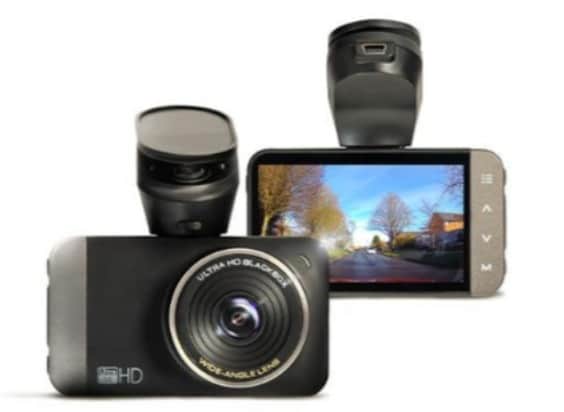
Dash cam listings are written in resolutions. 1080p, 2K, 4K, as though the number on its own told you how far down the road you can read a registration plate. It does not, and the gap between the marketing figure and the useful figure is where most disappointed buyers end up.
The honest version takes a bit of arithmetic, some thought about where the power is coming from, and a look at an obligation that arrives with the camera whether or not anybody mentions it at the till. Here is the working.
Pixels on the plate, not pixels on the box
A 4K sensor gives you 3840 pixels across the frame. Spread those over a typical dash cam field of view of about 140 degrees and you get roughly 27 pixels per degree. That number is the one that matters, because it tells you how much detail lands on a specific object at a specific distance.
An Irish or UK registration plate is 520 mm wide. At 10 metres it occupies about 3 degrees of your field of view, so roughly 82 pixels of plate width. At 20 metres it is about 41 pixels. At 30 metres, 27 pixels. At 50 metres, 16 pixels, which is a grey smear no amount of enhancement software will rescue.
Reading a plate reliably in a still frame needs somewhere around 50 to 60 pixels across its width, more if the light is poor or the vehicle is moving across the frame. So a 4K front camera gives you dependable plate capture out to somewhere around 15 to 18 metres and nothing usable past 30. Run the same maths on a 1080p camera and 1920 pixels over 140 degrees works out at 13.7 per degree, which puts the same readable limit at about 8 metres.
That is the real gain, and it is worth having. 4K does not let you read plates down the road. It doubles the distance at which you can read them, which in practice is the difference between capturing the car that pulled out of a junction and capturing a blurred silhouette.
The 2K rear camera works out at about 18 pixels per degree, so around 55 pixels of plate at 10 metres. Marginal on paper, and worse in the real world, because a rear camera shoots through a heated screen, road film and whatever the last wet motorway run left behind. Clean the rear glass if you expect the footage to be worth anything.
What continuous dual recording does to a memory card
Nobody writes about this and it is the most common reason a dash cam has no footage on the one day you needed it.
A 4K stream in H.265 runs around 25 Mbps. Add a 2K rear stream at roughly 12 Mbps and the kit is writing about 4.6 megabytes every second, which is close to 17 GB an hour. A nine hour driving day produces around 150 GB. A 512 GB card, the maximum this unit supports, holds about 31 hours before loop recording starts overwriting, so three and a half working days on a van and less on a tractor unit.
Extend that over a year of five day weeks and the camera writes something in the region of 35 terabytes to the card. Ordinary microSD cards are not built for that. They are built for a phone that writes a few gigabytes a week. High endurance cards exist specifically for surveillance and dash cam duty, they cost more, and they are the difference between a working camera and a card that silently stopped recording in March.
Two habits follow from this. Format the card in the camera itself every month or two rather than in a laptop, and treat the card as a consumable with an annual replacement rather than a one time purchase. Check the footage occasionally too. A failed card usually looks fine on the screen until you go looking for a file.
Parking mode is a wiring decision, not a menu setting
The AMiO kit takes 12 to 24 volts in and steps it down to 5 volts at 1.5 amps, which makes it agnostic about whether it goes in a van or a truck. That is convenient. What it does not solve is where the power comes from when the engine is off.
Parking monitoring and time lapse mode only work on a permanent live feed. In time lapse the unit draws somewhere in the region of 2 to 4 watts, call it 0.25 amps at 12 volts. Over a weekend of 60 hours that is around 15 amp hours out of the battery. On a truck with a pair of 110 amp hour batteries that is a rounding error. On a van with a single 70 amp hour battery, half of which is usable before starting gets marginal, and with a tracker and an alarm already sitting on the same battery, that is a Monday morning jump start.
The fix is a hardwire kit with a low voltage cut off, set to drop the camera at around 12.0 to 12.2 volts on a 12 volt system. Wiring it to a permanently live fuse without a cut off is how people end up blaming the camera for a battery that was already tired.
The obligation that arrives with the camera
This is the part that catches operators, and it is not optional. A dash cam records identifiable people and vehicles, which makes the footage personal data. In private use there is an argument about the household exemption, and the Court of Justice narrowed it considerably in the Rynes case in 2014 by holding that a camera covering public space is not a purely household activity.
In a commercial vehicle there is no argument at all. Ireland’s Data Protection Commission has been clear that where a dash cam is used by professional drivers, taxis, buses or delivery firms, the personal exemption does not apply and the operator carries full controller obligations. In practice that means a lawful basis, usually legitimate interests for incident evidence; a visible sticker in the vehicle telling people recording is taking place; a written retention period, which loop recording conveniently enforces if you set it and leave it; and a process for handling a subject access request, since anyone appearing in your footage can ask for a copy and you have a month to answer.
Audio deserves separate thought. This unit has a microphone and a speaker, and the DPC has taken the view that in cab audio recording needs strong justification on necessity and proportionality, because of what it captures incidentally. Leaving the mic running by default across a fleet is difficult to defend. Turning it off in the menu takes ten seconds and removes the problem.
One more thing. Posting footage on social media is where most complaints originate. Sending a clip to your insurer or to An Garda Síochána is a different act entirely from publishing it.
Heat, and where the unit actually lives
The AMiO kit is rated for operation from minus 10 to 65 degrees and storage from minus 20 to 70. Those are reasonable numbers, and a cab parked in July sun with the screen facing south can still test the upper one. Mount high and tight behind the mirror where the glass is shaded and the unit sits outside the swept view, run the cable through the headlining rather than across the screen, and be aware that summer heat rather than winter cold is what shortens the life of anything stuck to a windscreen.
What to check before you buy anything
Resolution first, but only after you know the field of view, because the two together determine detail and the second number is rarely advertised. Then check voltage range, since a 12 to 24 volt input saves stocking two versions across a mixed fleet. Check the card ceiling and buy an endurance rated card to match. Check whether GPS is built in or an add on module, because without it the footage carries no speed or location data, which is precisely what an insurer will ask about.
The Maypole front dash cam kit covers most of that list in one box: 4K front, 3.2 inch screen
Maypole MP5103 Specifications:
4K Ultra HD resolution (30 FPS)
Small & discreet
Bulit In WIFI
Built in GPS
3″ Screen
Wide angle 170 degree lens
Loop Recording
G Sensor
Parking Monitor (Hardwire kit only)
Superior Low light vision
Class 10 TF micro SD card (max capacity 128 GB) *Not included
Includes mounting bracket, adhesive pad & 3.5m power supply cable
Optional additional camera (MP5104) available
Optional Hardwire kit (MP5105) available
For yard manoeuvring and blind spot coverage rather than road evidence, that is a different job again, and the reversing camera kits range is the place to start.
Fit the camera, wire it properly, buy the right card, turn the microphone off, put a sticker on the glass. The footage will be there when you need it, and nobody will have a complaint about how you got it.

