What Are 5-Axis CNC Machining Services? A Complete Guide
What Is 5-Axis CNC Machining?
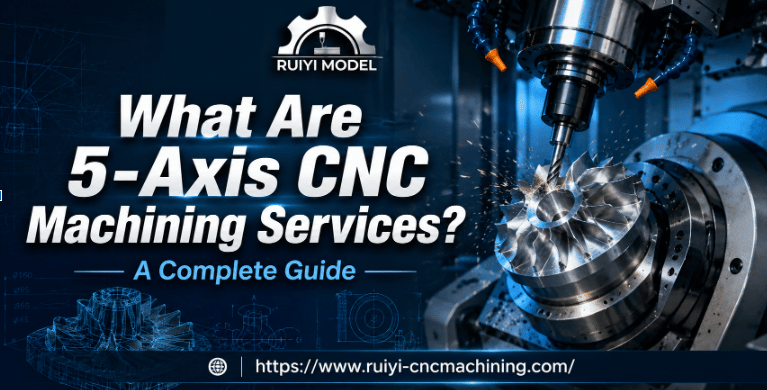
5-axis CNC machining is an advanced manufacturing process where the cutting tool and workpiece move simultaneously along five different axes, three linear axes (X, Y, and Z) and two rotational axes (A and B or A and C, depending on the machine configuration). This advanced capability allows a 5-axis CNC machining service to machine highly complex parts from nearly any angle in a single setup.
Unlike traditional 3-axis machining, 5-axis CNC machining can produce deep cavities, compound curves, undercuts, and intricate angled features without repeatedly removing and repositioning the workpiece. Fewer setups mean higher precision, tighter tolerances, faster production, and a better surface finish.
As a trusted 5-axis CNC machining parts manufacturer, we use advanced multi-axis machining technology to produce high-precision components for industries such as aerospace, automotive, medical, robotics, electronics, and industrial equipment. Whether you need rapid prototypes or large-scale production, our 5-axis CNC machining service delivers complex parts with exceptional accuracy, consistency, and efficiency.
How 5-Axis Machining Actually Works
A standard 3-axis CNC mill moves the cutting tool along X, Y, and Z, essentially left-right, front-back, and up-down. A 5-axis machine adds two rotational movements: the table or the tool head tilts (A-axis) and rotates (C-axis, or B-axis depending on configuration), letting the spindle reach the part from virtually any angle without moving the workpiece itself.
This matters because every time a part is unclamped and repositioned on a 3-axis machine to reach a new face, you introduce a small amount of positional error. Complex parts requiring five or six setups on a 3-axis machine can often be completed in a single setup on a 5-axis center, which is where most of the precision and efficiency gains come from. A detailed look at tool path planning and dynamics simulation in 5-axis CNC machining breaks down exactly how these movements are programmed and simulated before cutting begins.
Simultaneous vs Indexed 5-Axis Machining
Not all 5-axis machining is the same. There are two distinct approaches, and the difference matters for both cost and capability:
Indexed (3+2) machining locks the rotational axes in a fixed position for each operation, essentially using the 5th-axis capability to reposition the part between 3-axis cutting operations. This is faster to program and less expensive, and it's sufficient for many parts that just need multiple angled faces machined accurately.
Simultaneous (true 5-axis) machining keeps all five axes moving continuously during the cut, allowing the tool to maintain an optimal cutting angle across complex curved surfaces. This is what's required for aerospace impellers, turbine blades, and other parts with continuously varying compound curves. It requires more sophisticated programming and simulation, often informed by process work like the helical gear machining process design that shows how simultaneous toolpaths are planned for complex geometries.
Key Benefits of 5-Axis Machining
Fewer setups, higher accuracy: Reducing part repositioning eliminates the cumulative positional error that comes with each new clamping
Access to complex geometry: Undercuts, deep pockets, and compound curves that are physically unreachable on 3-axis machines become straightforward
Better surface finish on curved surfaces: Maintaining an optimal tool angle throughout the cut, rather than approaching at a fixed angle, produces smoother, more consistent finishes
Shorter overall cycle time on complex parts: Even though the machine itself may run at a similar speed, eliminating multiple setup and re-fixturing steps often reduces total production time
Reduced fixturing costs: Fewer custom fixtures are needed when a single setup can access most or all of a part's features
Industries and Applications That Rely on 5-Axis
Aerospace: turbine blades, impellers, structural brackets with compound angles
Medical devices: orthopedic implants, surgical instruments with organic, curved geometry
Automotive: engine components, complex housings, prototype tooling
Robotics and automation: multi-axis joints, precision housings requiring tight tolerance across multiple faces
Mold and die: complex cavity and core geometry for injection molds
Manufacturers offering custom CNC machining across these industries typically maintain a mix of 3, 4, and 5-axis equipment, matching the machine to the part rather than defaulting to the most complex option for every job.
Materials Commonly Machined on 5-Axis Centers
5-axis machining works across the same material range as standard CNC processes, but is especially valuable for hard-to-machine metals where minimizing setups reduces tool wear and thermal distortion risk:
Aluminum alloys (6061, 7075) for aerospace and general precision parts
Titanium alloys, common in aerospace and medical applications, where multi-axis access reduces tool engagement issues
Stainless steel for medical and structural components
Engineering plastics (PEEK, Delrin, PTFE) for lightweight, complex housings
Tolerances and Precision You Can Expect
Reputable 5-axis machining services typically hold tolerances of ±0.005mm to ±0.01mm on critical features, depending on part size, material, and geometry complexity. Because simultaneous 5-axis reduces the number of setups, it often achieves tighter positional tolerances between features on opposite or angled faces than an equivalent multi-setup 3-axis process could realistically maintain.
Expert insight: The rotational axis calibration itself matters as much as the linear axis precision. A 5-axis machine with a poorly calibrated rotary table can introduce errors that a 3-axis machine simply doesn't have to account for, which is why regular kinematic calibration is a differentiator between shops, not just a spec sheet number. This is closely tied to the working range of the AC rotary axis in 5-axis machining centers, which directly affects how consistently a machine holds tolerance across its full range of motion.
Cost Considerations Compared to 3-Axis
5-axis machining generally carries a higher hourly machine rate than 3-axis, sometimes 30 to 50 percent more, because the equipment itself is more expensive and requires more skilled programming. However, for genuinely complex parts, the total cost per finished part is often lower once you account for the setups, fixtures, and labor hours a 3-axis process would need to achieve the same geometry.
The break-even point depends heavily on part complexity. Simple prismatic parts almost always remain cheaper on 3-axis equipment. Parts requiring more than two or three distinct setups on a 3-axis machine frequently become more cost-effective on 5-axis, once setup labor and cumulative tolerance risk are factored in.
When Your Project Actually Needs 5-Axis Machining
Ask these questions before specifying 5-axis for your project:
Does the part have features on more than two or three faces that must maintain tight positional tolerance relative to each other?
Does the geometry include undercuts, compound curves, or angled features unreachable in a standard 3-axis setup?
Is surface finish on a curved or angled surface a functional requirement, not just cosmetic?
Would a 3-axis process require custom fixturing for multiple setups that adds significant cost or lead time?
If you answered yes to two or more of these, 5-axis machining is very likely the right process. If your part is largely flat or prismatic with features on one or two faces, 3-axis or indexed 4-axis machining will typically be more cost-effective without sacrificing quality.
Did You Know?
The two rotational axes on a 5-axis machine are commonly configured in one of three ways, table-table, table-head, or head-head, and the configuration significantly affects the machine's rigidity, maximum part size, and achievable surface finish, which is why "5-axis capable" alone doesn't tell you everything about a shop's actual precision.
Frequently Asked Questions
What is the difference between 3-axis and 5-axis CNC machining?
3-axis machines move the tool along X, Y, and Z only, requiring the part to be repositioned for multi-face features. 5-axis machines add two rotational axes, allowing the tool to reach nearly any angle in a single setup.
Is 5-axis machining always more expensive than 3-axis?
The hourly machine rate is typically higher, but for complex parts requiring multiple setups on a 3-axis machine, the total per-part cost on 5-axis is often lower once setup time and fixturing are included.
What tolerances can 5-axis CNC machining achieve?
Reputable shops typically hold ±0.005mm to ±0.01mm on critical features, depending on material, part size, and geometry.
What's the difference between indexed and simultaneous 5-axis machining?
Indexed (3+2) machining locks the rotary axes for each cut; simultaneous 5-axis keeps all axes moving continuously, required for continuously curved surfaces like turbine blades.
Which industries use 5-axis CNC machining most?
Aerospace, medical devices, automotive, robotics, and mold/die manufacturing rely on 5-axis machining most heavily due to their complex, multi-face part geometries.

