What are your pain points when collecting user feedback?
👋 Yo, Hackers! 🤓
I'm working on this fantastic tool to collect and summarize user feedback. Yeah, I know there are already a gazillion products out there doing this stuff (if you use any good ones, drop 'em in the comments below!). But hey, I believe there's always room for improvement, right?
Now, picture this: I'm not just offering the same old generic features like grouping feedback by similarity or pulling insights with ChatGPT (which, by the way, is pretty slick). I'm going full throttle, focusing on the small SaaS and tech startup niche. 🚀
Check out what I've got in mind:
1️⃣ A Slack/Discord bot that snags feedback automatically.
2️⃣ Jira/GitHub integration that'll have your back, creating issues faster than you can say "bug squashing party." 🐛
But hey, I need your input! What features would make you jump for joy in a product like this? And seriously, spill the tea on your current pain points when it comes to collecting user feedback. I want to hear it all! 😅
Thanks a million, folks! ❤️

The idea is good. But in my case the most difficult step is actually finding people out there to receive feedback from. This idea assumes a pre-existing community but that is the most painful step for me.
Keep it up!
Have you thought about doing a Linkedin search for your target group (would that be Project Managers, Product Designers, Developers?) and cold messaging them?
Usually, something like: "Hey [name], my name is [your name], and I am working on a product that tackles [Problem]. As a [Occupation], you are an expert in [Link Occupation to Problem], and I would love to get your feedback on what I am working on. Would you be available for a 15 min Call? Feel free to book a session here - [Calendly Link]."
You should add more words of appreciation to this and target the specific audience. But there are a lot of people who are open to interviews for free.
I'd say Low response rates, Feedback quality & Biased feedback
+1 on low response rates
Biggest thing for me is organizing feedback well -> connecting related feedback, grouping feedback in total, ... .
Integration with GH sounds interesting, I am not sure exactly how you imagined that but it sounds potentially useful!
I also love the idea of smart clustering, for discovery purposes -> looking how feedback is connected and grouping. But this is a bit different direction.
This sounds like an interesting product idea.
Major pain point that I've encountered while collecting user feedback is the difficulty in finding the right feedback tools or methods for different types of user feedback, such as customer satisfaction, net promoter score, user experience, or product improvement.
If possible, consider adding these two features:
(1) Sentiment analysis feature, that helps you understand how your users feel about your product and identify pain points or areas of improvement.
(2) Nudge feature, that allows you to create interactive prototypes and collect feedback from users before launching new features or updates.
Amazing, thanks for the info! How do you store the feedback you've collected?
For the time being, using Salesforce CRM to store feedback documents, track changes to feedback documents, and collaborate with others on feedback documents.
Looks pretty good. The biggest pain point for is not visually being able see something from user reviews. For an app store review, would be helpful to get an attachment of a a screenshot of where a user may see a bug or where they may want a new feature to be incorporated
Btw do you use some kind of specific software to store users' feedback?
Noted! :)
nice job, this looks great! Where can I try it out?
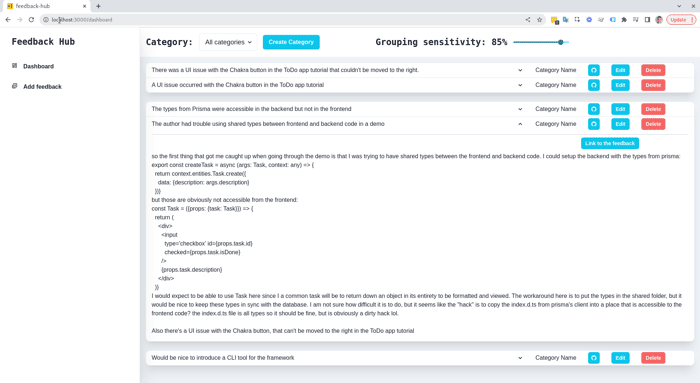
Thanks! It's not live yet, you can check out the demo env: https://feedback-hub-client.fly.dev
The biggest pain point I have right now is understanding the gap between buying and not buying.
I have user surveys of people who bought from me, and I can collect information about and responses from those who have not yet bought from me. ( I have a few anecdotes from them already)
What I really really need to do is synthesize the two groups of feedback to know the gap.
What context does that person who bought have, that that person who did not buy does not have.
And I can, at times, figure this out myself. I can always understand what someone tells me. But I can't just say it back.
Saying or just "telling" someone the gap, doesn't actually bridge that gap for them. Benefits and Features are just empty promises and words on a screen on a homepage.
Testimonials and Success Stories are useless if the reader can't identify with the hero of that particular story.
Highlighting a unique value proposition is still just going to be words.
I'd love to be able to really hone in on the emotions, the context, the feelings, and understand from a non-user's perspective the actual roadblocks and challenges that they need to overcome.
Maybe it's building more knowledge gaps. They know this, you don't. Maybe it is more visual. "I just can't see myself as a member". Maybe it's a completely different unique value proposition than ever before "But I can get everything for free"
No user reviews leaving indie developer unsure if app is useful or not…. People tend to only leave feedback when something is bad… it is human nature….
If it is employee to employer feedback, a Slack bot is great.
If it is customer feedback, the sales reps and customer success team has to be the ones who collect feedback in a phone or video call (and usually are, at least in the most successful companies). But a company reaches a scale that it needs to start automating their feedback loop.
It usually is after Series B/C. Have that in mind for your UX & UI!
Either way it looks great :)
We have a problem getting feedback on your forms backend fabform.io
Most times people won't tell you the good or the bad about your product.
The most challenging part about collecting user feedback is translating from a feeling towards the product to the actual features of the product.
Something might feel wrong to the user, but they will usually not be able to pinpoint exactly what it is and just use another product if they can.
So for the Jira/Github integration to work, the user feedback has to be translated to the technical specifications - maybe this could be done with ChatGPT if the context window allows it. Maybe chunking up the codebase and retrieving chunks from a vector database and adding it to the prompt might help :D