What game devs actually use AI for (5B tokens of data)
I run Ziva, an AI plugin that lives inside the Godot game engine. We've processed over 5 billion LLM tokens across thousands of game projects. Here's what I learned about what developers actually do with AI when it's embedded in their workflow.
The short version: I was completely wrong about what people would use it for.
What I thought they'd use it for
When I started building Ziva, I assumed the killer feature would be code generation. "Tell the AI what you want your character to do and it writes the GDScript." That's how I pitched it. That's what the landing page said. That's what I thought would drive signups.
I was wrong. Code generation is maybe 20% of actual usage.
What they actually use it for
The number one use case, by a wide margin, is debugging. Game devs paste an error, describe what's happening vs what should happen, and the AI figures it out. Not glamorous. Not what makes a good demo video. But it's the thing people actually pay for.
Here's the rough breakdown from our data:
- Debugging and error fixing: ~40%
- Understanding existing code ("what does this script do?"): ~25%
- Code generation (new features): ~20%
- Scene and level editing: ~10%
- Asset generation: ~5%
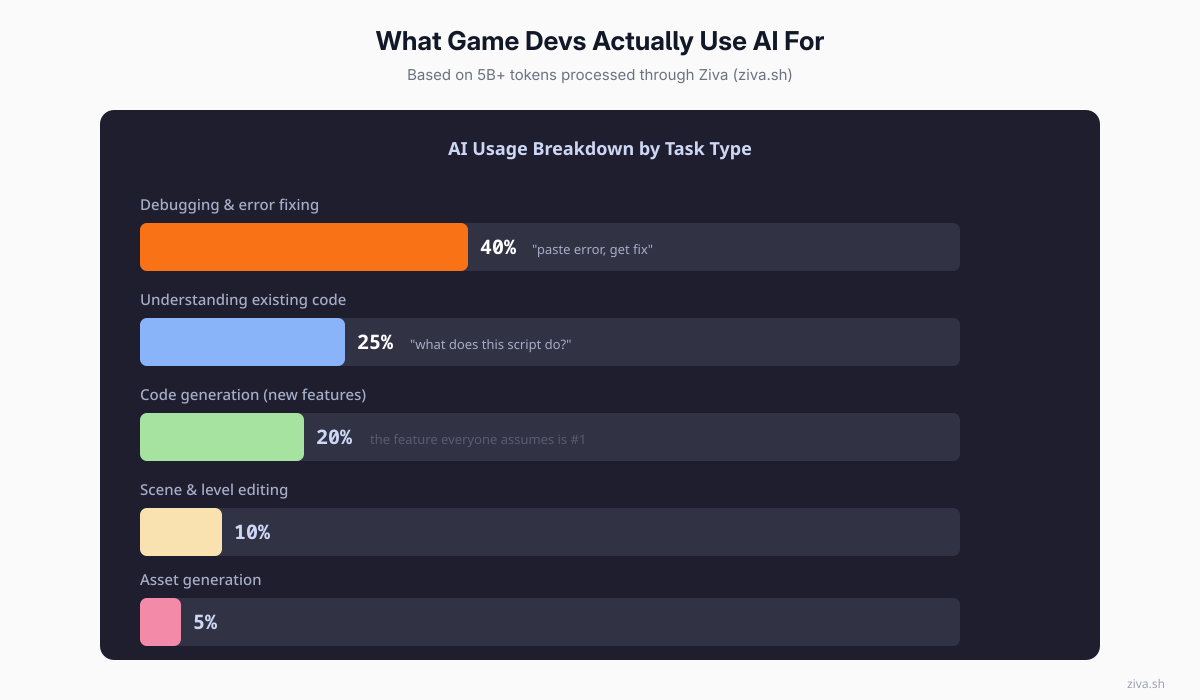
The "understand existing code" bucket surprised me. A huge number of users are working on projects they didn't start. They inherited someone else's codebase, or they're following a tutorial that's 2 Godot versions behind, or they wrote something 6 months ago and forgot how it works. AI as a "explain this to me" tool is way more valuable than AI as a "write this for me" tool.
Why this matters if you're building dev tools
If you're building any kind of AI developer tool, here's the uncomfortable truth: your flashiest feature probably isn't your most valuable one.
I spent months polishing the code generation UX. Making it smooth, adding previews, building a nice animation for when it writes code. That feature gets the most tweets and the most "whoa cool" reactions in demos.
But the feature that keeps people paying month over month? The thing that makes them open the plugin every day? It reads their error logs automatically and tells them what went wrong. Zero setup. No prompting required. It just watches for errors and explains them.
I almost didn't build that feature. It felt too simple. There's no wow factor in "your AI tool reads error messages." But it turns out reliability beats novelty every single time.
The niche advantage
Godot has about 11% market share among new indie studios (per the GDC 2026 report). Unity is at 30%, Unreal at 42%. Every rational person told me to build for Unity first because that's where the users are.
I went with Godot anyway for two reasons:
- Godot's text-based file formats (.tscn, .gdscript) are way easier for AI to parse than Unity's binary serialization. The AI just works better.
- The Godot community is tight-knit and growing fast. 108K GitHub stars. The subreddit is active. When someone in r/godot recommends your tool, that actually means something.
The niche bet paid off. We didn't have to compete with GitHub Copilot or Cursor on their home turf. We just had to be the best AI tool in one specific engine, and let the community do the marketing.
What actually drove growth
For anyone selling dev tools to a niche audience, here's what worked for us vs what didn't:
Worked:
- Answering questions on r/godot without mentioning our product (people click your profile)
- Discord community with fast founder responses (I reply in under 5 min most days)
- SEO blog posts about Godot-specific problems (took 4 months to compound)
- Free tier that's actually usable ($3/month of AI balance, no credit card)
Didn't work:
- Product Hunt launch (tourists, not buyers)
- Cold outreach to game studios (zero conversions)
- General "AI for game dev" positioning (too vague, nobody searches for that)
- Paid ads on any platform (our niche is too small for ad targeting to work)
The biggest unlock was realizing that specificity converts. "AI for game dev" gets ignored. "Paste your Godot error and get a fix in 10 seconds" gets signups.
Current state
We're live on all platforms (Windows, Mac, Linux), supporting Godot 4.2+. Pricing runs from free to $200/month depending on how much AI usage you need. Most users are on the $20 or $50 tier.
Still a lot to figure out. The AI model market moves fast and our costs shift every time a new model drops. But the core insight holds: build for a specific community, solve their boring problems, and let the flashy stuff be the marketing hook rather than the product.
If you're building something for game devs or for any niche developer community, happy to share more specifics. Ask me anything.
