What Happens When a Photo Can Carry Multiple Voices? I Built VoxPho to Find Out
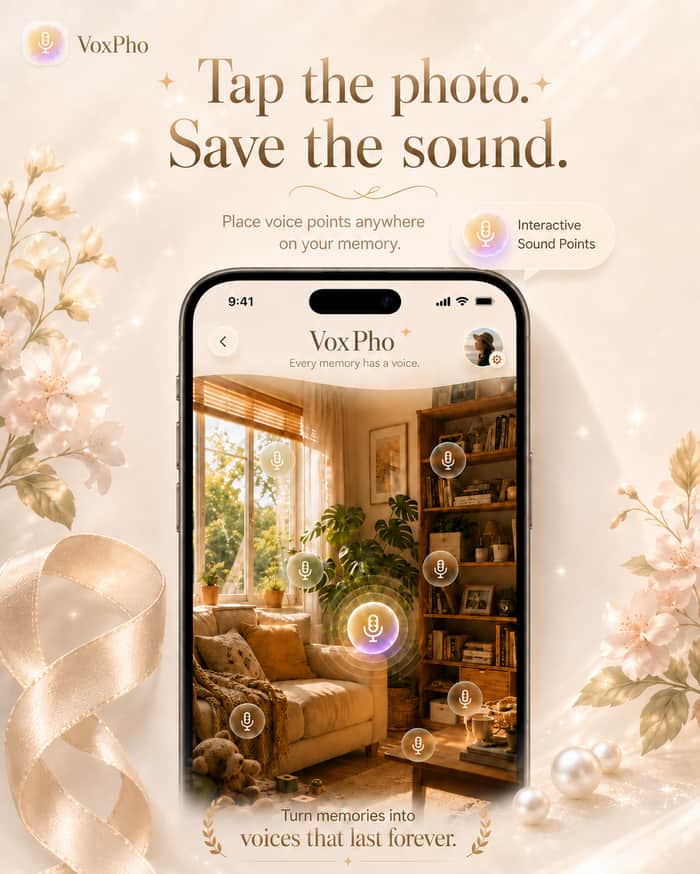
Introduction
We take thousands of photos in our lives, but most of them go silent the moment they’re taken.
A picture freezes what we see, but it loses what we heard:
the laugh behind the camera
the words said in that moment
the small stories no one wrote down
I started wondering:
What if a single photo could hold not just one memory, but multiple voices from that moment?
That question led me to build something small but meaningful — an app called VoxPho.
The Idea
The core idea is simple:
Instead of treating a photo as a static image, what if it became a layered memory?
With VoxPho, you can:
attach voice notes directly onto a photo
place multiple audio points anywhere on the image
replay different moments by tapping different spots
So a single photo might contain:
a child laughing in the background
a parent saying something small but unforgettable
ambient sound from that exact moment
It’s not just a photo anymore.It becomes a scene you can hear again.
Why I Built It
This started from a personal frustration.
I noticed that:
voice messages disappear in chat apps
photos lose emotional context over time
videos are too heavy for simple memories
Everything exists separately.
But real memories don’t work that way.
They overlap.
So I tried to combine them into one simple object:👉 a photo that can carry multiple voices.
Not a social network.Not a complex editing tool.Just a way to preserve moments more completely.
What I Learned Building It
Building VoxPho taught me something simple:
People don’t just want to save memories.They want to re-experience them.
Not through perfect media, but through fragments:
a sentence
a laugh
a short explanation
a sound you forgot existed
Even small audio details can completely change how a photo feels.
Where It Is Now
VoxPho is still early.
It’s an experiment in one idea:
Can memory be richer than just visuals?
Right now I’m testing:
how people use voice with photos
whether multiple audio points feel natural
whether memories become more emotional when sound is added
There’s still a lot to improve.
But the direction feels worth exploring.
Closing Thought
We usually think of photos as finished objects.
But maybe they’re not finished at all.
Maybe they’re just the surface.
And underneath them… there are sounds waiting to come back.
If you’re interested in experimenting with this idea, you can find VoxPho on the App Store.

the idea hits for me on old family photos specifically, the ones where i can't remember who said what. but i wonder if the people who'd love this most are the ones who won't set it up at the moment the photo's taken. you kind of need the audio captured live for it to land, and that's a behavior change. maybe it works better as something you add to old photos with a voiceover after, idk. not sure which way you're leaning.
Thanks everyone for the feedback 🙏
Based on early comments, we’re seeing people use VoxPho more for ___ than expected.
I’ll share updates as we improve it — curious what else you’d want to see.
This really hit me. I've got photos on my phone from years ago that I never look at because they're just... silent. The laugh, the joke someone made, the way my grandma said something — all gone.
The fragments thing you mentioned is so true. A perfect recording would feel staged. A crackly 3-second voice note attached to a photo? That's memory."
I'm really happy to be able to help you, it's my honor.Actually, it records for more than 3 seconds
you attach voice notes directly onto photos, The product exists. I can show it. People who try it say it’s interesting.
But there’s a problem I didn’t expect to be this hard:
I have no real way to get users.
If possible, I hope you can use it and get the first App Store review.
That's a unique project! You mentioned that this can solve for "what we heard: the laugh behind the camera, the words said in that moment". However, if a picture is already taken then it would be impossible to record the voice of the moment. I would suggest you allow users to record a temporary video, which contains all the sounds then turn it into a picture which your app is already capable of !
Really appreciate the suggestion — and I see why that feels like a natural approach.
The way I’m thinking about it is slightly different though. I’m not trying to capture everything in real time like a video does. Instead, I’m treating the photo as a “memory anchor”, and the voice layers as something users attach when they reflect back on that moment.
So it’s less about recording the moment perfectly, and more about reconstructing the emotional context afterward — which is actually how memory works for most people.
That said, I do think there’s an interesting overlap with video, and I’m still exploring where the boundaries should be.
The problem statement is clean: voice messages disappear, photos lose context, videos are too heavy. "A photo that carries multiple voices" is a coherent answer to that.
The thing I'd watch closely in your testing: where do people attach audio? On faces, on objects in the frame, or on blank areas? That behavioral data tells you what people think they're preserving — the person, the moment, or the feeling. Each answer points toward a different product direction.
The biggest question for something this early is usually about the replay experience, not the capture experience. Recording a voice point onto a photo is one action. Coming back six months later and hearing it again — that's the emotional payoff you're actually selling. Worth designing specifically for that moment rather than just the creation flow.
Good direction. The "photos are surfaces, not finished objects" framing is the kind of thing that sticks.
This aligns closely with what I’m seeing as well.
Voice messages disappear, photos quickly lose context, and videos often carry too much weight for something that should feel instant and personal. That gap is exactly what makes the problem interesting to me.
I’ve been experimenting with a different direction — treating a photo not as a static object, but as a container for multiple voice moments anchored in time and place. It’s early, but I’m also thinking about where this could go longer term: a new kind of “audio-layered memory” medium, and eventually a community built around sharing and exploring these living photos.
Appreciate your perspective — the replay experience is exactly where I think the real value lives.
This is a really cool idea! 🔥
I love how you turned a simple photo into something that can hold multiple voices and memories. The concept of tapping different spots on one image to hear different audio feels fresh and emotional.
Great execution for an early experiment.
Really appreciate this — glad the idea came through clearly.
That “tap different spots, hear different memories” behavior is exactly what I’m trying to explore: photos as living memory spaces instead of static images.
Still early, but I think this could evolve into a completely new way of capturing and sharing moments.
This is a really interesting direction — it feels like you’re basically turning photos into “multi-layer memory objects” instead of static media.
What stands out is the shift from capture → reconstruction of experience. Photos alone freeze visuals, but adding multiple voice layers starts bringing back context, emotion, and perspective in a way that feels closer to how humans actually remember moments.
The biggest challenge I see is not the concept, but UX clarity — making it intuitive to place, discover, and replay those audio layers without it feeling complex or noisy. If that works smoothly, it could feel surprisingly natural.
Overall, it’s a compelling idea because it sits between photo, voice note, and storytelling, instead of trying to replace any one of them.
Really appreciate such a thoughtful breakdown — especially around the UX challenge.
You’re absolutely right that the core risk isn’t the concept itself, but making it feel intuitive rather than complex or noisy. That’s actually what I’m spending most of my time thinking about right now.
The direction I’m exploring is less about “managing audio layers” and more about making those voices feel naturally tied to context — almost like they surface as part of remembering the moment, instead of being something the user has to organize manually.
Still early, but feedback like this is exactly what helps shape it in the right direction.
The part I'd be most curious about isn't whether people like adding voice to photos.
It's which of those three assumptions actually deserves the credit if they do.
Different answers could lead to very different versions of the product.
That’s a sharp way to frame it.
Right now I’m basically testing three bets behind the same feature set:
(1) people want richer memory capture
(2) people want spatial / “place-based” storytelling on a photo
(3) people want a new social/share format, not just a personal tool
You’re right that the winner changes the whole direction — it decides whether this becomes a retention-driven memory tool, a creative storytelling format, or something social/distribution-heavy.
What I’m watching in early usage is pretty simple: do people come back to replay, do they mostly create but not revisit, or do they share outward.
Curious from your side — if you had to bet, which one do you think is actually carrying the value?
Possibly.
The reason I stopped short is that I don't think the interesting part is which one I'd bet on.
I think it's what decision deserves confidence before the product starts getting shaped around one interpretation instead of the others.
That's where founders can end up with very convincing signals pointing in the wrong direction.
I wouldn't try to unpack that properly in a thread.
If you're curious, drop your email and I'll send over the tighter version.