What happens when your AI feature works… but the business underneath it starts breaking?
Hey Indie Hackers,
I’m Yuvraj, co-founder of synvolv.com.
I’ve been speaking with founders and platform engineers building AI into real products, and the pattern that keeps bothering me is this:
the product can be working exactly as intended,
and the business can still start feeling less stable underneath it.
An AI feature ships.
Adoption looks good.
Customers use it more than expected.
Prompts get longer.
Retries stack up.
Fallbacks kick in.
One account starts consuming far more than the rest.
Nothing is “broken.”
In fact, from the outside, it can look like success.
But that is exactly where the deeper problem begins.
Because once AI becomes part of the product, usage is no longer just usage.
It becomes economics.
It becomes margin.
It becomes control.
And I think that is part of the new order we are entering with AI software:
the challenge is not only building intelligence into the product.
It is building enough control around that intelligence so the business can actually sustain it.
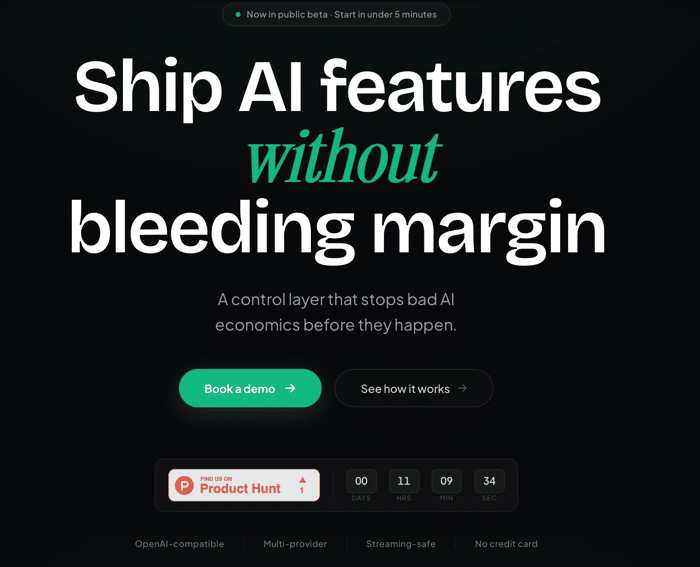
That is the obsession behind Synvolv.
We’re building Synvolv for B2B SaaS teams that want to scale AI features without losing visibility, economic control, or confidence in what happens when real demand arrives.
To me, this is not a small tooling problem.
It is a product and business problem hiding inside infrastructure.
And I’m posting it here because Indie Hackers is one of the few places where builders will actually tell you if you’re seeing something real, or just getting carried away by the market.
So I’d love to ask this openly:
have you felt this shift too?
Have you seen AI create value for users, while at the same time making the business harder to defend as usage scaled?
If yes, I’d genuinely love to hear where that tension showed up first for you.

Part of why I wanted to post this here is because builders usually see this shift early.
Something can look like product success on the surface,
while quietly becoming harder to sustain underneath.
That feels like a very important conversation in AI right now.