What I learned using soundscapes to support focus in my product
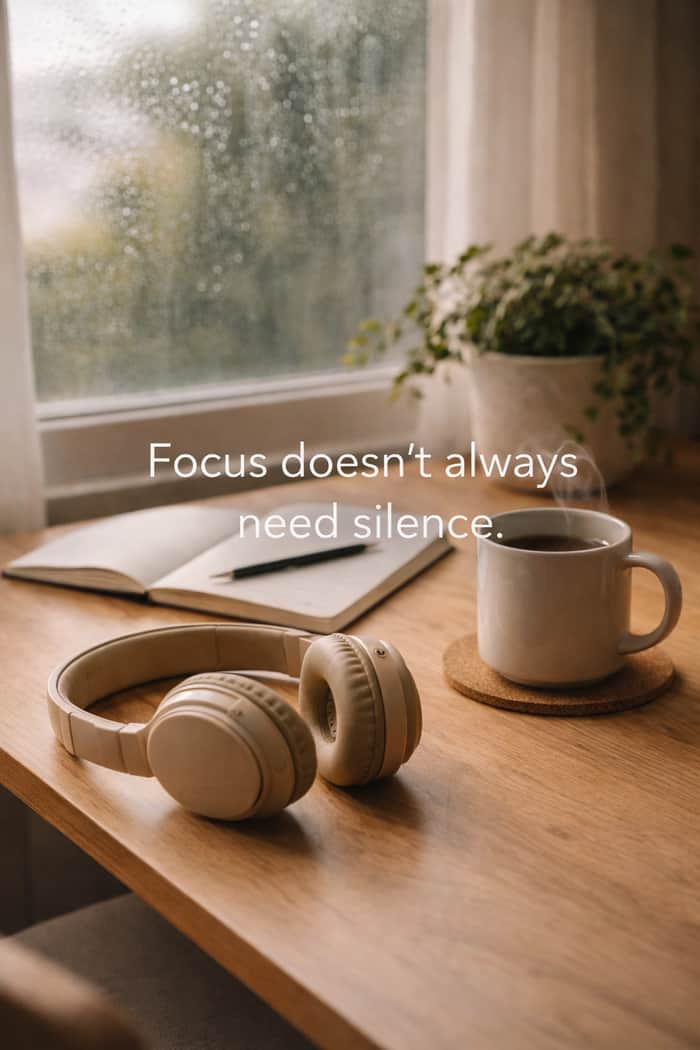
While building Focushala, I spent more time than expected thinking about sound.
Most productivity tools either assume silence or push music meant to energize. From my own experience, neither works consistently — especially over long periods.
So instead of treating sound as background music, I started treating it as part of the focus environment.
In Focushala, soundscapes are designed to:
be predictable and non-intrusive
reduce mental noise rather than add stimulation
help users settle into a session instead of hype themselves up
Think gentle rain, soft ambient layers, subtle nature sounds — sounds you stop noticing once focus kicks in.
One thing that stood out:
People don’t want sound to motivate them.
They want sound to hold space while they do the work.
Used this way, soundscapes support consistency more than intensity — especially on low-energy days.
Curious how others here think about sound:
Do you work best in silence, music, or ambient noise?
Has anyone experimented with sound design inside their product?

Interesting experiment. With focus-related features, I’ve noticed the tricky part is separating perceived calm from measurable behavior change.
Curious — what’s the one signal you’re using to decide whether soundscapes are actually helping users focus (longer sessions, fewer task switches, completion rate, etc.)?
That’s the hard part, agreed. We’re currently looking at session length and reduced task switching as early signals, while validating them qualitatively with user feedback. Still very much in learning mode.
That makes sense. Session length + task switching is a solid early proxy, especially when you sanity-check it with qualitative feedback. Feels like the right balance at this stage.
The distinction between "sound to motivate" vs "sound to hold space" is really insightful. Most focus products seem designed for the highlight reel moments - the intense deep work sessions. But you're right that consistency matters more than intensity.
I've noticed I switch between modes. For creative/writing work, I need near-silence or extremely predictable ambient sounds. For more mechanical tasks (email, data entry), I can handle more structured audio. The predictability point you made seems key - it's the unexpected changes that pull attention away.
Have you experimented with any adaptive elements - like soundscapes that shift subtly based on session length or time of day? Or does the simplicity of static ambient work better because there's nothing to "figure out"?
This matches what we’ve observed too. Creative work tends to need near-silence or very predictable sound, while more mechanical tasks can tolerate structure. The predictability point is key — even subtle changes give the brain something new to track.
On adaptive sound: we’ve been intentionally cautious. Anything that shifts automatically can become another thing to notice or “figure out.” In many cases, static ambient audio disappears more effectively and simply holds the space.
We’re leaning toward predictable by default, adaptive only if explicitly chosen — respecting different modes without turning sound into another control surface.
Curious: do you notice this shift more by task type or by energy level?
For me it's definitely task type first, energy level second.
Writing/creative work = near-silence mandatory. Even predictable ambient gets filtered out eventually, but any novelty pulls me back.
Code/debugging = can handle more structure, maybe because there's already a rhythm to the work itself.
Low energy days = I actually prefer more ambient texture. It masks the mental static that shows up when reserves are low. Almost like the sound fills the gaps my focus can't.
Your "predictable by default, adaptive only if chosen" approach sounds right. Automatic shifts create micro-decisions - "wait, did something change?" - which defeats the purpose.
Appreciate the thoughtful product thinking here.
This is a really clear articulation — especially the point about ambient texture on low-energy days “masking the mental static.” That matches what we’ve seen too: sound isn’t just about focus, it’s about regulating what the mind has to contend with in that moment.
Your note about rhythm in code/debugging is also important. When the work already has an internal structure, external structure is less disruptive.
This kind of nuance is exactly why we’re cautious about automation. Once sound creates even a hint of “did something change?”, it stops holding space and starts competing for attention.
Appreciate you sharing this — it sharpens the thinking.
The framing of "regulating what the mind has to contend with" resonates. It positions sound as environmental management rather than productivity hack.
And you've hit on something with "holding space vs competing for attention." That's the failure mode of most ambient tools - they start helpful, then become one more thing the brain is tracking. The cognitive load sneaks back in through the side door.
This thread's been valuable. Always good to find people thinking carefully about the invisible parts of the work environment.
Sharing the product I mentioned above in case it’s useful:
https://focushala.com/
We’re opening early access soon — early users will get 2 months of complimentary Prime membership at launch.
Would love feedback from fellow builders who care about calm, sustainable focus 🌿