What I shipped to make Rubies Unleashed feel like a real platform (not just a list of links)
There's a version of a publishing platform that's basically just a directory. Projects go in. People browse. That's it.
That was Rubies Unleashed six months ago. Good enough to launch, not good enough to stay.
The thing I kept noticing was that people were coming back. Not because I asked them to, just because they were curious about what was new, or they remembered a project they'd seen, or they wanted to check on something they'd bookmarked in their head. There was engagement trying to happen, but no infrastructure for it.
So I built the infrastructure. Here's what shipped.
Wishlists
The smallest feature with the most downstream impact.
Save any project. Your wishlist is public by default (private if you want). Other users can see what you've saved. Creators can see how many people have wishlisted their work.
But the bigger impact: wishlist count feeds directly into how projects surface on the platform. It's one of the key inputs for trending scores and for the automated Editor's Choice selection that runs daily. When you wishlist something, you're not just saving it. You're giving it a push.
For context on why this matters: we have 80 projects on the platform. The signal-to-noise problem is still manageable. But as that grows, wishlists become increasingly important as a quality filter. People's saves reflect genuine interest, not algorithmic inflation.
Reviews with developer replies
Standard reviews: star rating (1 to 5), written feedback, tied to your account.
The part that isn't standard: the developer can reply.
This sounds small. It isn't.
Most platforms treat reviews as a read-only data stream for creators. Ratings go up or down and there's no mechanism for a developer to engage with the feedback. Here there is. A creator can respond to a bug report in a review, clarify how a feature works, or just say thank you to someone who wrote something kind.
It changes the relationship between creator and audience from passive to active.
Other details:
- Rating distribution chart on every project so you can see the full picture, not just the average
- Review notifications anchor directly to your specific review so there's no hunting through the page
- No anonymous reviews, which keeps quality signal intact
The Community Hub
The most complex thing I shipped in this batch.
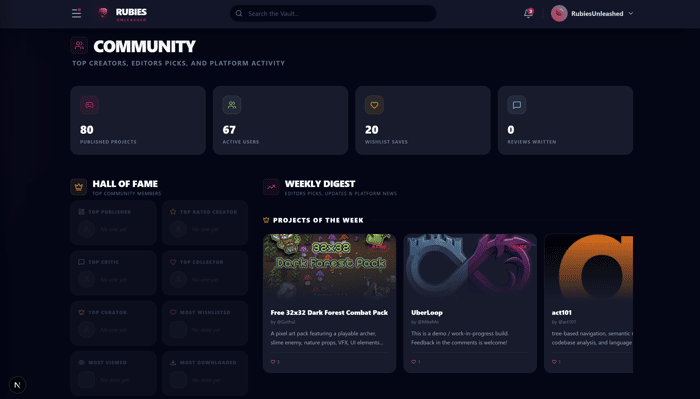
rubiesunleashed.app/community is a live view of the whole platform.
Live Activity Feed — real-time events. Someone publishes a new project. Someone leaves a review. A creator ships an update. A project gets wishlisted. 30-second refresh. The platform feels alive.
Hall of Fame — computed daily from real data. Seven categories:
- Top Publisher
- Top Rated Creator
- Top Critic (most reviews written)
- Top Collector (most projects saved)
- Top Curator
- Most Wishlisted Project
- Most Viewed Project
Not editorial. Earned.
Weekly Digest — Editor's Choice picks, recent changelogs, and automatic milestone cards. When a project crosses a view or wishlist threshold, a milestone appears automatically. No manual curation required.
Discord to Website — our Discord announcements pull directly into the community page via Discord's REST API, cached every 5 minutes. Platform news shows up on the site without me copying anything manually. People who aren't on Discord still see announcements.
Stats — total projects, users, wishlist saves, reviews. Filtered to real published content. Honest numbers.
Five automated emails:
- Welcome on signup
- Password change notification
- Weekly digest with Editor's Choice, activity, and milestones
- Monthly recap
- Re-engagement at 90 days inactive
The digest and recap are the ones that move the needle. They're not marketing. They're a summary of what actually happened on the platform. Real projects, real activity, real milestones.
Everything opt-out. Unsubscribe from any email independently.
Revenue and business model
Zero. This is free. I'm building in public while I figure out what sustainable looks like.
Right now I'm focused on building the best possible platform for indie creators and their audiences. Monetization is a later problem. The platform has no ads and no paywalls.
Metrics
- 80 projects live
- 67 registered creators
- Platform live since December 26, 2025
- Creator accounts live since January 13, 2026
Not huge numbers. But everyone on the platform is there because they wanted to be, not because an algorithm pushed them there.
What's next
A few things I know need work:
- Analytics for creators (just shipped this, separate post coming)
- Better onboarding for new creators
- More collection types in Explore
- Mobile experience polish
Happy to answer questions about any of this, the technical choices, the product decisions, what worked and what didn't.
What features actually moved the needle for your platform?

What caught my attention is how many of these features are designed to strengthen activity inside the platform.
The risk isn't that they don't work.
It's that activity can become increasingly visible without necessarily becoming increasingly valuable.
That's a distinction that's easy to miss when engagement starts improving.