What if a debt-payoff app copied anti-addiction apps, not fintech?
The moment nobody builds for
I kept seeing people around me gamify their own way out of debt, or wonder how to actually start saving, without any app doing it for them.
So I went and did the research. The insight wasn't "people don't know where their money goes." They do. The gap is one specific, repeatable moment: open the banking app, see the number, close it, then doomscroll or comfort-eat for twenty minutes. Relief without action. That moment has a dopamine loop built for spending and nothing built for the useful thing.
Stealing the anti-addiction playbook
Brainrot and Unrot solved a version of this same problem in reverse: a living avatar that decays the longer you scroll, friction before you can open the time-sink, stats you earn back by doing something real off your phone.
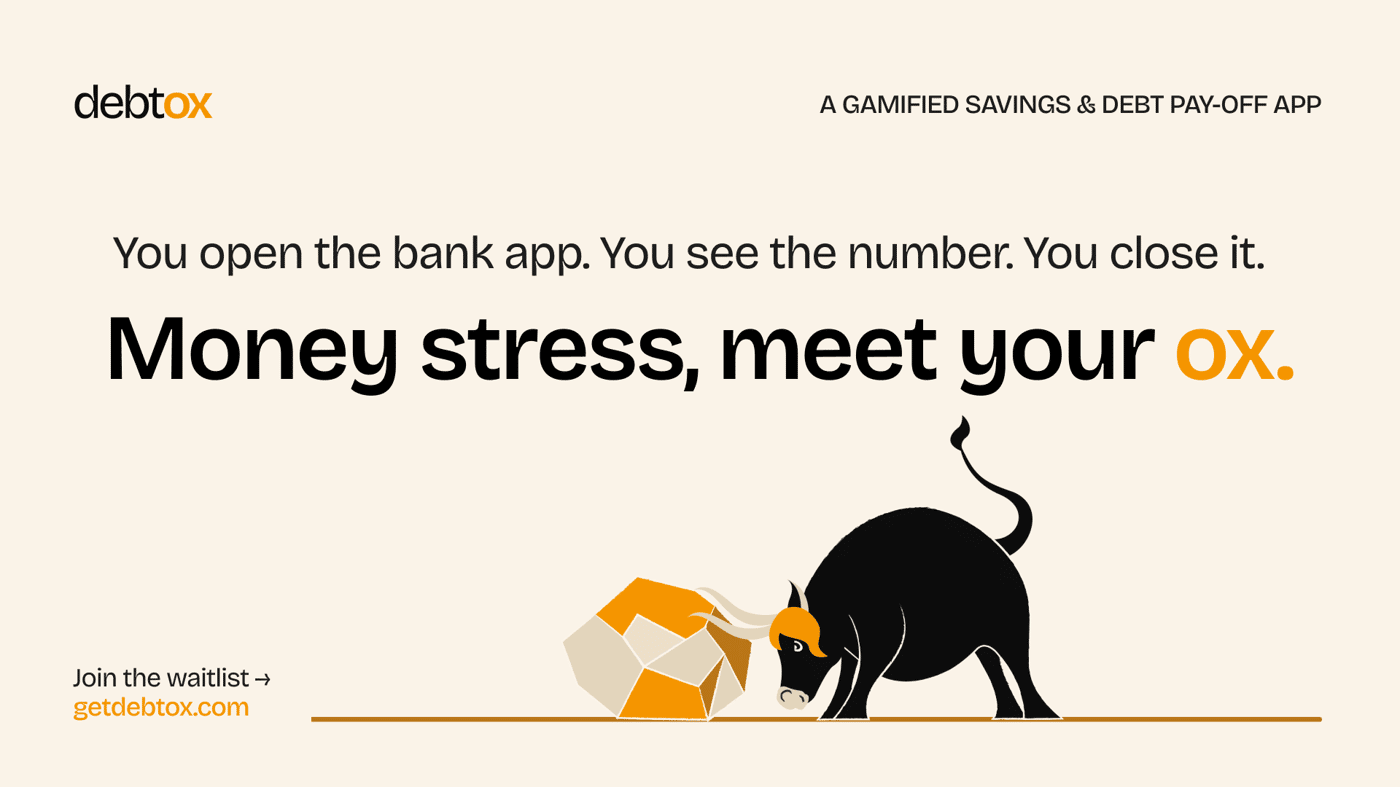
I borrowed that craft for Debtox and flipped the one part that mattered. Their avatar punishes you. Ours doesn't. The ox works while you work, and when you stop, it just sits down and waits. Debt is a rock it pushes down, savings is a cushion it builds up. One small money move a week is the unit, never a budget.
What I killed
Early on, the "draw a different move" interaction was a straight-up fortune wheel. Three spins a day, come back tomorrow. Fun in a prototype.
I killed it after testing it with a small poll of users. A spin wheel is mechanically a slot machine, and debt and gambling vulnerability overlap in ways that are well documented. "Come back tomorrow" is a catalogued engagement dark pattern. I didn't want to build the thing I was setting out to fight.
What replaced it: same beat of anticipation, but every draw is a real, doable move, never a jackpot or a blank. If nothing lands, there's an honest exit: tell us what you'd actually do.
How it's built
No local codebase, on purpose. Debtox runs on TanStack Start (SSR) on Cloudflare Workers with Supabase, built almost entirely through Lovable, an AI builder, with me relaying specs and Claude Code handling the research and reasoning behind each decision. Concretely:
A weekly behavioral email system (Sunday nudge, Monday recap), timezone-targeted per user
60+ move templates across two languages (English and Spanish), each grounded in real behavior research: cost-per-wear, subscription-audit stats, automatic-transfer inertia
PostHog wired end to end for retention tracking before scaling past a handful of testers
Where it stands
Beta opening in waves. The weekly loop, the challenge system, and the email cadence are live. And a Rive animator bringing the ox to life, everything else is verification and polish.
What I'd love your take on
I keep drawing a hard line: anything that smells like a dark pattern gets killed on sight, even if it would probably work. Where do you draw that line in your own products, especially anything touching money or habit?

