What If I Delete 50% of My Features?
A few months ago, I had an unsettling thought:
"What if I deleted half of my product’s features?"
I wasn’t planning on doing it (yet), but the idea kept nagging at me. Like many founders, I had spent months (or years) building, tweaking, and expanding my product. But what if all that extra functionality was actually slowing it down? What if my users didn’t even need half of what I had built?
So, I decided to run a thought experiment. I challenged myself to strip my product down to the bare essentials—the core features that actually mattered.
And the results? Eye-opening.

The Feature Creep Trap
Let’s be honest: building features is fun. Every new feature feels like progress.
But there’s a hidden cost:
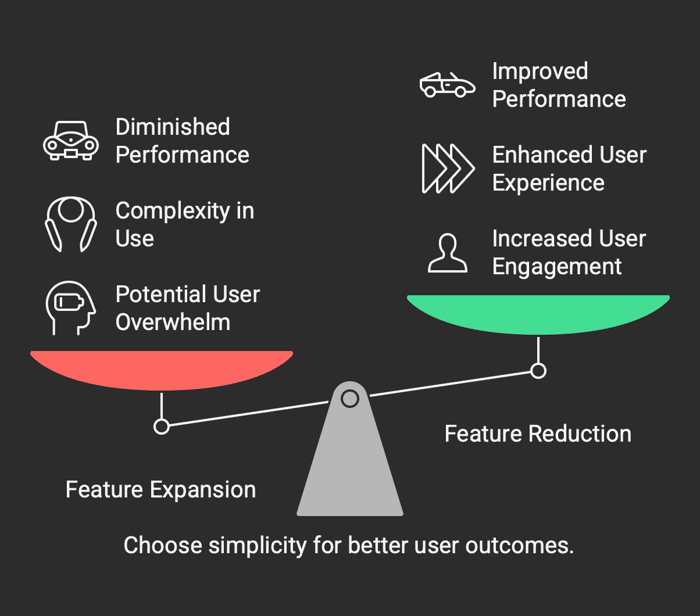
- More features = More complexity (for both users and developers).
- More features = Higher maintenance costs (more things break).
- More features = Lower adoption rates (users get overwhelmed).
A famous study by Harvard Business Review found that the biggest driver of customer loyalty is simplicity—not more features, but easier usage.
And yet, SaaS founders (including me) often fall into the feature creep trap. We keep adding things, thinking more is better. But is it?
The 50% Feature Cut Challenge
I decided to test this by asking myself:
"If I had to delete 50% of my product’s features today, which ones would I keep?"
I grabbed a spreadsheet and listed out all the features in my product. Then, I grouped them into three categories:
✅ Essential – Users can't live without these.
🤔 Useful – Nice to have, but not critical.
❌ Rarely Used – Added because they seemed like a good idea.
Surprisingly, I found that over half of my features fell into the "Useful" or "Rarely Used" categories.
Even more surprising? Some of the ones in the "Rarely Used" category had taken the most development time.
Lessons Learned from the Experiment
1. The 80/20 Rule is Real
You’ve probably heard of the Pareto Principle (80% of results come from 20% of efforts). Turns out, this applies to SaaS as well.
For most products, 80% of users only use 20% of features.
There’s even data to back this up. A study by Pendo found that only 12% of features in a typical software product are used regularly.
That means we’re spending time building and maintaining 88% of features that barely get used.
2. Features Can Hurt More Than They Help
A bloated product isn’t just a pain for developers—it’s frustrating for users too.
Consider the paradox of choice: The more options people have, the harder it is to decide.
A famous experiment by psychologists Sheena Iyengar and Mark Lepper found that when people were presented with 24 jam flavors, they were less likely to buy than when they were offered just 6 flavors.
Too many choices create decision paralysis.
The same happens with SaaS products. The more buttons, settings, and options we throw at users, the less likely they are to engage.
3. Simplifying Leads to Faster Growth
Slack, one of the fastest-growing SaaS companies, started with a super simple product: messaging.
They didn’t launch with advanced integrations, workflows, or automation. They focused on one thing and did it well.
Now, Slack has a ton of features—but they built those over time, based on real user demand.
The key lesson? Start simple, stay simple.
How Fuzen Reinforces This Approach
This is exactly why Fuzen, a no-code platform, works so well. Instead of overwhelming users with unnecessary complexity, Fuzen allows businesses to build simple, customized workflows that focus on what truly matters.
By enabling users to create streamlined solutions without coding, Fuzen helps avoid feature bloat while still delivering high-value automation.
The best part? Fuzen grows with its users, adding complexity only when needed—not by default.
What I’m Doing Differently Now
So, am I actually going to delete 50% of my features? Not overnight. But here’s what I am doing:
✅ Tracking actual feature usage. (If less than 10% of users touch a feature, it’s a red flag).
✅ Asking customers what really matters. (Instead of assuming, I ask).
✅ Prioritizing depth over breadth. (Better execution on fewer things).
And when I build new features, I ask myself:
“Will this make my product simpler or more complex?”
If it makes things more complex without a clear benefit, it’s probably not worth it.
Would You Take the 50% Challenge?
Now, I want to throw this challenge back at you:
If you had to delete 50% of your product’s features today, what would you keep?
Would your product still deliver value? Would it actually be better?
I’d love to hear your thoughts—let’s chat in the comments. 👇
