What if the next social platform isn’t photos or videos — but memories you can actually hear?
For the last decade, social media has been dominated by two formats:
Photos (Instagram)
Short videos (TikTok, YouTube Shorts)
Both are powerful. But both share the same limitation:
they only preserve what you can see.
- Something always gets lost in every photo
When you take a photo of a moment, you lose:
the voices in the background
the way someone said something
the laughter that happened off-frame
the emotional tone of the moment
the context that made it meaningful
A photo is not the memory.
It’s just the visual residue of it. - I kept thinking: what if a photo wasn’t silent?
That question led me to build VoxPho.
The idea is simple:
A photo should not be a single moment. It should be a container of moments.
So instead of attaching a caption or a single voice note…
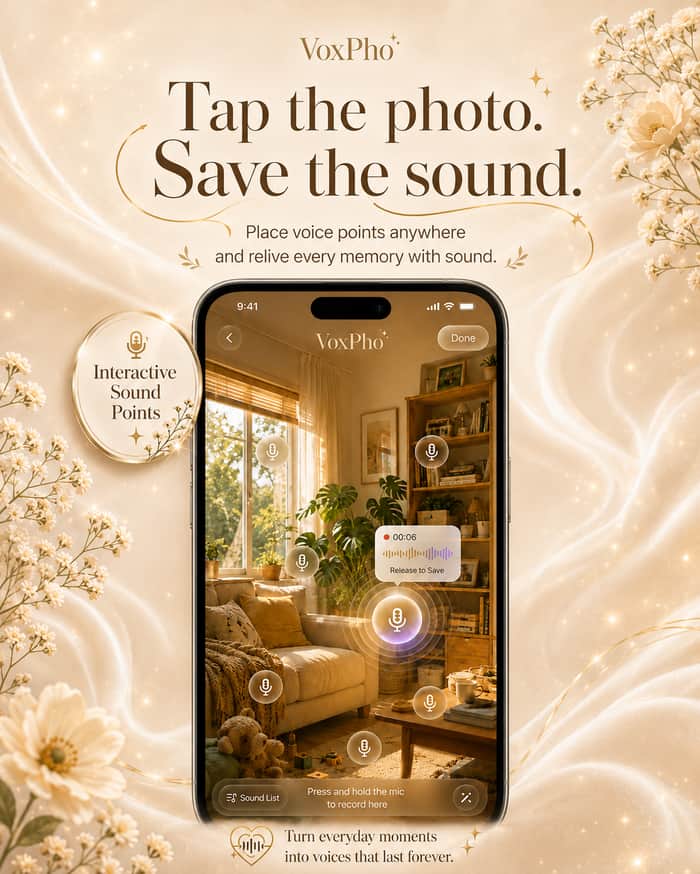
You can place multiple voice points directly on a photo.
Each one anchored to a position.
Each one tied to a specific memory. - A photo becomes something you explore, not just view
In VoxPho:
tap a corner → hear someone laughing
tap another spot → hear what someone said
tap the center → hear the “main moment”
layer multiple voices on the same image
Suddenly, the photo is no longer static.
It becomes a spatial memory map. - This changes what “sharing” means
Today:
post → scroll → like → forget
With VoxPho:
post → explore → listen → remember
The goal is no longer just engagement.
It’s memory reconstruction. - Why I think this matters now (not 5 years ago)
This idea probably wouldn’t have worked before:
audio capture was inconvenient
storage was expensive
UX for multi-layer content didn’t exist
But now:
recording voice is instant
storage is effectively free
touch-based interaction is natural
So the only real question is:
do people want richer memories, or just better feeds? - VoxPho is not trying to replace Instagram or TikTok
It’s not trying to be a better feed.
It’s trying to answer a different question:
What if memory itself was a social object?
Not just what you saw.
But what you heard.
And where you heard it. - The uncomfortable assumption behind this
If VoxPho is wrong, then:
photos are enough
video already captures “everything important”
audio is just an add-on, not a structure
If VoxPho is right, then:
we’ve been sharing memories in 2D, when life is actually multi-layered.
Curious what others think:
Is this genuinely useful or just a niche idea?
What would be the first real use case that makes this stick?
Would people actually go back and “re-hear” memories?

Some honest feedback?
Audio is temporal. An image is an instant. Combining the two feels like an awkward experience to me. Like sometimes you go to a museum and they show you photos from World War II and then they add on some sound in the background to make it feel more immersive. They do that because they couldn't shoot a video. What I have seen sometimes is a short six second video that sort of captures a still moment. And that also captures sound, but it feels more immersive because you're seeing the wind the curtains wafting in the wind, you're seeing a bird fly by, but you're looking at somewhat of a still experience.
What stood out to me isn't the audio layer itself.
It's that you're framing this as a memory product rather than a social product.
I suspect the answer to "does this stick?" changes a lot depending on which of those people believe they're using.