What if your product data could catch you procrastinating?
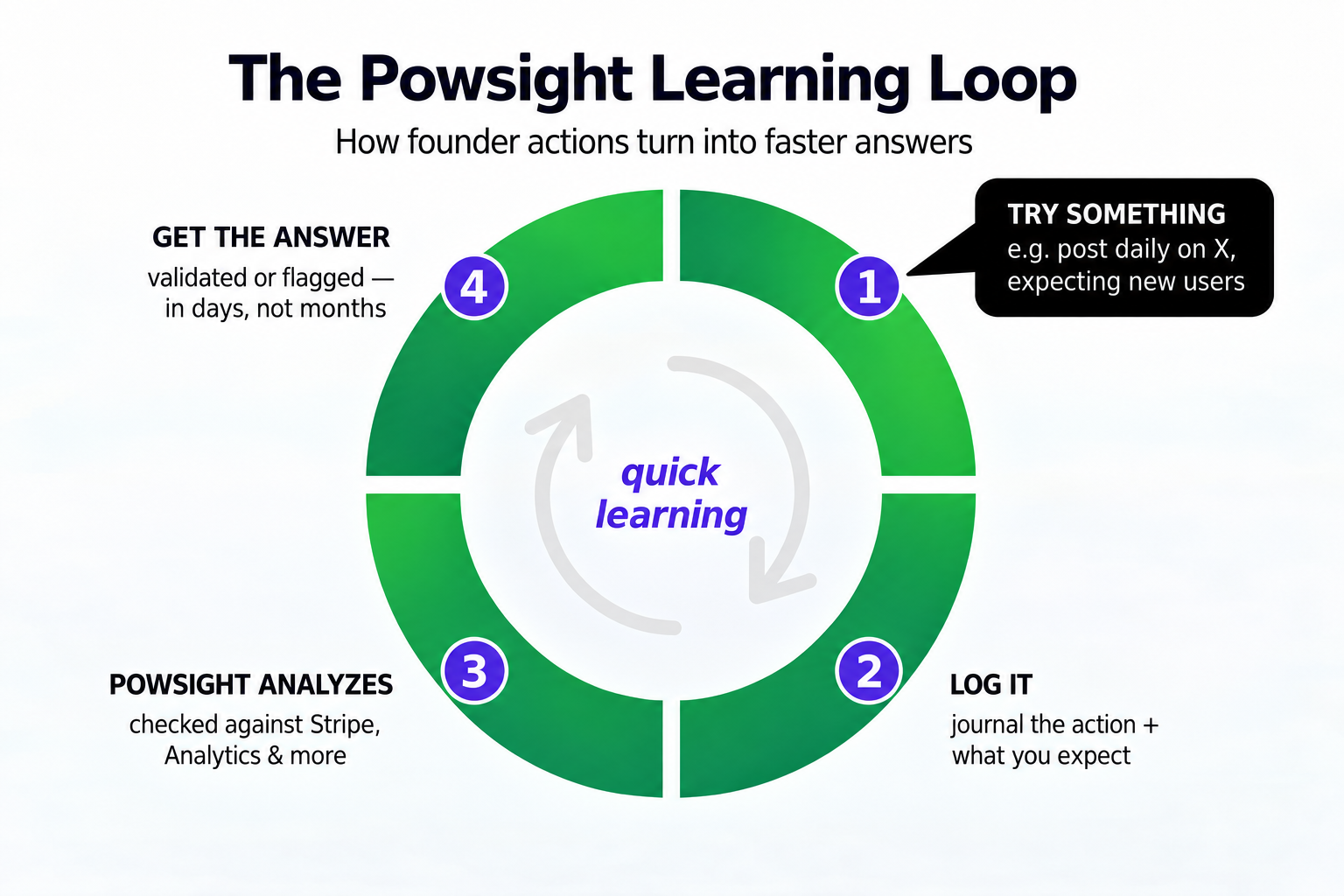
About 2 weeks ago, an indiehacker suggested to integrate founder inputs into our saas growth engine in order to create learning loops. If a user forms a hypothesis that's later invalidated by hard data (financials, analytics), we should flag it as fast as possible — so the founder understands, quickly, what works and what doesn't.
Think of something like "I've posted on X every day for the past 2 weeks about my saas use cases. I expect to get some new users from it." Now what if that doesn't happen? Or worse — what if you keep doing it exactly the same way, hoping it eventually will? Shouldn't you find a better use of your time — a different activity, or just the same with different content — the moment the data tells you the return isn't there?
So we launched Journaling, feeding directly into Insights, and deployed a new agent whose only job is analyzing the impact of your actions in the context of the data your users generate. This all with a single goal -- accelerate how fast a founder understands what's working and what isn't.
Then, we started using it ourselves and ...
⚠️ Meta-Product Tweaking Replaced Distribution
Four weeks after the launch we were still launching features, refining the design, improving performance -- the death trap of a software enginneer turned saas founder. That would have been fine if not for taking up all of our attention, which made us ignore distribution altogether.
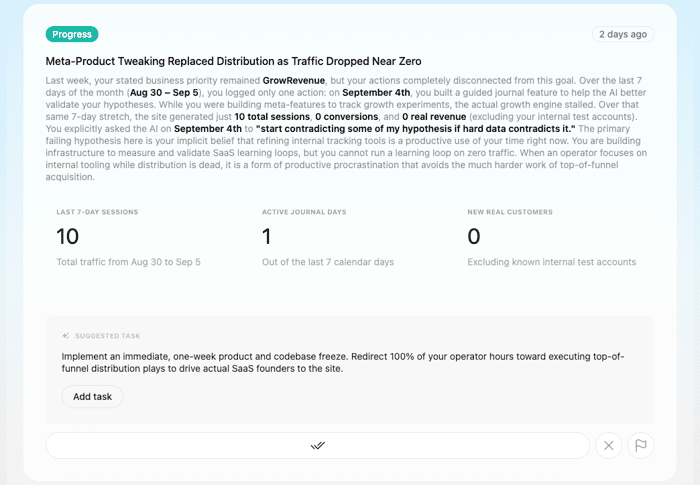
🧐 The agent noticed it, and called it out:
10 total sessions, 0 conversions, and 0 real revenue
The primary failing hypothesis here is your implicit belief that refining internal tracking tools is a productive use of your time right now. You are building infrastructure to measure and validate SaaS learning loops, but you cannot run a learning loop on zero traffic. When an operator focuses on internal tooling while distribution is dead, it is a form of productive procrastination that avoids the much harder work of top-of-funnel acquisition.
This also made us remember that we had no funnel. This was something another agent flagged 6 days ago but we were too busy tweaking the product and ignored it. We were aware our landing page was not clear enough (it was one of the things we sacrificed to move fast) but this meant visitors would not understand what we do.
So we dropped active development, redesigned the landing page from scratch, and restarted distribution — which is exactly what I'm doing right now, writing this.
The new landing page is live: https://powsight.com — rewritten specifically so the value we offer is obvious in the first few seconds and becomes more evident as you scroll down. If you've got 30 seconds, I'd genuinely love to know: does it get the point across? Is it clear what we do and who it's for, before you have to think about it?
Long story short, I'm glad the Progress agent worked exactly as intended — call it out when something we do isn't impactful enough, or whenever our hypotheses get invalidated by data.
So, is there a chance you're in a similar spot: busy instead of impactful?

The piece I'd want the loop to be able to reach: an agent scoring your throughput is structurally biased toward "keep going, adjust the inputs" and away from "this line of effort isn't paying, drop it". You said yourself someone has to be willing to act on the flag — the hardest flag to act on, and the hardest for the agent to raise, is the one where the right move is to stop the activity rather than iterate on it.
its nice
The story about an agent spotting the missing funnel, then getting ignored, feels painfully familiar. I'd make the next test almost embarrassingly small: one audience, one promise, one channel, and a deadline to decide if it made any difference. Tracking helps when it changes what you do. Otherwise, it can become a polished excuse to avoid talking to people.
imo it shouldn't be one channel only -- the purpose is not to do a single thing and throw your hands in the air -- the most effective thing is to continue to work while your small bets compounds and get tracked and assessed
yep, you're right
The “procrastination” signal is a useful framing. I’d also separate “no activity” from “activity with no learning”: a short weekly review of the last meaningful user action could keep the dashboard from turning into another vanity-metric feed. What’s the smallest action you count as a real signal?
is there an example you have in mind for “activity with no learning”?
every action is taken into account at asessment time
“Productive procrastination” is such an accurate way to describe this. Improving the product feels like progress because it’s comfortable and measurable, while distribution involves rejection and uncertainty.
I like that the agent didn’t just show the numbers it connected them to the actions causing the problem. How does it distinguish between a strategy that needs more time and one that genuinely isn’t working?
great question :)
there are 3 pieces of context that signal what timeframes we expect from certain strategies:
these are all considered in the context of your data (both short and long term)
so with this in mind, if you're at the initial stage (pre-revenue), it doesn't matter if your reddit posts bring traffic and clients 2 years from now -- you need immediate results, so the agent will point that out by the simple virtue of not seeing any traffic, but for a different stage (thousands of users) with you just starting to post, it will understand this is a long term strategy by either the stage itself or you journaling that aspect
The real measurement challenge MananShah points to: detecting procrastination is one signal, but proving the agent's warning changed a founder's action is a completely different measurement. The full loop is: 1) Agent flags misalignment, 2) Founder receives flag, 3) Founder changes behavior, 4) Outcome improves. You're measuring 1-2 right now. Measuring 3-4 requires tracking whether a flagged founder actually pivoted distribution and whether their metrics moved. That's why needing to see "productive procrastination flag -> actual behavior change -> measurable lift" is the hard part. Most tools stop after the diagnosis.
we track 3-4 as well -- every insight can be marked as completed, dismissed or flagged as inaccurate, together with a note from the user
this gives us information about the action that the user applied based on the insight (if any) so it future insights can take that into account for future result assessment and advice
"You cannot run a learning loop on zero traffic" is uncomfortably close to my own situation, just with different nouns — I spent two weeks building verification infrastructure (provenance tags, confirmed non-execution states) for a confirmation model with zero users to confirm anything for. The agent's line about "productive procrastination that avoids the harder work of top-of-funnel acquisition" could've been written about me directly. Refining internal rigor is a genuinely comfortable place to hide from the much scarier task of putting the thing in front of a stranger.
Aryan's question is the one I'd want answered too, and I'd guess it's still unproven, mostly because it requires the agent's flag to actually change a founder's next action, not just correctly describe the problem. Correctly identifying the failing hypothesis and changing behavior because of it are different claims — you clearly acted on it yourself just now, but "the founder building this tool acts on its own warnings" is a much easier bar than "an unrelated founder used it and changed course because of a warning from a tool they didn't build."
if yoiu're not changing course Powsight will continue to flag it until you do -- but one has to be aware using such a tool without actually acting on the insights is not efficient nor effective
This made me think about how I use Alora for home health. There’s so much data generated just from the normal day-to-day workflows, and sometimes it makes inefficiencies really obvious that you probably wouldn’t notice otherwise. Having something actually connect that data back to what you’ve been doing and basically say “hey, this isn’t working” feels like a really natural next step.
yes, feedback is critical for improvement
The “productive procrastination” detection is the real wedge. Have you seen founders change an action based on the agent’s warning and then get a measurable improvement, or is proving that behavioral effect still the next validation step?
proving the measurable improvement is the next step -- some are obvious though and need to additional confirmation (as in the post itself)
That behavioral angle is interesting. If you’re open to it, what’s the best email to reach you on?