What Is Business Observability? (And Why Every Company Needs Datadog for Business Metrics)
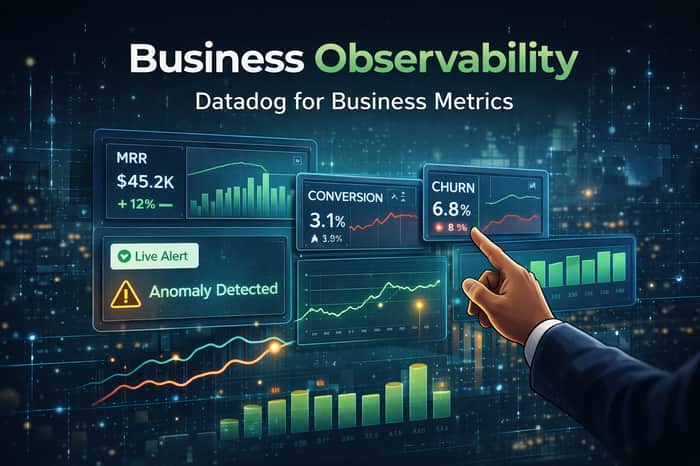
Bridging the Gap Between IT Performance and Business Growth
For years, "observability" was a buzzword reserved strictly for DevOps and site reliability engineers. It was all about tracking server uptime, CPU usage, and memory leaks. But in today’s digital-first economy, the health of your servers is only half the story. If your infrastructure is green but your checkout conversion rate just dropped by 40%, do you really have a healthy system? This is where business observability comes into play, transforming how companies approach and operational growth.
What Is Business Observability?
At its core, business observability is the practice of monitoring the health of business processes by analyzing the outputs of your digital systems. While traditional business intelligence tools look at historical data to tell you what happened last month, observability focuses on real-time business analytics to tell you what is happening right now and why.
When we talk about observability vs analytics, it helps to think of it this way: analytics is the map of where you’ve been, while observability is the dashboard of the car you’re currently driving. It connects the dots between technical performance (like page load speed) and business outcomes (like average order value).
The Evolution from Monitoring to Observability
Standard KPI tracking software often operates in a vacuum. You might see a dip in your dashboard, but finding the root cause requires a game of "telephone" between the marketing team, the product managers, and the engineering department.
A true business observability strategy breaks down these silos. By using advanced anomaly detection for business metrics, teams are alerted the moment a trend deviates from the norm. Whether it’s a sudden spike in churn or a drop in ad spend efficiency, you aren't just seeing the "what" you have the context of the "how" and "why."
Why Every Company Needs Datadog for Business Metrics
While there are many tools on the market, Datadog for business metrics has emerged as a powerhouse. Originally built for cloud monitoring, Datadog has expanded its capabilities to allow businesses to ingest, visualize, and alert on custom business data right alongside their technical stack.
Full-Stack Context: Imagine seeing a drop in your conversion rate monitoring dashboard and being able to instantly see that it correlates with a high error rate on your payment gateway API. That is the power of Datadog.
Predictive Insights: With predictive analytics for business, Datadog helps teams forecast revenue trends and identify potential bottlenecks before they impact the bottom line.
Unified Language: It gives the CTO and the CFO a single source of truth. No more arguing over whose data is correct.
Core Pillars of Business Observability
To implement a successful strategy, you need to focus on several key areas that impact your daily operations and long-term scaling:
-
Revenue Monitoring Tools
Revenue is the ultimate heartbeat of any company. Business observability allows for real-time revenue monitoring tools that track every dollar as it flows through your funnel. If a promotion code stops working in a specific region, you should know within minutes, not when the weekly report comes out. -
Churn Prediction and Customer Health
For subscription-based models, churn prediction software is vital. By observing user behavior patterns such as a decrease in login frequency or a high rate of support tickets—you can intervene before a customer cancels. This proactive approach to is what separates market leaders from those who are constantly firefighting. -
Marketing and Conversion Optimization
Your marketing analytics platform shouldn't just show you clicks; it should show you the entire journey. Observability allows you to track lead quality and funnel velocity in real time, ensuring your ad spend is actually translating into pipeline growth.
The Benefits of Real-Time Business Analytics
Why should you care about moving toward an observability model? The benefits extend far beyond just "having better charts."
Faster Incident Resolution (MTTR): When a business metric fails, you don't have to spend hours digging through logs. Integrating business metrics with system logs means you find the "smoking gun" instantly.
Increased Agility: Companies that rely on data driven decision making can pivot faster. If a new product feature isn't being adopted as predicted, business observability provides the granular data needed to iterate quickly.
Better Customer Experience: By monitoring the actual user journey—from the first click on a marketing analytics platform to the final checkout—you ensure every friction point is identified and smoothed over.
Getting Started: From KPI Tracking to Observability
Transitioning to a business observability mindset requires a shift in how you view your data. Start by identifying your most critical "Golden Signals" for business. These might include:
Checkout success rate
Customer acquisition cost (CAC) in real-time
Subscription renewal velocity
API usage by premium vs. free users
Once you have identified these, use a platform like KPILIO to bridge the gap between your raw data sources and actionable insights. By centralizing your with an observability lens, you ensure that no critical change goes unnoticed.
Conclusion: The Future is Observable
In an era where every second of downtime or every friction point in a user journey costs thousands of dollars, playing "guess-and-check" with your business data is no longer an option. Business observability isn't just a technical requirement; it's a competitive advantage.
By leveraging tools like KPILIO for your business metrics and integrating them into a holistic SaaS analytics platform, you empower your team to act with confidence. Stop looking at what happened yesterday and start observing what is happening right now. Your revenue, your customers, and your bottom line will thank you.
Ready to take your business metrics to the next level? Explore how with KPILIO can transform your data into a clear roadmap for growth.
Check out: kpilio.com

The split between 'technical' and 'business' observability is mostly a tooling artifact, not a real distinction. If your error spike correlates with a 12% checkout drop, you want both on one timeline — not in two SaaS tabs you have to flip between at 3 AM. That integration tax is exactly why most teams abandon their 'business' dashboards within six months.
Yeah, fair, and the article kind of glosses over that. The two-tab problem is real.
But I'd take it a step further. The reason teams abandon the business dashboard isn't just the integration tax. It's that the dashboard shows the 12% checkout drop and then nothing happens. Nobody owns it. It just sits there blinking until the next standup. When they do finally figure out it's a problem, especially companies with low expereince in analytics actions, it's often too late, I think.
That's the part I care about now. Not another timeline to stare at, but "this dropped, here's who's on it, did it actually get fixed." Detection is the easy part. The follow through is where it all quietly dies.
Robert :D.