What is Cryptocurrency? Your Simple Guide to How It Works
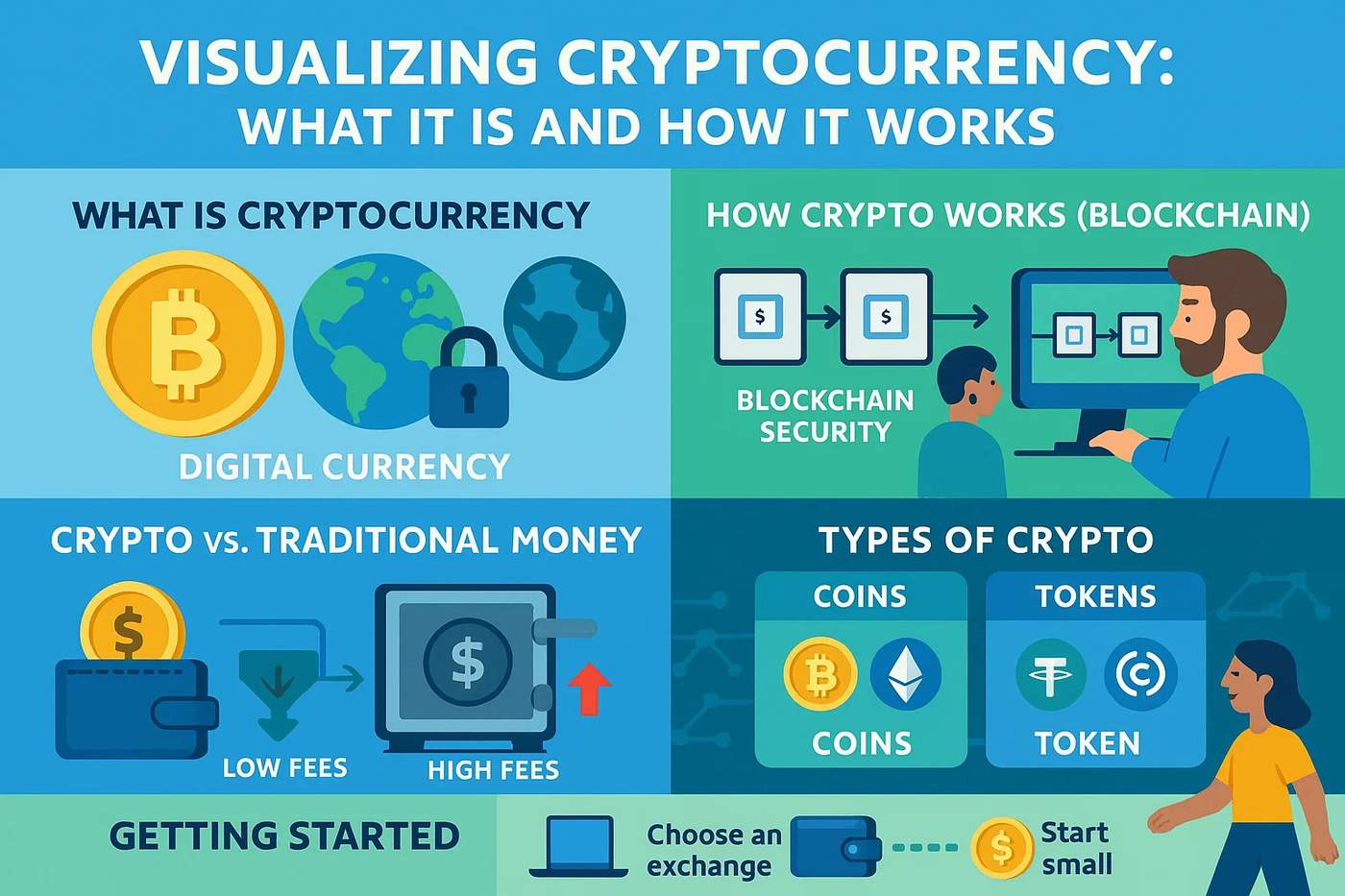
Ever heard terms like Bitcoin, Ethereum, or blockchain and felt a bit lost? You're not alone. Cryptocurrency can seem like a complex new world, but at its core, it's a fascinating innovation changing how we think about money and transactions. If you're curious about what cryptocurrency is and how it actually works, you've come to the right place.
This guide is designed for beginners. We'll break down cryptocurrency in simple terms, explore its underlying technology, discuss its pros and cons, and even touch on how you might get started if you're interested. By the end, you'll have a much clearer understanding of this digital phenomenon.
What Exactly is Cryptocurrency? The Simple Definition
At its most basic, cryptocurrency is a type of digital or virtual currency that uses cryptography for security. Unlike traditional currencies issued by governments (like the US Dollar or the Euro), cryptocurrencies are typically decentralized. This means they aren't controlled by any single entity, like a central bank or government.
Think of it as digital cash that you can use to buy goods and services, or hold as an investment, but it exists only in electronic form. The "crypto" part refers to the complex cryptographic techniques used to secure transactions, control the creation of new units, and verify the transfer of assets.
Key takeaways:
Digital: It exists only in computers and on the internet.
Decentralized: No single bank or government controls it (usually).
Encrypted: Uses cryptography for security.
Peer-to-Peer: Transactions often happen directly between users.
How Does Cryptocurrency Work? Unpacking the Core Technology
Understanding how cryptocurrency works means getting to grips with a few key concepts. Don't worry, we'll keep it simple.
Blockchain Technology: The Shared Digital Ledger
Most cryptocurrencies operate on a technology called blockchain. Imagine a continuously growing list of records, called "blocks," that are linked together using cryptography. Each block contains a batch of transactions.
Shared and Distributed: Instead of one person or organization keeping this ledger, it's typically shared across many computers in a network. This makes it very difficult to tamper with.
Transparent: While user identities can be anonymous or pseudonymous, the transactions themselves are often public and can be viewed by anyone on the network.
Immutable: Once a transaction is added to the blockchain, it's extremely difficult to alter or delete. This creates a permanent and verifiable record.
So, when a cryptocurrency transaction occurs, it's broadcast to this network. Computers on the network (often called "miners" or "validators") work to verify the transaction and add it to a new block on the blockchain.
Cryptography: The Security Backbone
Cryptography is essential to cryptocurrency. It's used in several ways:
Securing Transactions: Digital signatures, based on cryptographic keys (a public key and a private key), ensure that only the owner of the cryptocurrency can send it. Your private key is like your secret password – you must keep it safe!
Controlling Supply: Cryptographic algorithms also control the creation of new cryptocurrency units, ensuring that they are generated at a predictable rate and that the total supply is often limited (as in the case of Bitcoin).
Maintaining Anonymity/Pseudonymity: While transactions are on a public ledger, users are typically identified by their cryptographic "addresses" rather than their real names.
Decentralization: Who's in Control?
One of the most defining features of many cryptocurrencies like Bitcoin is decentralization. This means:
No Central Authority: There's no central bank to print more money or change the rules.
Distributed Network: The blockchain is maintained by a network of participants. Decisions about the network are often made by consensus among these participants.
Censorship Resistance: Because no single entity controls the network, it's difficult for anyone to block or censor transactions.
This decentralization is a core appeal for many, offering an alternative to traditional financial systems.
Transactions: How Crypto Moves
When you want to send cryptocurrency to someone:
You initiate the transaction using your private key to authorize it from your digital wallet.
The transaction is broadcast to the cryptocurrency's network.
Network participants (miners/validators) verify the transaction (e.g., checking if you have enough funds).
Once verified, the transaction is bundled with others into a new block.
This new block is added to the existing blockchain.
The recipient then sees the cryptocurrency in their digital wallet.
This process can take anywhere from a few seconds to several minutes or more, depending on the specific cryptocurrency and network congestion.
Cryptocurrency vs. Traditional Money: What's the Difference?
While both are used for exchange, there are fundamental differences:
FeatureCryptocurrencyTraditional Money (Fiat)FormDigital/VirtualPhysical (cash) and Digital (bank accounts)ControlTypically Decentralized (no central bank)Centralized (Government & Central Banks)IssuanceOften algorithmically controlled, sometimes minedIssued by central banksSecurityCryptography, BlockchainBank security, government backing (e.g., FDIC)TransparencyTransactions often public on blockchainTransactions generally private between partiesAccessibilityAnyone with internet accessMay require bank accounts, IDRegulationEvolving, varies by countryHeavily regulatedVolatilityCan be highly volatileGenerally more stable
What is Cryptocurrency Mining (or Staking)? Creating New Coins
You might have heard of "cryptocurrency mining." This is the process by which new cryptocurrency coins are created and new transactions are verified and added to a blockchain. It's most famously associated with Bitcoin.
Proof-of-Work (PoW): This is the original mining mechanism. Miners use powerful computers to solve complex mathematical problems. The first one to solve the problem gets to add the next block to the blockchain and is rewarded with newly created cryptocurrency and transaction fees. This process is energy-intensive.
Proof-of-Stake (PoS): An alternative mechanism where users "stake" (lock up) their existing coins to validate transactions and create new blocks. Validators are chosen based on the number of coins they hold and are willing to stake. PoS is generally more energy-efficient than PoW.
Other consensus mechanisms exist, but PoW and PoS are the most common ways new coins are introduced and networks are secured.
Understanding Cryptocurrency Prices
The price of a cryptocurrency, like Bitcoin or Ethereum, can be highly volatile, meaning it can change dramatically in short periods. Several factors influence price:
Supply and Demand: Like any asset, if more people want to buy a cryptocurrency than sell it, the price tends to go up, and vice versa. Many cryptocurrencies have a limited supply, which can also drive up demand.
Market Sentiment: News, social media trends, and general investor confidence (or fear) can heavily impact prices.
Adoption: As more businesses and individuals start using a cryptocurrency, its utility and demand can increase.
Regulation: Government announcements or new regulations can cause significant price swings.
Market Capitalization (Market Cap): This is the total value of all the coins in circulation (Price per coin x Circulating Supply). It's often used to gauge the relative size of a cryptocurrency.
It's crucial to understand that investing in cryptocurrencies carries significant risk due to this volatility.
Common Types of Cryptocurrency
While Bitcoin is the most well-known, there are thousands of different cryptocurrencies, often referred to as "altcoins" (alternative coins). Here are a few major categories and examples:
Bitcoin (BTC): The Pioneer
Launched in 2009 by the pseudonymous Satoshi Nakamoto, Bitcoin was the first decentralized cryptocurrency. It remains the largest by market capitalization and is often seen as "digital gold" – a store of value.
Ethereum (ETH): Smart Contracts and Beyond
Ethereum is more than just a digital currency. It's a decentralized platform that runs smart contracts: self-executing contracts with the terms of the agreement directly written into code. This enables decentralized applications (dApps) for things like finance (DeFi), gaming, and NFTs. Ether (ETH) is the native currency used to power the network.
Altcoins: The Diverse Crypto Landscape
Any cryptocurrency other than Bitcoin is generally considered an altcoin. Examples include:
Cardano (ADA): A proof-of-stake blockchain platform focused on sustainability and scalability.
Solana (SOL): Known for its high transaction speeds and scalability.
XRP (XRP): Developed by Ripple, focused on facilitating fast and low-cost international payments.
Dogecoin (DOGE), Shiba Inu (SHIB): Originally started as "memecoins" but have gained significant communities and market caps.
Each altcoin typically has its own specific goals, technology, and community.
Stablecoins: Bridging to Traditional Currency
Stablecoins are a type of cryptocurrency designed to maintain a stable value by being pegged to another asset, typically a fiat currency like the US dollar (e.g., USDT, USDC, DAI). Their goal is to offer the benefits of cryptocurrency (fast transactions, low fees) without the extreme price volatility.
Advantages of Cryptocurrency: Why the Buzz?
Cryptocurrencies offer several potential benefits that have attracted users and investors:
Transparency: Many blockchain transactions are publicly recorded, offering a high degree of transparency.
User Control & Empowerment: Cryptocurrencies can give individuals more control over their own finances without relying on traditional banks.
Accessibility: Anyone with an internet connection can potentially access and use cryptocurrencies, which is particularly relevant in regions with underdeveloped banking systems.
Lower Transaction Fees (Potentially): Especially for international transactions, crypto can sometimes offer lower fees compared to traditional banking.
Transaction Speed: While varying between cryptocurrencies, some can offer faster transaction settlement times than traditional bank transfers, especially across borders.
Decentralization: Reduces reliance on single points of failure or control, potentially making the system more resilient.
Risks and Challenges of Cryptocurrency
Despite the advantages, it's crucial to be aware of the risks:
Volatility: Prices can fluctuate wildly, leading to potentially significant losses for investors. This is a primary risk.
Security Risks (Individual Level): If you lose your private keys, you lose access to your cryptocurrency forever. Scams, phishing, and hacking of exchanges are also concerns.
Regulatory Uncertainty: The legal status and regulations surrounding cryptocurrencies are still evolving in many countries, creating uncertainty.
Complexity: Understanding the technology and navigating the ecosystem can be challenging for beginners.
Scalability Issues: Some cryptocurrencies face challenges in handling a large volume of transactions quickly and cheaply.
Illicit Use: While often overstated, the anonymity features of some cryptocurrencies have been exploited for illegal activities, attracting regulatory scrutiny.
Environmental Concerns: The energy consumption of some Proof-of-Work cryptocurrencies like Bitcoin has raised environmental concerns.
Is Cryptocurrency a Good Idea for You?
This is a personal question with no one-size-fits-all answer. This article is not financial advice.
Before considering using or investing in cryptocurrency:
Understand Your Goals: Why are you interested in crypto? Is it for learning, transacting, or investing?
Assess Your Risk Tolerance: Cryptocurrency investments are speculative and high-risk. Never invest more than you can afford to lose.
Do Thorough Research (DYOR): Don't rely on hype or social media. Understand the specific cryptocurrency, its technology, use case, and risks.
For many, cryptocurrency is an exciting technology with transformative potential. For others, it's a risky asset class. Education is key.
Getting Started with Cryptocurrency: Basic Steps
If you've weighed the risks and are keen to explore, here’s a simplified guide to getting started:
Do Your Research (Seriously!): Before buying anything, deepen your understanding. Read whitepapers, follow reputable news sources, and learn about different projects.
Choose a Cryptocurrency Exchange: Exchanges are platforms where you can buy, sell, and trade cryptocurrencies. Popular options include Coinbase, Binance, Kraken, and Gemini. Look for exchanges with:
Good security practices
A range of supported cryptocurrencies
User-friendly interface
Reasonable fees
Good customer support
Create an Account: This usually involves providing personal information and verifying your identity (Know Your Customer - KYC process), similar to opening a bank account.
Fund Your Account: You can typically fund your exchange account using a bank transfer, debit card, or sometimes PayPal.
Buy Cryptocurrency: Once your account is funded, you can place an order to buy the cryptocurrency of your choice. Start with a small amount you're comfortable with.
Storing Your Cryptocurrency: Wallets Explained: While you can leave your crypto on an exchange, it's generally considered more secure to store it in a personal crypto wallet. A wallet gives you control over your private keys.
Hot Wallets (Software Wallets): These are connected to the internet (e.g., desktop, mobile, or web-based wallets). They are convenient for frequent transactions but are more vulnerable to online threats. Examples: Exodus, Trust Wallet, MetaMask.
Cold Wallets (Hardware Wallets): These are physical devices that store your private keys offline (e.g., USB drives). They are considered the most secure option for long-term storage as they are isolated from online attacks. Examples: Ledger, Trezor.
Conclusion
Cryptocurrency is a complex but undeniably revolutionary technology. It represents a new way of thinking about digital ownership, transactions, and decentralized systems. From its foundation in blockchain and cryptography to the diverse ecosystem of coins and applications, there's a lot to learn.
While the potential benefits like increased transparency, user control, and accessibility are compelling, the risks associated with volatility, security, and regulatory uncertainty cannot be ignored. Understanding what cryptocurrency is and how it works in simple terms is the essential first step for anyone looking to navigate this evolving landscape, whether for curiosity, use, or investment.
Ready to dive deeper and continue your learning journey into the world of digital assets? Explore more guides and insights at CryptoCrafted.org to build your knowledge base.

