What is Penetration Pricing?
Entering a new market can be extremely intimidating, especially a market as competitive as the SaaS industry. No matter how good the product is, you come face to face with a challenging and sometimes overwhelming task. The good news is that penetration pricing can level the playing field and make the whole process less unnerving.
Assuming everyone loves a good bargain (and why wouldn’t they?), penetration pricing will be your best friend and trusted ally when striving to earn a toehold in the market.
This strategy entails putting into place low prices in order to lure customers away from your competitors, essentially sacrificing immediate profits for long-term growth.
In this article, we’ll be looking at the ins and outs of penetration pricing and exploring how one can leverage the power of this pricing technique:
- What Is Penetration Pricing?
- How It Works
- The Pros & Cons of Penetration Pricing
- 5 Best Practices For Successful Penetration Pricing
- 3 Real-Life Penetration Pricing Examples
- Is Penetration Pricing Right For Your SaaS?
- Penetration Pricing Vs. Price Skimming
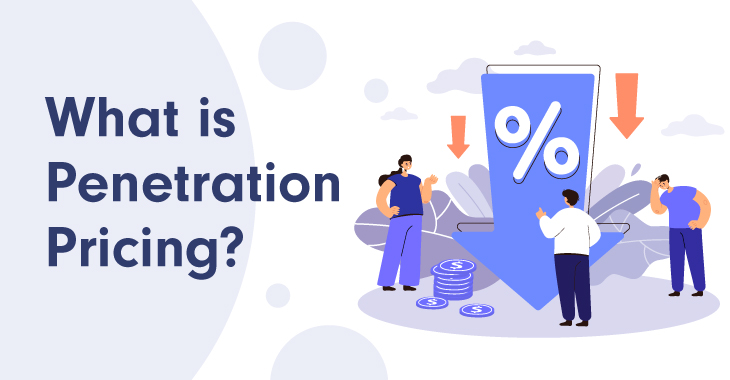
What is Penetration Pricing?
Penetration pricing is a user acquisition strategy that purposefully offers a product at a low initial price with the sole purpose of rapidly winning customers and brand recognition.
While penetration pricing can actually work, it can also prove to be risky business when not correctly put into place. Because prolonged short-term profit can stifle a company’s business growth.
How It Works
In the early stages of product growth, penetration pricing offers businesses the great advantage of gaining popularity quickly through price alone.
Since price is a key factor in purchasing decisions, businesses can acquire a larger customer base as well as brand awareness by positioning a new product or service at a lower market value.
Once the product has gained market acceptance, this strategy requires companies to gradually increase their prices. But keep in mind this adjustment must be executed with precision, as it also has the potential to drive away price-sensitive customers.
Here’s an example of how price penetration works:
🔹 A new streaming service, priced at $4 lower than the competition’s offer, is made available to customers.
🔹 The following year, the streaming service raised its prices to $8.
Scenario 1:
If users had a positive experience with the streaming service during this year of operation, having access to a wide and constantly updated range of entertainment options, strong customer support, and high streaming quality, a large portion of the customer base will stay even though there has been an increase in cost.
Scenario 2:
If users are unsatisfied with the services provided, they will most likely cancel and switch to one of your competitors, new or established.
| Key Takeaway:
| To enjoy the desired results after pricing has been implemented, businesses must immediately start fostering strong customer relationships.
The Pros & Cons of Penetration Pricing
The penetration strategy can be extremely helpful when it comes to helping businesses gain a foothold in a competitive industry. But, like everything else in this world, it comes at a cost. Let’s find out whether or not you should use this pricing strategy.
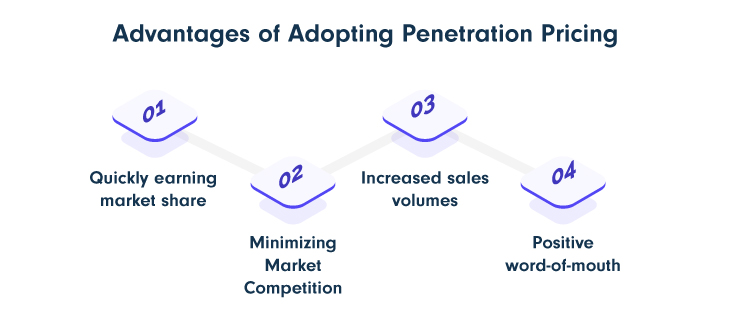
Quickly earning market share
The goal of the price penetration strategy is to swiftly draw in new customers and secure a significant market share while reaching the expected price. When executed effectively, it enables new businesses to quickly penetrate and establish themselves in fresh markets.
Reducing potential market competitiveness
When using the penetration pricing model strategy, you are making it difficult for new competitors to enter the market. Should they wish to entice customers to compete with you, they would have to entirely give up business profitability.
Increased sales volumes
Lower prices not only ensure market penetration but also incentivize customers, making them invest in your product. This, as you can imagine, leads to a high number of sales, which is obviously always good for business.
Positive word-of-mouth
Who doesn’t want to create market buzz? The market penetration method is not only an effective pricing technique but a lucrative marketing strategy as well. If users are happy with the product or service acquired, they are more likely to be willing to pay higher prices.
Plus, they will recommend it to friends and family, which will help you obtain even more clients. Plus, building a positive brand image will be beneficial when having to increase product pricing.
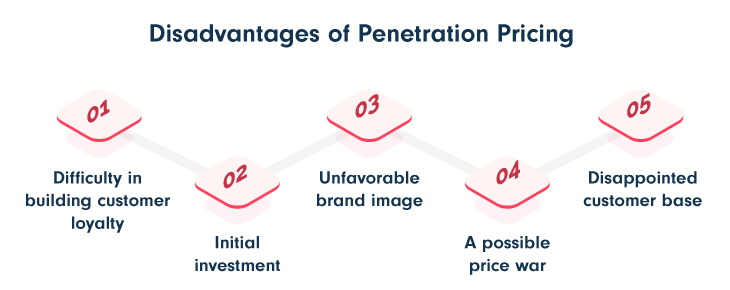
Difficulty in building customer loyalty
Everybody knows a lower price is a strong magnet for bargain hunters. But unless you move quickly to cultivate brand loyalty, which, as you know, comes at a cost, there is a high risk you will lose part of your recently acquired customer base just as soon as you raise your price.
Initial investment
Launching a business requires significant resources for production, distribution, maintenance, support, and marketing. Plus, to remain competitive, continually developing new products is necessary. As long as you practice the market penetration pricing technique, short-term profits are sacrificed, leaving you with little to no resources to continue your expansion.
Unfavorable brand image
One of the biggest risks of the market penetration strategy is how customers may perceive you. Because of your product’s low price, your target market might end up seeing your brand as low-quality, making it impossible for you to establish your business as premium.
A possible price war
Keep in mind, though, that In your battle to gain market share, you might discover that not all competitors are so easily defeated. Some actually might consider lowering their prices to come closer to your offer. If you follow suit, they might push even further, creating an endless cycle of price adjustments, which isn’t pretty for anyone involved in the war.
Disappointed customer base
Unfortunately, the penetration pricing strategy can be effectively used to attract customers, but it’s just not sustainable in the long run. Eventually, you will be forced to raise prices, disappointing customers who have grown accustomed to lower costs.
| Key Takeaway:
| It is essential that you carefully weigh the pros and cons of this strategy to determine if it is the right approach for your product or service, both short and long-term.
Discover the 3 real-life penetration pricing examples on PayPro Global's Blog.
