What Is the Difference Between AI Screening and AI Interviewing?
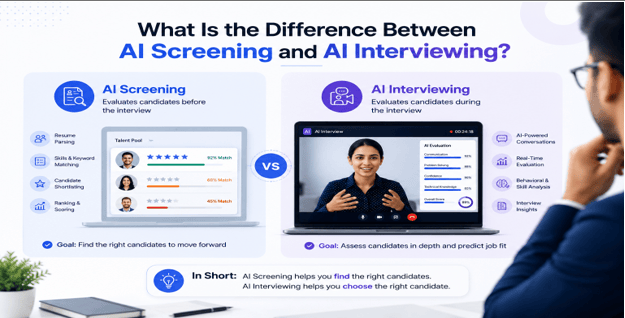
AI screening and AI interviews are often used interchangeably in enterprise hiring conversations, but they represent two distinct stages of the talent acquisition pipeline. AI screening filters and ranks candidates based on resume data, keywords, and structured criteria before any conversation takes place. AI interviews go a step further, conducting a live or asynchronous conversational assessment that evaluates communication, reasoning, and role-specific competency in real time.
Understanding this distinction matters at the executive level because the two technologies solve different problems, carry different compliance considerations, and deliver different returns. This article breaks down the differences in depth, using current industry data to help HR leaders and C-suite decision-makers determine where each technology belongs in their hiring architecture.
Defining AI Screening
AI screening refers to the automated evaluation of candidate applications before a human or AI conversation occurs. It typically operates on static data: resumes, cover letters, application form responses, and sometimes assessment test scores.
Core functions of AI screening include:
● Parsing resumes to extract skills, job titles, education, and years of experience
● Ranking or scoring candidates against a defined job requisition
● Filtering out applicants who do not meet minimum qualifications
● Flagging candidates for further review based on keyword or skill matches
● Automating initial candidate search across internal and external talent pools
AI screening is now standard practice across large organizations. Industry research indicates that 75 percent of large US enterprises, including 99 percent of Fortune 500 companies, automate their applicant screening process in some form, ranging from basic keyword matching to advanced AI-powered candidate ranking (Harvard Business School, 2024). Separately, 82 percent of large corporations report using AI specifically for resume screening and candidate shortlisting (Careertrainer.ai, 2026).
The primary value of AI screening is volume management. For enterprises receiving hundreds or thousands of applications per requisition, screening technology reduces the manual burden of initial review and ensures no qualified candidate is overlooked due to reviewer fatigue.
Defining AI Interviewing
AI interviewing is a conversational assessment layer that occurs after initial screening. Rather than analyzing static documents, AI interviews engage candidates directly, asking role-specific questions, evaluating verbal or written responses, and producing a structured competency assessment.
Core functions of AI interviewing include:
● Conducting structured, role-specific interview conversations
● Evaluating communication clarity, reasoning, and problem-solving in real time
● Scoring candidates against consistent, predefined competency frameworks
● Reducing scheduling dependency by allowing candidates to interview on demand
● Generating interviewer-ready summaries and comparative candidate scorecards
Where AI screening asks "does this candidate's background match the role on paper," AI interviewing asks "can this candidate actually perform in the role, and how do they communicate and reason under structured questioning."
Key Differences at a Glance
Stage in the pipeline. AI screening operates before any interview occurs. AI interviewing operates as a replacement for, or supplement to, the first or second live interview round.
Data source. AI screening relies on resumes, applications, and structured form data. AI interviewing relies on live conversational responses, including tone, reasoning process, and follow-up answers.
Output. AI screening produces a ranked shortlist or pass/fail filter. AI interviewing produces a scored, evidence-based competency assessment tied to specific interview questions and candidate responses.
Candidate experience. AI screening is largely invisible to candidates, occurring behind the scenes. AI interviewing is a direct, interactive touchpoint that shapes the candidate's perception of the company.
Bias exposure. AI screening carries risk of bias embedded in historical resume data and keyword weighting. AI interviewing, when properly designed with structured, standardized questions, can reduce interviewer-to-interviewer inconsistency that is common in unstructured human interviews.
Regulatory scrutiny. Both technologies fall under increasing regulatory attention, but AI interviewing tends to draw closer scrutiny because it more directly resembles an employment decision-making process, particularly under frameworks like New York City Local Law 144 and the EU AI Act.
Why Enterprises Need Both, Not Either
A common misconception among hiring leaders is that AI screening and AI interviewing are competing solutions. In practice, they are sequential and complementary.
Consider the typical enterprise hiring funnel for a high-volume role:
Application intake. Candidates apply, generating a large volume of resumes and application data.
AI screening. The system filters and ranks candidates based on qualifications, reducing the pool to a manageable shortlist.
AI interviewing. Shortlisted candidates complete a structured AI interview that evaluates competencies screening alone cannot assess, such as communication skill, situational judgment, and role-specific reasoning.
Human review and final interview. Hiring managers review AI interview scorecards and conduct a final human-led conversation with top candidates.
This layered approach reflects how enterprise adoption is actually trending. Among organizations using AI in HR, close to two-thirds apply it across recruiting, interviewing, and hiring collectively, with 44 percent specifically screening resumes and 32 percent automating candidate searches (SHRM, 2025). This indicates that leading organizations are not choosing between screening and interviewing automation, they are building integrated pipelines that use both.
Measurable Impact: Screening and Interviewing Compared
Numerical outcomes differ between the two technologies, which is important for executives building a business case.
Time savings. AI-powered recruitment tools can reduce time-to-hire by up to 40 percent overall (Careertrainer.ai, 2026), with AI interviewing specifically contributing to faster shortlisting by removing scheduling delays, while AI screening contributes primarily by reducing the manual hours spent on resume review.
Cost impact. Organizations using AI-driven recruitment platforms report a 30 percent reduction in recruitment costs per hire (WeCreateProblems, 2025), and teams report 20 to 40 percent lower cost-per-hire specifically when AI automates screening and scheduling functions (SHRM, 2024, via RecruitAI Suite, 2026).
Quality of hire. Companies using AI in recruitment report a 35 percent improvement in quality of hire metrics (Careertrainer.ai, 2026), a metric more closely associated with AI interviewing, since it evaluates candidate competency directly rather than relying solely on resume proxies.
Adoption at scale. 78 percent of enterprise companies use AI in recruitment, reflecting 189 percent growth since 2022, indicating that enterprise adoption of these combined technologies is no longer experimental but mainstream (Second Talent, 2026).
Executive-level engagement. 93 percent of Fortune 500 Chief Human Resources Officers report integrating AI into business practices, with talent acquisition identified as one of the leading functions for AI adoption (Gallup, 2024).
Compliance Considerations for the C-Suite
Because AI interviewing involves direct interaction with candidates and produces assessment outcomes that influence hiring decisions, it typically requires more rigorous governance than AI screening alone. Enterprise leaders should ensure:
● Interview questions and scoring criteria are validated for job relevance and consistency
● Bias audits are conducted on both the screening algorithm and the interview scoring model
● Candidates are informed when AI is used in the interview process, consistent with disclosure requirements under applicable regulations
● Human oversight remains part of the final hiring decision, rather than full automation of the employment decision itself
Properly implemented, AI-driven hiring processes have been associated with a 56 to 61 percent reduction in hiring bias across gender, racial, and educational categories when continuously monitored (Second Talent, 2026), underscoring that governance quality, not just technology adoption, determines the fairness outcome.
Choosing the Right Technology for Your Hiring Stage
For enterprise HR leaders evaluating where to invest, the decision typically comes down to which bottleneck is causing the most friction.
● If the primary challenge is application volume and resume review capacity, AI screening should be the first investment priority.
● If the primary challenge is inconsistent interview quality, scheduling delays, or interviewer bandwidth, AI interviewing addresses that bottleneck directly.
● If both challenges exist simultaneously, which is common at enterprise scale, a combined pipeline using screening for volume management and AI interviews for competency assessment produces the most measurable return.
The Bottom Line
AI screening and AI interviewing are not competing categories, they are sequential layers within a modern enterprise hiring pipeline. Screening manages volume and filters candidates based on qualifications data, while AI interviewing evaluates how candidates actually think, communicate, and perform under structured questioning. Enterprises that understand this distinction, and that build governance around both layers, are positioned to capture the full range of time, cost, and quality-of-hire benefits that AI-driven hiring technology has demonstrated across large-scale deployments.
For C-suite and HR leaders evaluating next steps, the most effective starting point is an audit of the current hiring funnel to identify whether the primary bottleneck sits at the screening stage, the interviewing stage, or both, before selecting and integrating the appropriate AI interviews solution.

