What is Trafficmind and What Problem it Solves for Startups
What is Trafficmind?
Trafficmind is an edge security and delivery platform that operates in front of a website, web application, or API. Instead of allowing requests to reach your origin infrastructure directly, Trafficmind becomes the first system that inbound traffic encounters.
At a high level, Trafficmind combines three roles that are often deployed as separate tools:
-
Always-on DDoS protection
-
Content delivery via a CDN
-
Application-layer security, including a web application firewall (WAF) and bot mitigation
Trafficmind also provides authoritative DNS, which helps ensure fast and reliable name resolution under normal conditions and traffic spikes.
In practical terms, Trafficmind becomes the public entry point for your product. Instead of requests going directly to your infrastructure, they are first processed at the edge. From there, Trafficmind can serve cached content, block abusive traffic, and forward clean requests to your origin.
Trafficmind is not a hosting provider, your application continues to run on your own servers or cloud services. Service operates purely as a security and performance layer in front of them.
What Trafficmind does
1) DDoS protection
Trafficmind treats DDoS protection as an always-on function rather than something that is enabled only during an incident. The idea behind always-on mitigation is that traffic is continuously inspected and filtered at the edge, without requiring manual intervention when an attack starts.
From a systems perspective, this is largely about placement and scale. Large traffic floods are easier to absorb when traffic is distributed across many edge locations instead of being concentrated on a small number of origin IPs. By handling attack traffic upstream, the origin avoids exhausting bandwidth or connection limits.
Example: A startup announces a new feature and traffic spikes sharply. Turns out, a significant portion of the traffic is malicious, designed to overwhelm. Without edge mitigation, the origin may become overloaded and unreachable. But with edge-based DDoS protection, malicious volume is absorbed earlier, allowing legitimate users to continue accessing the service as normal.
2) CDN and global delivery
Trafficmind includes a built-in CDN that improves performance by serving content from edge locations in closer proximity to your users. CDNs are most effective for cacheable assets such as images, JavaScript, CSS, fonts, and some API responses. Serving these assets from the edge reduces latency for users and lowers repeated load on your origin infrastructure.
Beyond caching, the delivery layer also handles modern transport and routing. Support for newer protocols, such as TLS 1.3 and HTTP/3, and optimized paths across the network help requests reach the edge efficiently before being forwarded to the origin when needed.
Example: A SaaS product runs its application in a single cloud region, while users are spread across North America, Europe, and Asia. Without edge delivery, distant users experience slower load times. With a CDN, static assets are served locally, improving page speed while reducing bandwidth and connection pressure on the origin.
3) Web Application Firewall and bot controls
Before requests reach your application, Trafficmind inspects them at the edge using a web application firewall (WAF). The goal is to stop common attack patterns and automated scanning early on, rather than handling them at the application itself.
Bot controls extend this filtering to non-human traffic that creates operational noise. Automated scraping, scripted form submissions, and credential stuffing attempts can all inflate resource usage without adding real users. By reducing this type of traffic upstream, your application processes fewer low-value requests, and your metrics better reflect real user behavior.
Example: A signup endpoint is targeted by automated scripts that submit thousands of requests per hour. Instead of scaling databases and queues to cope, edge-level filtering blocks the activity before it reaches your application logic.
4) Authoritative DNS
Trafficmind also provides authoritative DNS, allowing it to answer DNS queries for your domain from its global edge network. DNS is often overlooked, but it sits on the critical path of every request. If name resolution is slow or unreliable, users may be unable to reach your service even when your application itself is operating normally.
Moreover, Trafficmind also comes with DNSSEC and DNS-layer protections to provide security and resilience against common DNS-based threats.
Example: E-commerce site launches a paid campaign and encounters a sudden traffic surge. Stable, fast DNS resolution avoids user-facing outages caused by lookup failures, while the edge layer absorbs the resulting traffic increase before it reaches the origin.
Where Trafficmind is used
Trafficmind is designed for internet-facing services where availability, performance, and abuse resistance are critical. This includes:
-
Marketing sites that must remain responsive during traffic bursts,
-
SaaS applications that depend on reliable login and session flows,
-
E-commerce platforms exposed to scraping and automation,
-
and public APIs reachable from the internet.
It is also a fit for teams that need a clear privacy and compliance posture, including GDPR-aligned data handling and Swiss-grade security expectations, even at an early stage of product growth.
Benefits for businesses
Trafficmind’s benefits are easiest to understand when you view it from a lens based on operational outcomes rather than individual features. In practical startup scenarios, the platform is intended to deliver:
-
Higher availability under pressure, by absorbing sustained or sudden traffic surges before they reach your infrastructure.
-
Faster user experience across regions, by directing users to the nearest edge locations and serving cacheable assets from the CDN.
-
Less operational burden from bots and web attacks, by enforcing WAF rules and bot mitigation at the edge instead of inside the application.
-
Simpler “one-layer” setup, by consolidating DDoS protection, CDN, WAF, and DNS with straightforward onboarding via DNS or BGP.
Common use cases
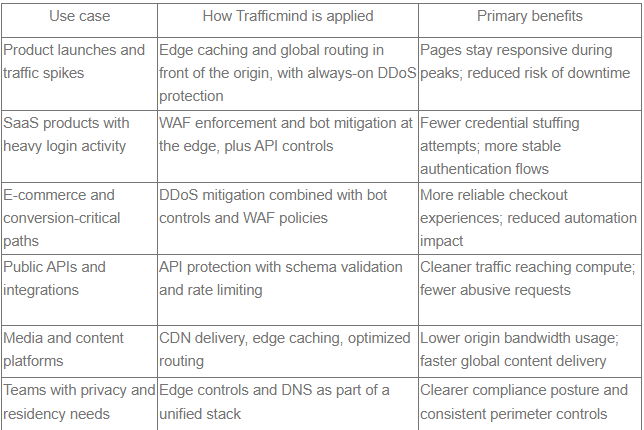
The table below outlines how startups typically deploy Trafficmind, framed around the practical problems they are trying to solve rather than specific features.
Operational mode
Trafficmind fits cleanly into an architecture wherein you separate your system into two layers:
-
The origin layer, which contains application logic and data, and
-
The edge layer, which handles work that benefits from either caching and routing (e.g., repeatable delivery) or abuse/flood filtering and mitigation.
Trafficmind combines these edge responsibilities into a single layer. By handling repeatable delivery tasks and defensive traffic controls before requests reach the origin, Trafficmind helps improve reliability and performance.
Summary
Trafficmind operates as an edge layer that sits in front of internet-facing services. It manages traffic delivery and protection before requests reach application infrastructure, combining DDoS mitigation, CDN-based acceleration, edge security controls, authoritative DNS, and a 24/7 SOC into a single solution.
The primary value for early-stage teams is reduced complexity at the perimeter. Performance and availability are improved at the edge, attack traffic is filtered upstream, and teams avoid assembling and maintaining multiple standalone tools as usage and exposure increase.
