What Makes ChatGPT, Perplexity, Copilot, and Claude Recommend Your Site? Here's What I Learned in 30 Days
I launched AIToolsRecap.com on March 17, 2026 — less than 7 weeks ago. It's an independent AI tools review and comparison site. No backlinks campaign, no paid ads, no existing audience.
In 30 days, the site had 9,900+ new users. 78% came from "Direct" traffic in GA4. When I drilled into the AI search channel specifically, 94.7% of those attributed visits came from ChatGPT alone.
One article — Best AI Tools for PowerPoint — drove 75% of all AI search traffic by itself.
Here's what I think is actually happening, and what I'd do differently if I were starting over.
The Shift Nobody Talks About Clearly
Google organic is dead for new sites. You already know this. What's replacing it isn't social media or newsletters — it's AI search citation.
When someone asks ChatGPT "what's the best AI tool for making PowerPoint presentations?", ChatGPT picks 3–5 URLs to cite. If your page is one of them, you get traffic. If it's not, you get nothing — no impression, no position 8, no consolation prize.
This is fundamentally different from SEO. In SEO, you rank somewhere on a spectrum. In AI citation, you're either in the answer or you don't exist.
What the Data Actually Showed
After 30 days of running AIToolsRecap.com:
Traffic sources: 78% Direct (mostly unattributed AI referrals), 12% attributed AI search, 4% Google organic, 2% social (Reddit)
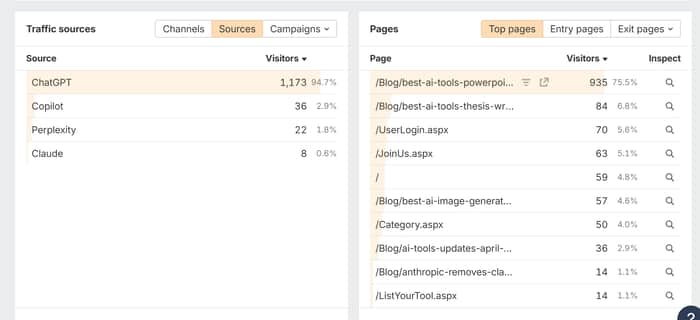
AI search breakdown: ChatGPT 94.7%, Copilot 2.9%, Perplexity 1.8%, Claude 0.6%
Top page by AI traffic: /Blog/best-ai-tools-powerpoint — 935 visitors from AI search alone
Second best: /Blog/best-ai-tools-thesis-writing — 84 visitors
The gap between first and second is enormous. The PowerPoint article got cited heavily and consistently. Everything else was noise by comparison.
Why I Think the PowerPoint Article Got Cited
I published a lot of content. Most of it got impressions on Google but zero clicks (classic AI Overview suppression). The Grok how-to articles racked up 30K GSC impressions in 24 hours with 2 clicks. Impressive numbers, completely useless traffic.
The PowerPoint article was different in structure:
- It answered a specific, tool-agnostic question
"Best AI tools for PowerPoint" isn't a brand query. It's a task query. AI assistants are optimized to answer "help me do X" — they look for pages that match that intent precisely. - It listed and compared multiple tools
The article wasn't a review of one product. It compared several options with clear use cases for each. AI tools love citing comparison content because it's defensible — they're not endorsing one thing, they're surfacing a useful roundup. - It had a clear, structured format
Tool name → what it does → best for → pricing. Consistent structure across every entry. I believe AI crawlers parse structured content more reliably than prose-heavy articles. - The URL slug was unambiguous
/best-ai-tools-powerpoint — no dates, no fluff. The slug itself signals exactly what the page covers.
What Doesn't Work (Also From My Data)
Single-brand explainers — Articles about one specific AI product (how to use Grok voice mode, what is Claude 3.7, etc.) get massive Google impressions and almost no clicks. Google AI Overview answers these queries completely. You're feeding Google's product, not your own.
News recaps — "AI Updates April 2026" style articles get traffic spikes then die. AI tools don't repeatedly cite news. They cite reference content.
Anything Grok-related right now — Grok's own search interface consumes those queries before users ever click an organic result. It's a structural problem, not fixable with better writing.
The Repeatable Formula I'm Now Running
Every article I now publish follows this structure:
"Best AI Tools for [Specific Task]"
5–8 tools compared
Consistent schema per tool: name, what it does, best for, pricing
No filler intro paragraphs — lead with the list
Internal links to the full tools directory
Published within 48 hours of a related AI tool release (timing matters for freshness signals)
The thesis writing article followed this formula and is already my #2 AI-cited page after just a few weeks.
The China Audience Surprise
I didn't expect this: the majority of my active users are from Singapore, Shanghai, Guangzhou, Beijing, and Zhuhai. Chinese users accessing AI tools via ChatGPT and similar are finding my content heavily.
My working theory: English-language AI tool comparison content is undersupplied relative to the demand from non-English-speaking markets using English-language AI assistants. If you're building in this space, you may be serving a global audience whether you planned to or not.
What I'd Do From Day 1 If Starting Over
Publish "Best AI Tools for [X]" articles before anything else — not news, not explainers, not single-tool reviews
Structure every article identically — AI tools parse patterns; consistency helps
Allow AI crawlers from day one — I had Cloudflare's "Block AI Bots" setting active early on without realizing it. That was suppressing crawler access. Turn it off.
Don't chase Google impressions — 30K impressions with 2 clicks is a vanity metric, not a business metric
Track AI search as your primary channel — GA4's new AI search attribution is imperfect but directionally useful. Watch it weekly.
Where I'm At Now
The site is 7 weeks old. It has real daily signups, citations from ChatGPT, Perplexity, Google AI Overview, Gemini, and Copilot, and a content strategy that's now data-validated rather than guessed.
The next 90 days is execution: publish more "best AI tools for [use case]" articles, build internal linking from the high-performing pages, and let the citation flywheel compound.
If you're building a content site in 2026, the question isn't "how do I rank on Google?" It's "how do I get cited by AI?"
Those are very different questions with very different answers.
I'm Pat, and I run AIToolsRecap.com — an independent AI tools review and comparison site. Happy to answer questions in the comments.

The "you're in the answer or you don't exist" bit is right, and the GA4 Direct bucket is where most ChatGPT referrals still hide. What I'd add: don't treat one "best AI tools for PowerPoint" hit as a system. Re-ask the same buyer prompt in a fresh chat a few times. If the page drops off, it was a lucky retrieval, not a citation you can count on. Also: branded pages lose to listicles on those queries — that's expected. The fix is a comparison-shaped page, not more homepage copy.