What product market fit is for you?
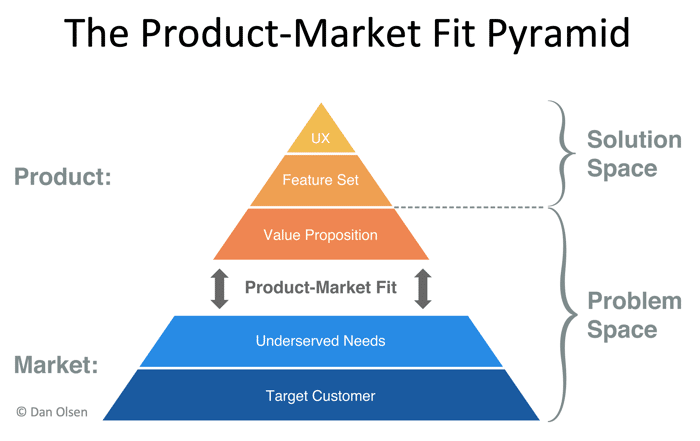
Hello,
As I was reading through the IndieHacker feed, I saw a wide variety of terms for "product/market fit." But which one is correct?
- Product/market fit is "finding a compelling value hypothesis with audience and seeing at how they respond to it."
- Creating something that customers are willing to pay for.
- Product/market fit occurs when you have the correct answer to an issue that needs fixing and consumers actively interact with that solution.
- You've found product/market fit when your customers are so pleased with your solution-product that they enthusiastically recommend it to their friends.
- When a product is a perfect match for the market, it generates a tremendous amount of interest.
To that end, how would you characterize Product-Market fit? In terms of metrics, what exactly do you look for? What exactly is the goal and objective?

People sign up with your product and start using it. If they cancel due to feature issue, it means we have not found the prodcut-market fit .
In my experience, many individuals mistakenly believe that obtaining email addresses or registered people who just register for a free trial is sufficient proof of a successful validation procedure. Goal-oriented: targeting customers who have shown a propensity to pay for your service. Not your folks, not your GF/BF, not your neighbors, not your pet dog/cat, but real users. Don't use their approval as proof. Only a paying consumer is the REAL validation.
You mentioned that only paying customer is a real validation. It means that you need to build (or fake it) a product. How about validating before writing a single line of code? We're thinking about it at http://focusity.space/ - we're building product for ourselves too but I'm looking for serious proof from customers. Building MVP will take some time, so we are thinking how to validate it before writing code.
Focusing on manual services makes sense for this kind of product because, if people are willing to pay for manual services, they will almost certainly be willing to pay for this kind of automation because it is cheaper, more effective, and has an easier onboarding process. If you'd like more detailed suggestions, we can schedule a short call session in which a Unicamel auditor will offer his insights, which should make it easier and cheaper to test the viability of your product. Registration form - https://unicamel.io/get-started/, it takes the 30s to register for this type of audit, later our auditor sends you all instructions for the next step.
What is your advises for the early stage founder to validate their startups ideas
There is no short answer, but I try to craft something.
Founders struggle to properly verify their ideas, resulting in implementation difficulties.
Ideas are abundant. Everywhere you look, there are many brilliant "ideas" that never materialize or perish far sooner than anticipated.
Why do so many individuals who have a "Great Idea" face so much difficulty? What do they lack that others possess?
The solution may be quite complex, and no one may have discovered it. Before plunging in with all feet, one of the most essential things entrepreneurs must do is assess whether or not the concept has the potential to become a successful firm.
Here are my thoughts on the proper method of startup concept validation.
What should be verified throughout the concept validation process:
Do not focus on the following as part to validate your idea:
Before diving into the ocean of concept validation, it is important to grasp the following.
Focus on Actual Clients
Users are distinct from customers. Concentrate on clients who "will" pay money for your service. True users are not your parents, girlfriend, boyfriend, neighbors, dog, or cat. Do not accept their comments as validation.
I wanna BOLD - true Customers are those that spend money on your product or service!!!
So, understand the consumer really well.
There are several entrepreneurs that extrapolate the opinions of a few others to validate their own. To comprehend the customer's perspective, you must communicate directly with them.
Do not begin with what you believe, what you know, or the answer you're proposing.
Start by attempting to comprehend the consumer by listening to him or her and asking questions about what he or she does and why he or she does certain things. Try to comprehend the difficulties by attentively listening to indirect references to them. Frequently, clients are only aware of a symptom, not the underlying cause. Do not ask the client what they believe the answer is. Ask inquiries to really comprehend their dilemma.
Thank you for your time writing all of that,
Can we have a call some time ?
Sure, just book a slot here -> https://unicamel.io/get-started