What Subsistence Farming Taught Me About Building Something That Actually Lasts
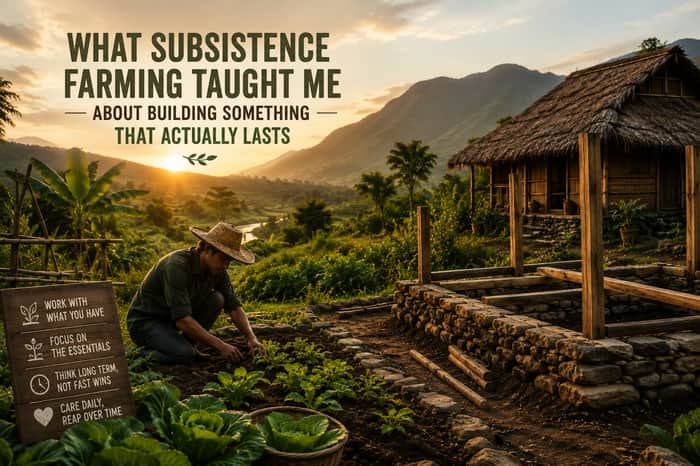
Most people see subsistence farming as something outdated.
Small-scale. Low income. Survival-based.
And honestly, I used to think the same way.
It didn’t look like growth. It didn’t look scalable. It didn’t look modern.
But the more I spent time understanding farming at its roots, the more I realized:
Subsistence farming isn’t weak—it’s just misunderstood.
In fact, it taught me some of the most important lessons about sustainability, risk, and building systems that don’t collapse under pressure.
1. It Prioritizes Survival Before Profit
In modern farming (and even business), the focus is often:
Maximize output.
Increase profit.
Scale quickly.
Subsistence farming works differently.
Its first goal is simple:
Make sure the system sustains itself.
That means:
- Growing what is needed first
- Reducing dependency on external inputs
- Managing resources carefully
At first glance, it feels limiting.
But in reality, it creates a strong foundation.
Because if your system can’t sustain itself, scaling it only increases the risk.
2. Dependency Is the Real Risk
One thing that stood out to me was how subsistence farmers operate with minimal external dependency.
They rely on:
- Their own seeds
- Their own inputs
- Local knowledge
- Natural cycles
Compare that to modern systems where:
- Seeds are bought
- Fertilizers are bought
- Solutions are imported
The more dependent you are, the more vulnerable you become.
Subsistence farming reduces that risk.
It’s not about avoiding growth—it’s about building resilience first.
3. Diversity Is Built Into the System
Another important difference is crop diversity.
Subsistence farming doesn’t rely on a single crop.
Instead, it includes:
- Multiple crops
- Different planting cycles
- Mixed farming approaches
This does two things:
- Reduces the impact of failure in one area
- Creates balance in the ecosystem
I’ve seen this play out clearly.
Where monocropping creates efficiency, it also creates fragility.
Where diversity exists, stability follows.
4. It Forces Smarter Resource Use
When resources are limited, you use them better.
That’s exactly what subsistence farming teaches.
- Water is managed carefully
- Soil is protected
- Waste is reused
- Inputs are optimized
There’s no room for waste.
And that mindset changes everything.
Because when you’re forced to work within limits, you build systems that are naturally efficient.
5. It’s Not About Staying Small—It’s About Staying Stable
One of the biggest misconceptions is that subsistence farming is about staying small.
It’s not.
It’s about staying stable.
It focuses on:
- Consistency over volatility
- Sustainability over short-term gain
- Balance over aggressive expansion
And once you have that stability, growth becomes a choice—not a risk.
That’s a powerful position to be in.
What Changed for Me
Understanding subsistence farming didn’t make me go backward.
It changed how I move forward.
- I started valuing resilience over quick wins
- I focused more on system strength than output alone
- I reduced unnecessary dependency
- I looked at farming as a long-term structure, not just seasonal activity
It made my approach more grounded—and more sustainable.
Not every valuable system looks impressive from the outside.
Subsistence farming doesn’t promise scale, speed, or high returns.
But it offers something more important:
Stability. Control. Continuity.
And in a world where everything is optimized for growth, those things are often overlooked.
Sometimes, the strongest systems are the ones built quietly, with balance at their core.
If you want a clearer understanding of subsistence farming—its definition, types, characteristics, and how it actually works in practice—I’ve explained it in detail here:
Farming: Definition, Characteristics & Types
This will give you both the concept and the practical perspective.

What stood out to me is the idea that durability often comes from working within limits rather than constantly trying to overcome them. Subsistence farming has to account for seasons, resources, uncertainty, and recovery, which feels surprisingly relevant to building a business.
There is a useful lesson here for founders: optimize for resilience, not just growth. A system that can survive difficult seasons may be more valuable than one that performs exceptionally well under ideal conditions.
I’m curious how you think this principle changes the way founders should measure progress.