What surprised me after people started using my tiny browser tools
Hey IH 👋
After writing about the “Open → Do → Close” rule, something interesting happened.
People actually started using the tools more.
And I started noticing patterns I didn’t expect.
These weren’t analytics insights.
These were behavior insights.
Here’s what surprised me the most.
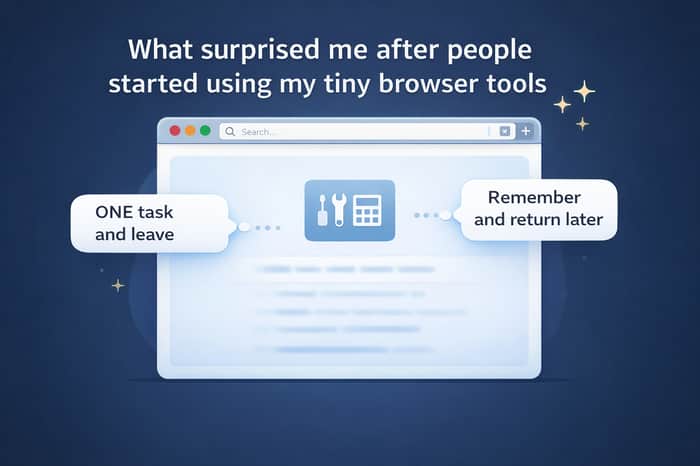
1. People don’t explore. They come for one job.
I assumed users would browse multiple tools.
They don’t.
They come from Google, do one tiny task, and leave immediately.
No curiosity. No exploration.
Which made me realize:
Tiny tools are not a product people explore.
They are a problem people solve.
2. Nobody reads anything
Descriptions, explanations, feature hints — ignored.
If the tool is visible and usable instantly, they use it.
If they have to read, they hesitate.
Speed beats clarity text.
3. The simpler the page, the longer they stay
I tested adding small “helpful” elements.
Usage dropped.
Removed them.
Usage went back up.
What feels helpful as a builder often feels like noise to a user in a hurry.
4. People trust tools that don’t ask for anything
No login. No popups. No permissions.
I noticed something subtle:
Users don’t rush when nothing is asking from them.
They calmly finish the task.
That calmness = trust.
5. Most users never come back — and that’s okay
This one was hard to accept.
Tiny tools are disposable by nature.
But that doesn’t mean they’re not valuable.
They’re valuable because they respect time.
And interestingly…
Some users do come back — weeks later — directly.
No reminder. No email. Just memory.
6. “Less” is actually a feature
I used to think I should add more.
Now I think my job is to remove more.
Because every extra element competes with the task.
What I learned
For tiny tools, success is not:
retention
time on site
feature depth
It’s this:
How fast can someone finish what they came for?
Curious if anyone else building small utilities or SaaS has noticed similar behavior patterns?

Cold outreach scales linearly - same effort per reply every week. It's necessary for early traction but the founders who get to $10k+ MRR almost always layer in a compounding channel underneath it. SEO, community, partnerships, or product-led growth.
What's the channel you're betting on to build independently of your outreach?
Right now mainly SEO. Tiny tools work well with search because people come with a very specific task.
This matches my experience as well.
What really clicked for me was realizing that “less” isn’t just simplicity — it’s a form of respect for the user’s time. The moment a tool asks for attention before delivering value, trust drops.
Treating small tools as disposable problem-solvers instead of products to explore changed how I think about building.
Totally agree — “respect for time” is a great way to put it.
Once I stopped thinking of these as products to explore and started treating them as problems to solve, a lot of design decisions became obvious.
If a tool delivers value before asking for attention, trust just happens naturally.
Appreciate you sharing this — reassuring to see the same pattern from others building small tools 🙌