What's New: Build first, market later? Nope
(from the latest issue of the Indie Hackers newsletter)
Build first, then find a market later?
- This common advice can get you in trouble. Instead, validate by talking to users, analyzing competitors, and more. Don't build to build. Build to sell.
- A viral post brings lessons: Don't overlook what makes you unique, sell the outcome your audience wants, and be open to experimenting.
- $20K MRR by combining digital products with productized services. Eric Alli used the community around marketplaces to build his user base.
Aptible is the Heroku alternative trusted by 20+ unicorns. Host your apps and databases in the cloud, and deploy them with a simple git push. Start your free 30 day trial today. #ad
Want to grow your business? Try running a promo in the Indie Hackers newsletter to get in front of 80,000+ founders.
Build First, Market Later? Wrong 🚫

by Dan Kulkov
Some advice tells you to build first, then find a market later. Avoid this trap at all costs.
It's all about solving problems
It's good that you can turn an idea into a real product, but your audience doesn't care about that.
They care about removing an irritating struggle from their lives so they can experience desired benefits.
If you build a product around your vision, and not customer's needs, no one will pay attention to it. Marketing begins on day zero.
Your product is not that new
It's 100% okay to launch the same thing that others have already built. Just don't expect the world to go crazy after your launch tweet.
It might be the first AI product for you, but it's not the first AI product for everyone else.
Only you?
Okay, maybe you are scratching your own itch. That's a good thing, right? Yes and no.
It's easier to sell to a community if you are part of it. But, very often, you are an outlier. Only you have experienced this problem. Only you need this type of solution.
If you don't thoroughly evaluate this before building, you will end up being the only customer of your product.
What to do instead?
Think about monetizing your product from the very beginning. Here's a list of helpful marketing tasks:
Idea stage:
- Talk to 15 people from your target audience segment to validate.
- Find and analyze the strengths and weaknesses of five direct competitors that have been active in the last three years.
- Pitch your product idea to five seasoned founders for feedback.
- Write down your product's value in two sentences, and how it is different from existing solutions.
- Outline your future marketing funnel.
MVP stage:
- Build a simple version of your future product.
- Show it to 20 people from your target audience for feedback.
- Create an early bird deal with a heavy discount.
- Aim to get at least 10 paying early bird customers.
Building stage:
- Create a waitlist page when the early bird deal is over.
- Show new features to early bird customers to get instant feedback and validation.
- Share educational, inspirational, or thought-provoking content about the problem you are solving to see what resonates with your audience.
- Run usability tests for your landing page.
There's a chance you will find out that your product isn't that promising. That's completely okay.
Pivot to a different, but connected, niche. Start again. Don't build to build. Build to sell.
Read more tips on reaching ramen profitability fast in our free guide!
Discuss this story.
In the News 📰

from the Growth Trends newsletter
📌 Yes, Pinterest is still very relevant as an ad channel.
🤖 Inside the AI porn marketplace.
🧵 The web version of Threads is finally here.
🎯 Younger consumers are more likely to be okay with targeted ads.
🔗 Analyzing backlinks: The key to SEO success.
🦄 Heroku alternative offers a 30 day free trial. #ad
Check out Growth Trends for more curated news items focused on user acquisition and new product ideas.
Lessons From a Viral Post 🌟

by Mac Martine
Well, that escalated quickly! My first viral post is nearing 1M views, and tripled my followers in 48 hours. It's about living, traveling, and working abroad as a digital nomad with my wife and two boys.
This experience has reinforced several good lessons!
Response relay
You never know what people will respond to, and it’s debatable whether laboring over something increases its chances of success.
I wrote that post in 10 minutes. I’ve spent much more time on posts that nobody cared about. I also spent years on a SaaS that went nowhere, then later, achieved major success with one I spent four weeks on before launching.
Look-see
Sometimes, we overlook what makes us unique. I’m part of a huge crowd of people who are bootstrapping businesses. I’m part of a smaller crowd that’s had life-changing success bootstrapping a SaaS. And, I’m part of an even smaller crowd that has done that while nomading with a family.
Nomading clearly strikes a chord, and is my unique differentiator. This is what we strive for in products and brands. In marketing messaging, we’re often told to sell the outcome, not the product, and that’s exactly what my viral post did.
Environmental awareness
Sometimes, our biggest breaks come from unplanned events. The key is to remain aware of what our environment is telling us.
In my case, I’m being told that my audience is interested in living with a sense of freedom, and on their own terms. Being a creator is the path they’re choosing to get there. Keeping that open awareness can change things in a big way.
Experiment. Remain open to surprises. Look at what’s right in front of you.
I also share what I've learned on this journey from $0-$58K MRR, and an exit, in The SaaS Bootstrapper. Check it out if you're interested!
Discuss this story.
Harry's Growth Tip 🧠
from the Marketing Examples newsletter
Don't complicate an original product. Explain it as simply as possible.

Subscribe to Marketing Examples for more short, sweet, practical marketing tips.
An Early Adopter of Themes 🎨

by Eric Alli
I recently hit the $20K MRR milestone with my theme shop, LayeredCraft. Here's the story of how I made it happen!
The journey
I began selling HTML and WordPress templates on ThemeForest in 2010. Of the 20 themes I would release on ThemeForest over the next decade, only about half would generate sales exceeding $10K throughout their lifetime.
In 2012 and 2013, I found my stride and introduced my most successful WordPress themes, and I hit $100K ARR. For marketing, I solely relied on the network effects of the marketplace, avoiding any external promotion. I dedicated my time to producing as many high-quality themes as I could manage as a one-person operation.
Around 2015, the market for WordPress themes had become oversaturated, leading to a steep decline in revenue:
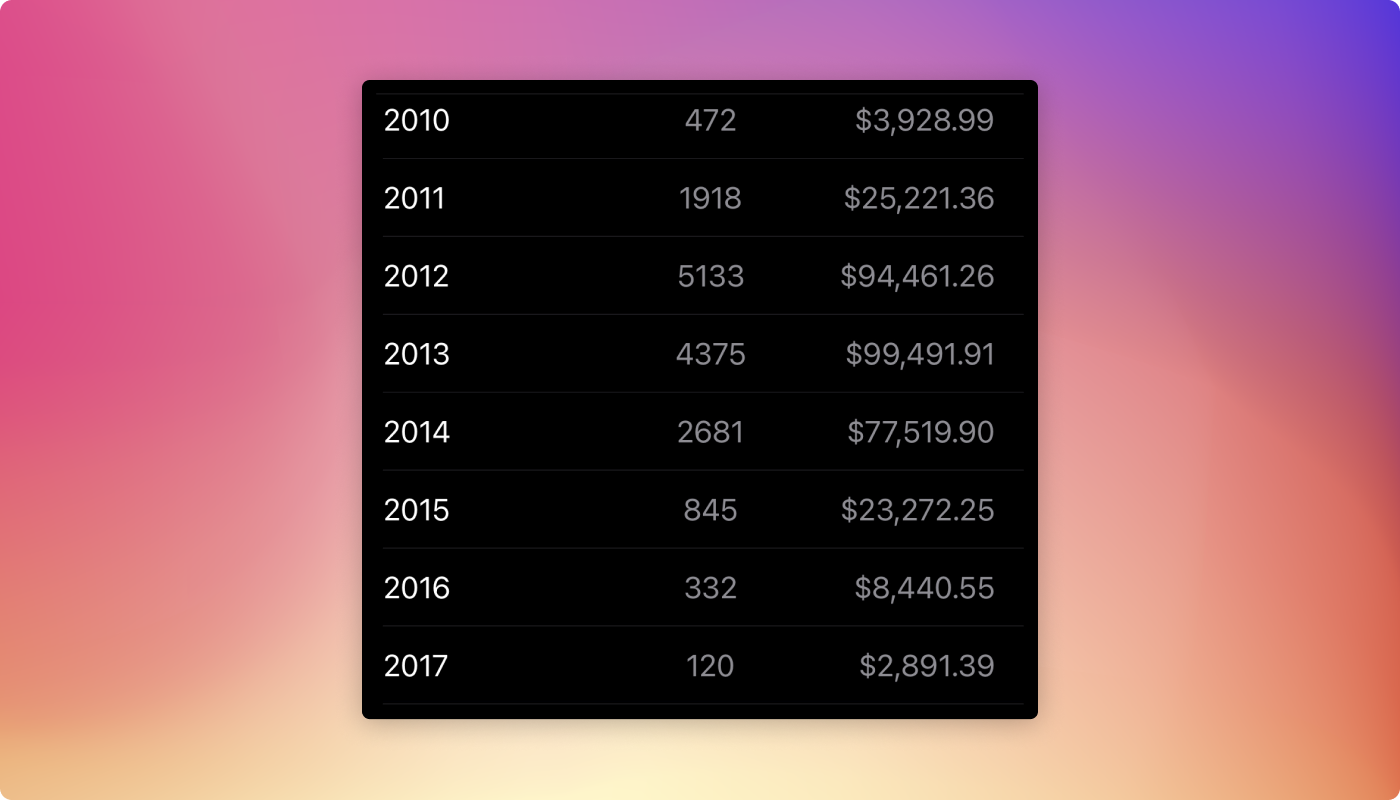
I later discovered the Ghost platform, and have gone on to release seven Ghost themes. I also became a certified Ghost expert.
The list
I managed to maintain a mailing list of ~2K customers. With this as a starting point, I started sending monthly build in public reports consisting of theme updates, marketing initiatives, and business metrics from the previous month.
Today, I’ve streamlined my entire operation to producing themes for various niches, writing organic content that speaks to potential Ghost users in those different niches, and upselling custom Ghost services to all theme purchasers.
Marketing
Aside from my mailing list, I started a blog to build domain authority and organic traffic. I've focused my content strategy mainly on creating tutorials and educational content based on my workflows, methods, and personal experiences.
I don’t run paid ads, nor am I particularly active on social media. I simply leveraged the network effects of marketplaces in the early stages, organic traffic, and upsells.
What’s next
I plan to continue running LayeredCraft as a solo founder, and leverage the experience I've gained in this realm by channeling it into a new endeavor: Crafting the next evolution of website builders. My new platform, Siimple, aims to make the process of creating, customizing, and managing a website truly simple!
Discuss this story.
The Tweetmaster's Pick 🐦

I post the tweets indie hackers share the most. Here's today's pick:

Enjoy This Newsletter? 🏁
Forward it to a friend, and let them know they can subscribe here.
Also, you can submit a section for us to include in a future newsletter.
Special thanks to Jay Avery for editing this issue, to Gabriella Federico for the illustrations, and to Dan Kulkov, Darko, Mac Martine, Harry Dry, and Eric Alli for contributing posts. —Channing

Build First, Market Later?
i am going to twist this one ...
So if you don't have nothing buit to show how are you going to effectively market it ? Isn't that wrong ?
Well for me it's a compromise between the two not a sequence of events. :)
Pedro
I think it depends on the product itself and your stakeholders (i.e your investors!). If the solution is complex, many stakeholders may want to see a MVP as proof that the solution is possible to build. On the flip side, if a solution has been proven to be possible (maybe there are competitors, etc), then stakeholders would be more interested in seeing if there is a market for your business over an actual MVP (They would want to see the business moat).
Overall, I agree, I think there needs to be a balance between the 2. You can't market effectively without some kind of demo, but you shouldn't waste your time building a demo if there is no market.
Awesome read! Just a question here. What if you are building a side project that may become a viable business? For example, say you see there is a gap in industry. You decide to build a MVP, but you are not sure whether you want to make it a business, open source it, sell it to a major brand, or keep it as a side project. What do you do? Should you begin marketing from day 1 still even though you are going to build the MVP regardless? Or is it better to build the MVP, decide what you want to do with it then proceed?
Great read! But everyone is telling talk to X customers first in my opinion this doesn't work anymore, because as an internet user every day you're bombarded with whatnot, and often I see myself just ignoring all the stuff. How do you guys successfully manage to talk with customers? Thanks!
I should get a tattoo with the quote “Build to Sell”. Good reminders, tips and stories in those articles.
Great read! The emphasis on 'Build to Sell' over 'Build to Build' is a game-changer. Validation and early marketing are the unsung heroes of successful products. 👏