What's New: Disrupt your own product
(from the latest issue of the Indie Hackers newsletter)
Try disrupting...your own product:
- Turning your service into a product can help you optimize your flow, acquire new customers, and gain visibility.
- Is your social media marketing actually "marketing?" Your goal should be to generate, nurture, and convert leads into paying customers.
- $6.5K ARR in passive income from a portfolio of small bets. For Chris McCormick, the most important trait for a founder is motivation.
Some indie hackers get stuck at $1K monthly revenue. Others figure out unique ways to break $10M fast. Founderpath has used data from the Latka podcast to showcase 9 ways to break $10M revenue in under 3 years. Click here to register and get the slide deck. #ad
Want to grow your business? Try running a promo in the Indie Hackers newsletter to get in front of 80,000+ founders.
Turn Your Service Into a Product 🪄

by Darko
Matthew Kuzmin, founder of digital agency Bleakers, breaks it down.
The analysis
After analyzing hundreds of apps, I've reached a conclusion that’s hard to dispute: The current market requires products.
Here are a few examples:
-
Taxi: Uber hasn't fundamentally changed taxi hiring. Before Uber, you would still figure out the destination and the cost, but it's easier if someone does it for you.
-
Travel: In the past, it took days to organize a trip, or you could hire an agency to do it for you. Now, anyone can do it using Booking, TripAdvisor, Airbnb, etc.
-
Banking: Every operation that once required you to be present at the bank can now be done in-app.
-
Retail: Currently, you don’t need to go inside a store to select an item. You can find the best deals from your home.
-
Food delivery: Simply outsource it to someone else.
-
Music: Before, in order to get music, you had to go purchase the record, cassette tape, or CD. Now, all you need is a streaming device.
All of these products are just rebranded services, which automate part of the flow. Base your next product on a service!
The benefits
-
Flow optimization: A simple chatbot with information about your company may answer important questions, and even convert your customers.
-
Staff expenses: Some processes may be eliminated by AI.
-
Media attention and community visibility: With the right marketing materials, you can gain attention and new customers.
The game changer
One thing that these products change is the way they communicate with the final user, making it much easier and faster to make a decision, or obtain something that the user needs.
There are still hundreds of potential ideas to be launched! It's not too late to get yours out there.
Discuss this story.
In the News 📰

from the Growth Trends newsletter
🔑 Instagram's new explainer breaks down key ad metrics.
🧠 Language-market fit will make your customers feel like you've read their minds.
🥊 Fight your way to 1K followers.
🏛 A US federal judge has ruled that AI-generated art can't be copyrighted.
🗽 NYC has banned TikTok on government devices.
🗓 Nine ways to break $10M revenue in under three years. #ad
Check out Growth Trends for more curated news items focused on user acquisition and new product ideas.
Reevaluate Your Social Media Marketing 📱

by Cyril Gupta
I entered the founder's community some time back, and while I enjoyed launching products and engaging with fellow creators, I couldn't help but feel that something was off.
Shifting focus
The community seemed to have shifted its focus. It was no longer about conversing with the audience; instead, it seemed to be talking to itself.
Products were being launched and supported as a strategic move to encourage reciprocity. There was an unspoken agreement that, if you supported someone else's product, they'd return the favor.
This is bad for the audience, and it's bad for the founders. We get nothing but vanity validation.
Getting back to the "who"
As I spent time on X, I got caught up in conversations revolving around #buildinpublic. But, it struck me: Who is really reading these build in public discussions?
If your fellow creators and peers are not your target audience, who are you actually creating your content for?
When utilizing social media marketing, there are three primary objectives you should be aiming for:
- Generating leads.
- Nurturing those leads.
- Converting those leads into customers.
If these three goals aren't at the core of your efforts, you are merely posting. It's not marketing.
Metrics like comments and replies might inflate your ego, but what truly matters is getting tangible results, like sales and conversions.
In cases where your social media traction is still gaining momentum, it's likely that you have more friends and colleagues connected to your profile than actual potential customers.
While this is natural, it's essential to acknowledge that they aren't your target market (unless, of course, they are).
Reconnecting
In order to effectively connect with your intended audience, it's crucial to craft content that resonates with them. Stop seeking validation from peers and stay focused on your mission: Acquiring more customers.
Here are a few actionable ideas:
- Compile a list of your prospective buyers' pain points. Don't worry if your product doesn't address all of them.
- Create a catalog of topics you plan to cover, and stick to these themes for consistency.
- Stay updated on relevant news and trends that might interest your target audience, and incorporate them into your content plan.
- Steer clear of seeking validation solely from peers. Remember, their opinions might divert you from your core mission of acquiring and serving customers.
Discuss this story.
Harry's Growth Tip 🧠
from the Marketing Examples newsletter
Don't write at the reader. Make the reader an active participant.

Subscribe to Marketing Examples for more short, sweet, practical marketing tips.
The Driving Force Behind $6.5K ARR 🚘

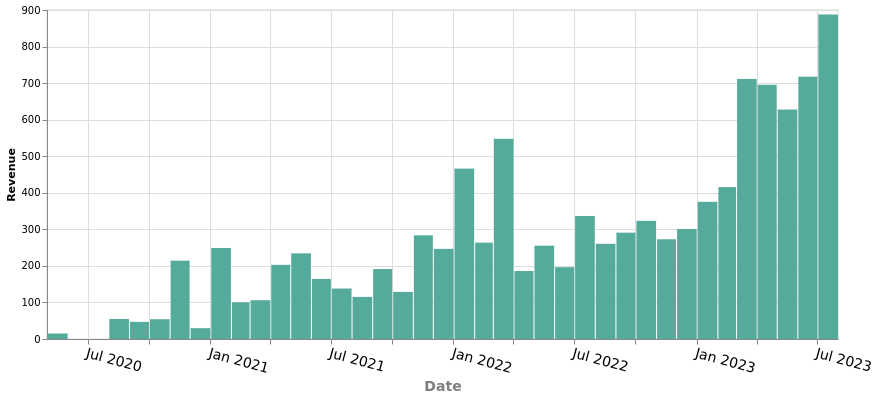
July was my best month ever! Revenue from my various paid side projects went over $500 in one month for the first time, which means I broke through my personal goal of $6.5K ARR.
Meaning behind the money
My revenue is small enough to be scoffed at, especially since I've been at this for at least three years now, but it's also large enough to be meaningful. $500 per month is enough to pay for server costs, Netflix, and some groceries. It's passive income. I don't get paid by the hour for the work I'm doing on these projects. Instead, I'm investing hours now for a larger payoff later.
The truth is that even $10 MRR is meaningful. You just have to think about it in the right way. The first way to think about it is that $10 is a stop on the way to $100 MRR, and that's a stop on the way to $1K MRR, etc.
The second way to think about it is as a literal investment of time for money. When you factor in everything I've learned, the fact that I was working only part-time, and the fact that it's largely passive income, it feels like three years well spent.
Motivation station
Of course, this is just the math I use to keep myself motivated. It's easy to take the other perspective and see this as a waste of time and effort for little yield. One thing that is definitely true is that, if you give up on something, you rule out any chance of reaching your goal. So, if one of your goals is to build a passive income business, then it makes sense to take the perspective that is most likely to keep you in the game.
Here's the list of my small bets, in rough order of profitability:
- hostedgitea: Git hosting for people who want off big corporate Git hosts.
- Music apps for Android and for iOS.
- TweetFeast: Download X follower lists.
- Eight-bit sound effects generator and organizer.
- DopeLoop: Procedural melody generator.
- Rogue-like browser boilerplate.
I also receive a small amount from the games I have made, and in donations for things like Rogule, DoodleCSS, and Doodle Rogue Tileset.
As you can see, I have shiny object syndrome hardcore. Instead of trying to fight it, I've channeled it into building lots of small things. I try to build products that do one thing well, and cut away all other features. I've come to realize that motivation is the most important resource!
Discuss this story.
The Tweetmaster's Pick 🐦

I post the tweets indie hackers share the most. Here's today's pick:

Enjoy This Newsletter? 🏁
Forward it to a friend, and let them know they can subscribe here.
Also, you can submit a section for us to include in a future newsletter.
Special thanks to Jay Avery for editing this issue, to Gabriella Federico for the illustrations, and to Darko, Cyril Gupta, Harry Dry, and Chris McCormick for contributing posts. —Channing
