What's New: Saving money on X ad campaigns
(from the latest issue of the Indie Hackers newsletter)
Thinking about trying influencer marketing on X?
- Save money by preparing the promotional materials yourself, and positioning yourself as a repeat customer to build long-term relationships.
- Agencies offer tailored solutions with high lifetime value. Use cold outreach to get new clients, and become a one-stop shop.
- George Moulos started a business at 13, and today, it's a global M&A advisor for e-commerce, Amazon FBA, content, and SaaS businesses.
Want your product seen by over 80,000 founders and businesses? Sponsor an issue of the Indie Hackers newsletter. Choose between 3 affordable tiers that can fit almost any budget.
Maximizing Your X Ad Campaign Spend 💰

by Igor Den
I actively promoted my product, M1-Project, on X by paying influencers to advertise it. In two months, I've ordered $15K worth of advertising, but I've only actually paid $8K after negotiating on terms.
Here are the approaches I use to reduce prices!
I prepare the promotional material myself
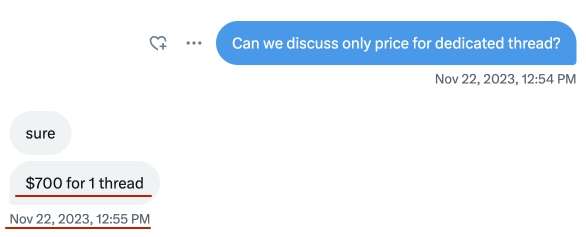
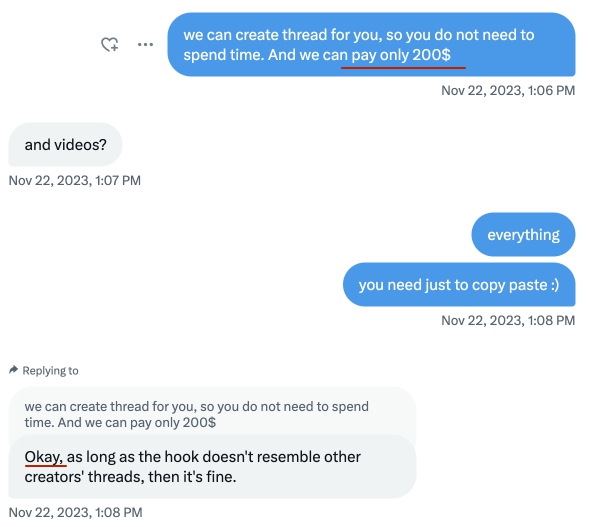
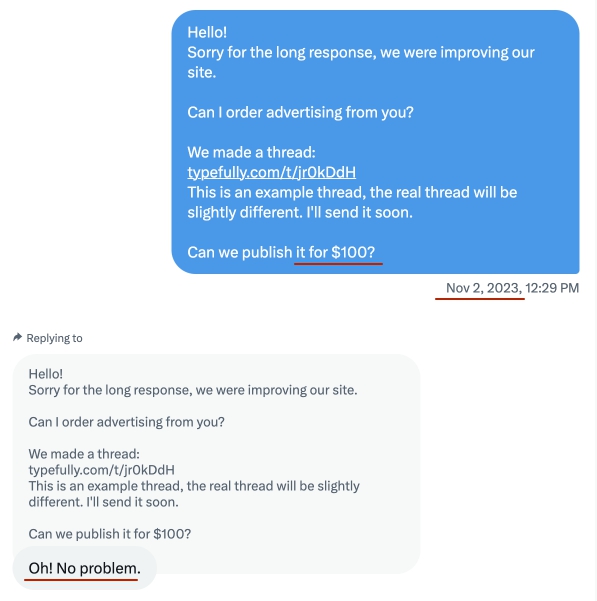
We fully prepare the advertising material (X threads), so the influencer just needs to copy and publish it. That takes a lot off of their plates, and helps us negotiate prices down.
Pros:
- Easy money for the influencer.
- We control the quality of promotional materials.
Cons:
- Expenditure of time resources on the creation of promotional materials.
- It takes skill to negotiate the price. Use the fact that you are creating the content as a selling point:
I position myself as a repeat customer
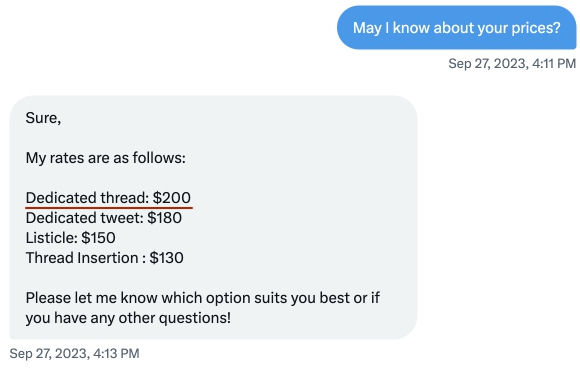
Another good argument in favor of a discount is that we are actively advertising, so we will be regular customers.
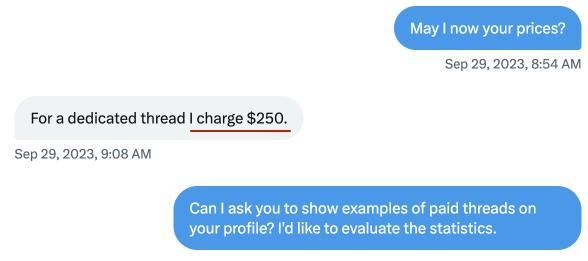
I often post examples of past threads posted by other influencers as evidence.
I build long-term relationships
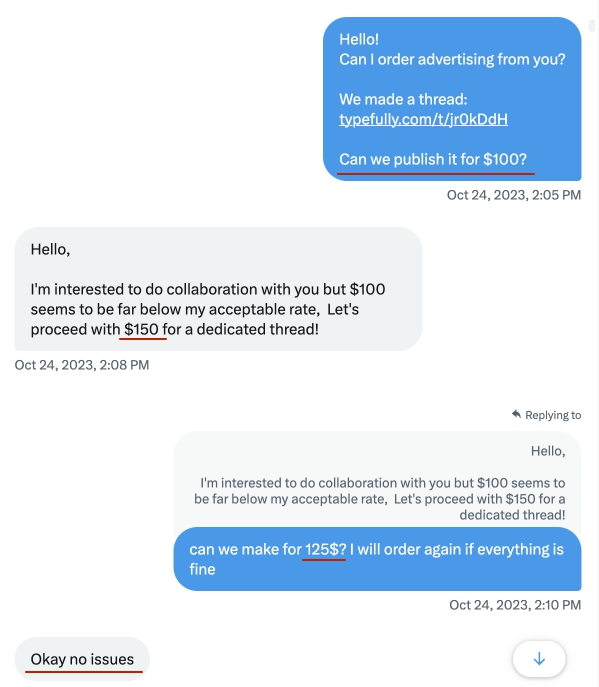
The more we've already paid an influencer, the more loyal they will be. I negotiated the price from $500 to $200 for one collaboration with a quality influencer. The discounts came in three stages: $400, $300, and $200.
For example: Starting price for $250, next ad placement for $125.
I don’t criticize
I don't criticize the influencer's reach or audience after running an ad campaign. Do your research to make sure that their audience aligns with your target audience before reaching out to them.
I give them time to think
Sometimes, the bargaining process is simple, and the influencer agrees immediately.
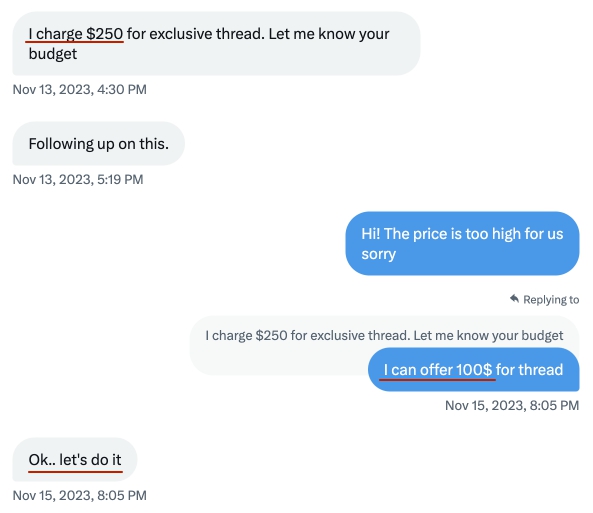
Other times, it’s worth leaving the influencer alone for a while, then writing to them again with a proposal.
If the influencer refuses to budge on price, we write: “I’ll discuss it with the team.” Then, we come back again. You can always count on discounts for long-term work.
Discuss this story.
In the News 📰

from the Growth Trends newsletter
📝 TikTok's new guide provides creative strategy tips.
🌟 Hey Foster: Humans rocking customer support tickets for you. #ad
💝 How to build and measure trust with your customers.
🚀 Google launches two new open LLMs.
🤖 How much electricity does AI consume?
🐶 The trend of animal-inspired workouts.
Check out Growth Trends for more curated news items focused on user acquisition and new product ideas.
Trend Alert: Agencies 💼

from the Trends.vc newsletter by Dru Riley
Problem
Companies need to solve short-term problems, access on-demand expertise, and scale fast.
Solution
Agencies offer tailored solutions with high lifetime value.
Players
Design agencies:
- Solveo: Launch smarter and grow faster.
- Outstandly: Game art design.
- OpenPurpose: Premium design services.
Content agencies:
- Hiperion Marketing: SEO-optimized content, audits, and backlinks.
- Fractl: Acquire more customers from organic search.
- Draft: Technical content.
Marketing agencies:
- Studio CO2: Digital marketing for product campaigns.
- Delverise: Managed growth solutions.
- Tetriz: Growth hacking for SaaS.
Recruiting agencies:
- A Team Overseas: Hire executive assistants for startups.
- Movevirtual: Hire virtual assistants for design, support, and marketing.
- RemotelyTalents: Find remote talent in marketing and e-commerce.
Lead generation agencies:
- clique.agency: Google Ads optimization.
- CyberLeads: Reach out to companies that have raised funds.
- Belkins: Book meetings with B2B leads.
How to build
-
Use cold outreach to get new clients.
-
Build your agency on top of an ecosystem. Use network effects to your advantage. For example, ThinkFuel offers HubSpot development services.
-
Build a full-service agency. Become a one-stop shop for all of your client’s needs.
How to grow
-
Build in public to earn trust and stay top of mind.
-
Share case studies. Build confidence in your ability to solve problems.
-
Offer lead magnets to get the contact details of prospective customers.
How to monetize
-
Charge per hour to offer clients flexibility. Let clients pay for what they use.
-
Charge per project to earn predictable revenue.
-
Share your price upfront to simplify the buying process.
Predictions
-
We’ll see AI-enabled agencies using AI agents and generative AI to automate work.
-
Agencies will become more niche. This will help to lower competition.
-
Agencies will build internal tools to boost their performance. Gosling Media has Gosling360 for managing work.
Haters
“Advising is a better business model than building an agency, with higher margins and lower mental overhead.”
You’re right. Margins are higher and client management is easier.
“Agencies are hard to scale.”
While agencies scale by hiring, you can build scalable products to offset this. Find a problem you can solve at scale with SaaS or a digital product.
“Managing an agency is hard. Managing a remote one is harder.”
Build processes and master communication. Unreliable communication amplifies the risks of async work.
Links
- From Indie Hacking to Owning an Agency.
- Building a Report on Agencies.
- How to Get Customer Testimonials.
Related reports
Become a Trends Pro Member to get the full report on Agencies, or get the next free Trends.vc report here.
Discuss this story, or subscribe to Trends.vc for more.
Harry's Growth Tip 🧠
from the Marketing Examples newsletter
Plant a seed. Remove the friction.

Subscribe to Marketing Examples for more short, sweet, practical marketing tips.
From Teen Founder to Global Advisor 🌎

by Marc Andre
Each week, Flip My Site publishes an inspiring success story featuring a founder growing and selling an online business. George Moulos founded Ecommerce Brokers in his early teens, and he now facilitates multimillion dollar exits for clients around the world.
Teen founder
George grew up near Sydney, Australia, as part of a Greek immigrant family. His grandfather left Nazi-occupied Greece at the age of 14 to start a business in Australia.
George didn't come from money or have connections, so he had urgency from day one. One of the major obstacles he had to overcome as a teen was the mindset of the people around him. He says that Greek immigrant culture around the world is conservative, and his family and friends were pessimistic about him pursuing what they called "silly internet stuff."
Breaking through these societal norms was the most challenging part for George, but he began creating Facebook Groups for students, and several reached tens of thousands of members. George monetized these groups with affiliate marketing, promoting products and services that were relevant to the audience.
He eventually sold the Facebook Groups, and moved on to his next venture.
Laying the foundation
George decided to use the knowledge and experience he’d gained to start a marketing agency, Moulos Media. Through this venture, started when he was just 13, George was helping clients grow their own businesses.
Many of George’s clients ran e-commerce businesses, and several asked for his help to sell. Since George had experience selling his own businesses, this became a natural extension of his services.
Early on, George was selling businesses worth $1K-$10K, but before long, he was selling $50K businesses. Then, it grew to $100K, then $1M, and so forth.
With a rapidly expanding professional network, the brokerage accounted for most of Moulos Media’s revenue. So, George decided to devote all of his efforts to growing the brokerage aspect, and that part of the business was rebranded as Ecommerce Brokers.

The growth
Today, Ecommerce Brokers is a global M&A advisor for e-commerce, Amazon FBA, content, and SaaS businesses. Its listings typically have six, seven, or eight figure valuations, with some exceeding $50M. Over the past 11+ years, George and his team have brokered more than 500 exits.
In addition to helping online business owners achieve a life-changing exit, Ecommerce Brokers also assists investors looking to purchase an online business by sourcing deals that meet the investor’s criteria. Ecommerce Brokers then negotiates on the client’s behalf, while advising throughout the process.
In 2021, George was named one of Greece’s top 30 entrepreneurs under 30 by Forbes. He's deeply driven to help and encourage other young founders, frequently speaking at universities throughout Greece, Cyprus, and other parts of Europe.
Discuss this story.
The Tweetmaster's Pick 🐦

I post the tweets indie hackers share the most. Here's today's pick:

Enjoy This Newsletter? 🏁
Forward it to a friend, and let them know they can subscribe here.
Also, you can submit a section for us to include in a future newsletter.
Special thanks to Jay Avery for editing this issue, to Gabriella Federico for the illustrations, and to Igor Den, Darko, Dru Riley, Harry Dry, and Marc Andre for contributing posts. —Channing
