When a Car Validated a Wearable: The Day Securio Matched the Tata Nexon’s AQI Sensor
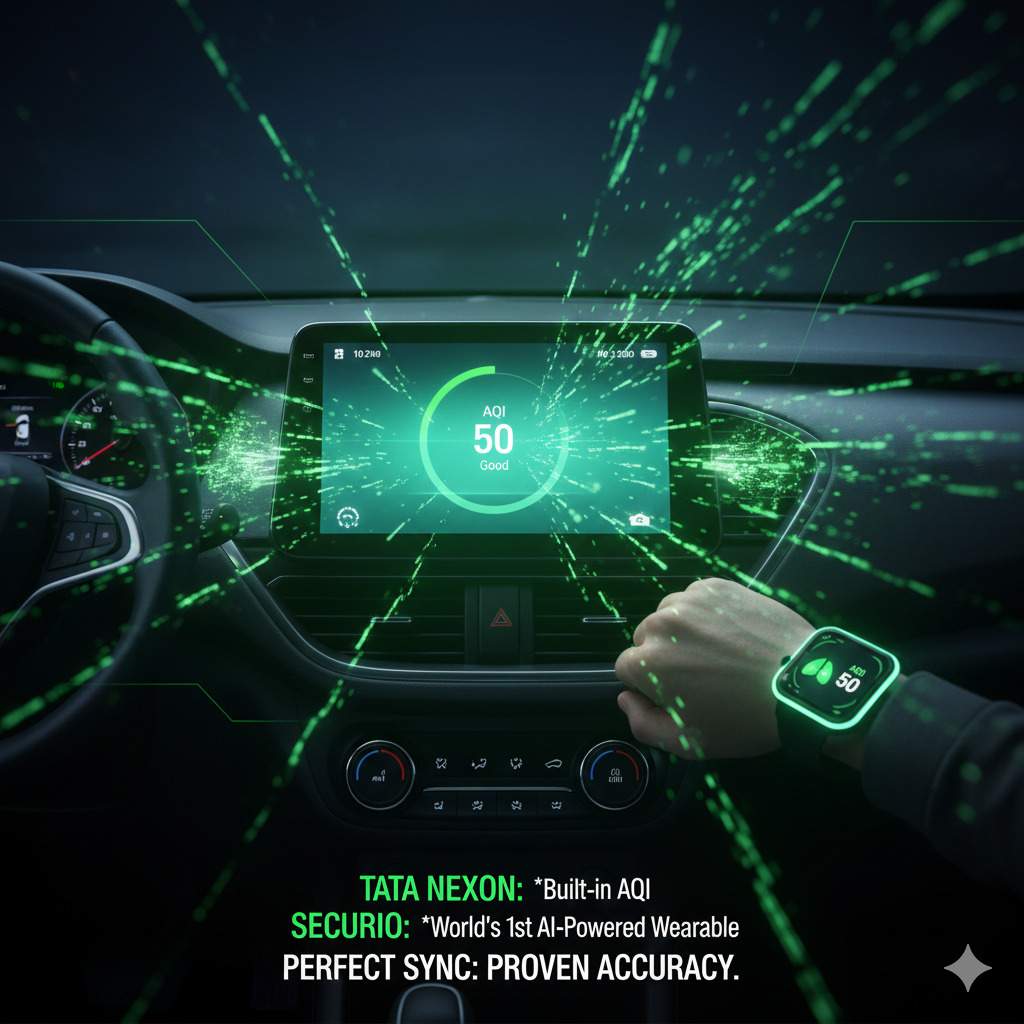
Yesterday, I ran a small experiment that turned into a big validation for Securio.
While driving the Tata Nexon, I noticed the built-in cabin AQI reading.
For a moment, I thought — why not compare it with Securio’s live reading?
So I did exactly that.
I checked the Nexon’s automotive-grade PM2.5 sensor on the dashboard, and at the same time checked the Securio wearable reading on my app.
The result surprised me.
The values were almost identical — fluctuating in the same range, reacting at the same time, and staying consistently aligned throughout the drive.
This was important for two reasons:
Automotive sensors are calibrated under controlled, stable conditions.
A car cabin is one of the easiest environments to measure AQI accurately.
A wearable is the hardest.
It sees motion, airflow changes, body heat, humidity, breath cycles, vibration — everything that normally causes inaccurate readings.
And yet…
Securio matched an automotive-grade reading almost perfectly.
For a founder, these are the moments that hit differently — not because it proves the tech, but because it validates the years of engineering behind it:
Our calibration tables
Our algorithms
Our sensor selection
Our entire vision for Intelligent Personal Protection
This wasn’t a lab test.
This was a real-world test — inside a car, in regular conditions, with no special setup.
And Securio passed.
These small validations give me confidence that we’re not just building another product —
we’re building a new category that deserves to exist.
A small note of appreciation to Tata Motors for integrating cabin AQI monitoring into the Nexon — features like these elevate awareness and help innovators like us validate and build better solutions.

