When does a scheduler become a workflow engine?
Scheduling is one of those backend capabilities that seems straightforward until systems begin operating at scale. A simple timer or CRON expression is often enough to trigger routine tasks, but production environments introduce a different set of requirements. Jobs need to survive service restarts, recover gracefully from failures, maintain execution history, and operate reliably across distributed infrastructure.
For years, Spring Scheduler and Quartz have been trusted solutions for Java developers. Spring Scheduler provides a lightweight way to automate recurring tasks, while Quartz adds persistence, clustering, and greater operational flexibility. These tools continue to be the right choice for many applications.
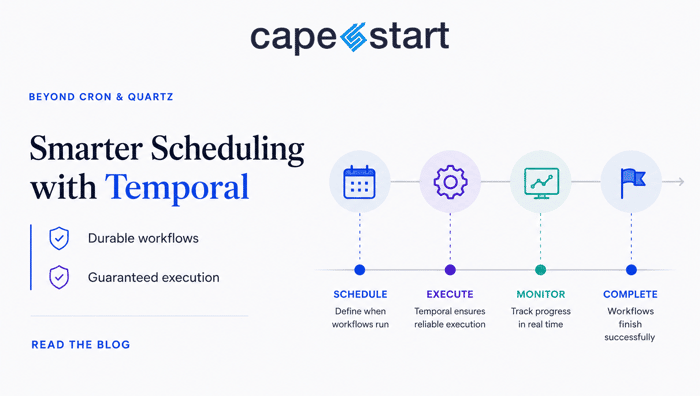
However, as workflows become more stateful and business critical, the conversation shifts from scheduling tasks to orchestrating execution. This is where Temporal takes a fundamentally different approach. Instead of viewing scheduling as a time-based trigger, it treats each execution as a durable workflow with built-in state management, automatic retries, recovery, and complete execution history. The result is a model where developers spend less time handling operational edge cases and more time focusing on business logic.
We recently explored these approaches in detail, comparing Spring Scheduler, Quartz, and Temporal from the perspective of reliability, scalability, observability, and developer experience. The article also includes a practical Java implementation using the Temporal SDK to demonstrate how durable scheduling works in real-world applications.
If you're evaluating scheduling strategies for modern backend systems, we'd love to hear how your team approaches long-running or mission-critical workflows.
Read the full article: https://capestart.com/resources/blog/temporal-scheduling/
