When should makers file for a patent?
When you’re developing an online project that can generate revenue -- and financial independence -- you’re focused on one thing: traction.
You’re measuring app downloads, early adopters, power users, revenue, average transaction volume, and all kinds of other metrics.
But are you overlooking one of the most important tasks: protecting your idea?
To be sure that nobody else can enter the market with a copycat of your idea, it may be time to consider a patent. The benefits of having a patent are numerous, with the most important one being that it protects your idea -- and often makes it more valuable in the long run.
One of the questions I get asked all the time is when to file for a patent. Is it better to patent first or to just get your product in the market and then think about patents later?
I get the tendency to want to publish first and patent later. After all, when you’ve worked this hard, you want to share your idea as fast as possible! But be prudent: you need to seriously think about getting a patent!
Here are a few things to consider when deciding when to file for a patent for your startup, idea or product.
1. Choose a strategy
You have two options for your patent strategy: to file for a patent before publishing your idea or to publish your idea and get a patent later.
Neither option will work well for you without a clear patent strategy!
I’ve had clients that are eager to share their ideas with the world and they want to publish as fast as possible -- but they’ve had strong patent strategies in place to protect their ideas.
Filing or publishing first are business strategies — you can’t just wing it.
2. Understand what “publishing” means
So, what does it mean to publish your idea?
Any information you make public about your idea counts as a publication. It can be a blog post, a tweet, a website, an app, an article -- any time you promote the idea publicly is considered publishing your idea.
Talking about your idea privately is different.
For example, if you’re in a meeting which is invitation only and you indicate that the talk is private, then it wouldn’t count as a publication. But if someone who was not invited wanders into the meeting, then it may count as a publication.
Even having a private talk in a public place — like on a shuttle bus at a conference — could potentially count as a publication.
If you’re not planning to publish first, be very careful who you talk to about your idea and which channels use.
3. Avoid filing too early...
It’s possible to file for a patent before you’re ready to publish. But then, as you develop the idea and things evolve, you could end up with a patent that doesn’t even protect your business.
For example, Twitter started life as a side project in a company devoted to podcasting called Odeo. Clearly, if they had focused their patent portfolio on podcasting, it wouldn’t have been useful to them today. Their current portfolio includes multiple patents and patent applications that focus on their existing business.
So, how to avoid filing too early? Ask yourself these questions:
Do you know who your idea will help? If you don’t have a specific audience or target market, it may be too early.
Do you know how your idea will work? If you don’t have a clear technical plan for how it all works, it’s too early.
Do you have a basic design concept for your idea? If it’s still a work-in-progress, it’s likely too early.
If the answer to all three questions is yes, then you may be ready for a patent!
4. ...but don’t wait too long
Some rules are meant to be broken, but not when it comes to patents! If you do, you could be blocked by the US Patent and Trademark Office (USPTO) from getting one.
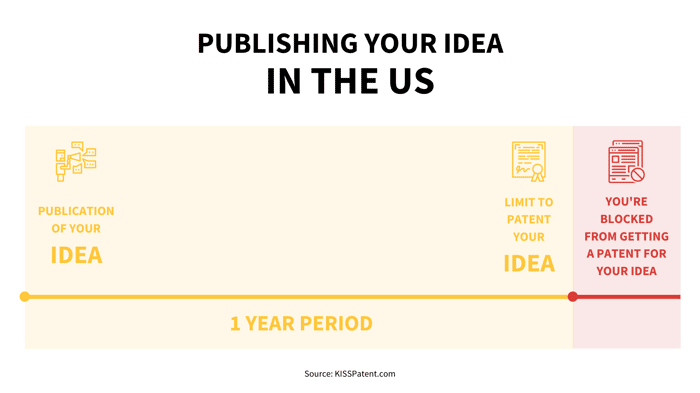
Bear in mind that different countries have different rules. In the US, for example, you only get one year to file for a patent if you’ve already published your idea. After that, it’s too late!
Other countries are even more strict - you must file before you publish your idea. Basically, don’t take any chances with your idea. If you’re going to publish, do it — but be careful to protect it first.
5. The benefits of filing for a patent first
Filing for a patent first always gives you more options and more opportunities for your business strategy.
First, it gives you the chance to also file outside of the US. This is perfect if your business is (or will be) international. For example, if you’re thinking about an app, the chances of it growing outside of the US market are very high.
If you want to file for a patent internationally, for example in China or Europe, then you have to file your patent before you publish it. Filing for a patent enables you to protect as much as possible of the details contained within your idea.
Remember patents last for 20 years from the date of filing. Having that protection from the beginning is also a perfect way to ensure your business will grow safely!
6. Consider filing a provisional application
Most businesses I’ve worked with have taken the provisional application route.
They file for a provisional patent, publish their idea, and finally file for a full utility patent in the US or internationally within a year.
A fantastic (and my recommended) cost-effective strategy!
This route is popular because it’s much more affordable, quick, and lets you keep developing and tweaking your idea while being protected.
So should you publish first or patent first?
To publish first or patent first...that is the question!
The benefits of publishing first are primarily that you can stake your ownership claim early. When you publish quickly, you block others from being able to file for a patent for your idea. This is because you (and only you, the inventor who publishes it) get one year of grace period to file in the US.
Another benefit is that everyone will know about your innovation! But, bear in mind, this is only in the US. In most other countries you do need to file first.
That’s one of the primary disadvantages of publishing first: you’re blocked from filing a patent outside the US! So, if you want to protect your idea outside of America, file before you publish!
